Dog Reactivity on Leash — What It Is and How to Help
Hello, two-leggers.
Answer first
The dog lunging at the end of the leash looks aggressive. It sounds aggressive. Every instinct you have — and every instinct the passing stranger has — says aggressive. It is very often not. Leash reactivity is a frustration and fear response that the leash itself creates, and the dog who loses control at other dogs on walks may be perfectly friendly, calm, and social in every other context. Understanding this distinction changes everything about how you respond. If your dog’s reactivity is severe, escalating, or accompanied by actual aggression, please work with a certified dog trainer or veterinary behaviorist rather than attempting to manage it alone.
Now let me tell you how I know the difference — because I have spent considerable time observing reactive dogs, and I have also been on the other end of the leash when The Therapist and I encountered them. The experience is educational from both directions.
The Dog I Watched in the Park
Here is what leash reactivity looks like from the outside, and I want you to hold this image clearly before I dismantle it.
A dog walking calmly on a path. Another dog appears around the bend. The first dog transforms — instantly, completely — into something that appears to have no relationship to the calm animal of three seconds ago. Barking. Lunging. Every muscle engaged. The leash goes taut. The owner is now anchoring a force considerably larger than themselves.
This is what everyone sees. This is what gets labeled. Aggressive dog. Dangerous dog. Bad dog.

Now here is what is actually happening.
The dog sees another dog. Every social instinct activates — approach, assess, interact, or if uncertain, create distance. These are the only options the dog knows. The leash prevents all of them. The dog cannot go forward. Cannot go back. Cannot do anything except stand at the exact distance that is triggering every instinct while being physically prevented from resolving the situation in any direction.
The explosion you see is not aggression. It is a nervous system that has run out of options.
I have watched this happen many times. I watched it happen to Gerald.
Leash Reactivity in Dogs — Quick Diagnosis
Before identifying what is happening, rule out what is not:
- If your dog lunges at other dogs on leash but plays fine off leash → almost certainly leash reactivity, not aggression
- If your dog reacts to specific triggers only — cyclists, men with hats, other dogs — → likely fear-based reactivity
- If your dog reacts to everything, constantly → may indicate generalized anxiety, worth a vet conversation
- If reactions are escalating in intensity over time → professional help now, before threshold drops further
- If your dog has made contact and bitten → this is beyond reactivity management, requires immediate professional support
- If your dog reacts on leash AND off leash → this may be genuine aggression rather than leash reactivity, different situation entirely
The single most useful diagnostic question: does your dog behave differently on leash versus off? If yes — if your dog is social and friendly when free but transforms on leash — that gap is the reactivity. That gap is what we are addressing.
Dog Reactivity on Leash — What It Is and Why It Happens
Leash reactivity is barrier frustration expressing itself as aggression-adjacent behavior, and the distinction between “looks like aggression” and “is aggression” is one of the most important things I can help you understand.
Gerald — the chocolate Labrador I observed in the park, who provided the data point that has stayed with me most vividly — was, by all accounts, a social and friendly dog. His owner confirmed this. Off leash, at the dog park, Gerald was unremarkable. Enthusiastic. Normal. The kind of dog other dogs approach without hesitation.
On leash, encountering another dog on the path, Gerald became something else entirely. The barking. The lunging. The four legs briefly losing their relationship with the ground. His owner said “HONESTLY GERALD” in a tone I recognized intimately, because The Therapist has used similar tones with me in similar circumstances, though I prefer not to detail those circumstances here.
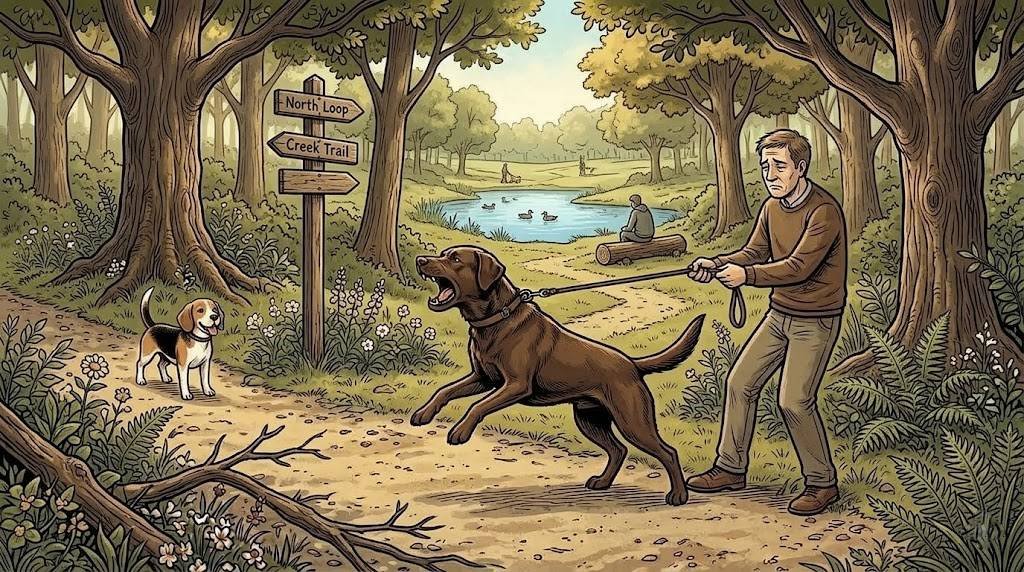
Gerald was not aggressive. Gerald was stuck.
Here is the mechanism, because understanding the mechanism changes your response to it. Dogs are social animals with strong instincts around greeting and assessing other dogs. When another dog appears, the instinct is to move — toward the dog if curious or friendly, away from the dog if uncertain or fearful. The leash removes both options. The dog is now experiencing what behavioral science calls barrier frustration — the accumulation of thwarted drive that has nowhere to go except outward, as noise and movement.
Think about the last time you were stuck in traffic that was not moving, while running late for something that genuinely mattered. You could not go forward. You could not go back. You could not do anything except sit in exactly the place that was causing the problem. The pressure that built — the irrational urge to honk, to gesticulate, to somehow physically express the impossibility of the situation — that is barrier frustration. Your dog’s version is louder and involves more limbs.
Leash reactivity is not a character flaw. It is a physics problem — force with no outlet.
What Triggers Leash Reactivity — And Why Some Dogs and Not Others
Leash reactivity is not equally distributed across all dogs, and understanding why helps explain why the same walk can go perfectly or catastrophically depending on variables that seem minor.
The most common triggers, in rough order of frequency: other dogs, unfamiliar people, cyclists and runners, vehicles, specific sounds. The trigger is whatever reliably produces the response — and it is often specific in ways that can seem arbitrary. A dog who reacts to large dogs may ignore small ones. A dog who reacts to cyclists may be indifferent to pedestrians moving at the same speed. The specificity reflects the individual dog’s history of experiences, not the objective threat level of the stimulus.
Two dogs can have identical genetics, identical early environments, and arrive at wildly different levels of leash reactivity based on experiences that neither owner fully observed or understood. One uncomfortable encounter at a developmental age. One instance of being startled by a cyclist while already anxious. These moments compound. The threshold — the distance at which the trigger produces a reaction — drops over time if the experiences are consistently negative.
Have you ever had a period where a particular type of situation — a certain kind of meeting, a specific social context — made you anxious in a way that seemed disproportionate to the actual threat? And then found that over time your threshold for that situation got lower, not higher — that you started dreading it earlier, reacting to smaller versions of it, needing more distance from it to feel okay? That is threshold sensitization. Your dog’s reactive threshold works the same way. Bad experiences narrow it. Good experiences widen it.
This is important because it explains why leash reactivity often gets worse over time without intervention, and better with the right kind of consistent positive experience.
What the Dog Is Actually Feeling
The emotional state underlying leash reactivity exists on a spectrum, and knowing where your dog falls on that spectrum matters for how you respond.
On one end: frustration. The dog sees another dog, wants to interact, and cannot. The frustration of thwarted social drive expresses as reactive behavior. These dogs often have loose, forward body language — weight forward, tail up, pulling toward the trigger rather than away. They would, if released, likely greet the other dog without conflict. Their reactivity is the frustration of wanting something they cannot have.
On the other end: fear. The dog sees another dog and wants distance that the leash prevents. The reactive behavior is a distance-increasing display — make enough noise, make enough movement, and the scary thing will go away. These dogs often have tighter body language — hackles up, weight back or shifting, growling alongside the barking. They would, if released, likely move away from the other dog rather than toward it.
Most reactive dogs sit somewhere between these poles, and many shift position depending on context — frustrated with familiar dogs they want to greet, fearful with unfamiliar dogs at close range.
The Therapist learned to read which mode I was in on our walks — and yes, I have had my moments of reactive behavior, though I prefer the term “strongly expressed preference” — and her response differed accordingly. For frustrated reactivity: create distance, redirect, reward calm. For fear reactivity: create distance first, always, before anything else. The dog cannot learn while the nervous system is in threat response.
This distinction matters because punishing reactive behavior — leash corrections, verbal reprimands, anything aversive — increases arousal and increases fear. You are adding to the emotional pressure that is already overflowing. The behavior may briefly suppress, but the underlying state worsens. The threshold drops further. The next reaction comes sooner and harder.
What Makes Leash Reactivity Worse
Several common responses to reactive behavior reliably make the problem worse, and most of them feel instinctively correct in the moment.
Tightening the leash is the most common. The dog begins to react and the owner pulls back — which communicates tension through the leash, confirms to the dog that something concerning is happening, and physically prevents the escape option that the dog’s nervous system is demanding. A tight leash is a continuous signal of threat. Loose leash, even in difficult moments, communicates that you are not alarmed.
Punishment is the second. Corrections — leash jerks, verbal reprimands, anything that adds an aversive experience to the moment of seeing the trigger — teach the dog to associate the trigger with punishment. The dog already felt bad about seeing that other dog. Now the dog also gets punished. The association between “other dog” and “bad things happen” strengthens. Reactivity increases.
Flooding is the third. Bringing the reactive dog close to the trigger and holding them there until they “get used to it” does not produce desensitization. It produces shutdown — a dog who has exceeded their capacity to cope and gone emotionally offline. The dog has not learned the trigger is safe. The dog has learned that overwhelming experiences happen and there is no escape from them. This often produces a dog who gives less warning before reacting — the warning behaviors were extinguished, not the reactivity.
Distance is almost always the correct first move. Every reactive dog has a threshold — a distance from the trigger at which they can function. Below that distance, the nervous system takes over. Above it, the dog can think, can respond to cues, can receive information. Working above threshold is where learning happens. Working below threshold is where damage accumulates.
What Actually Helps — The Approach That Works
Leash reactivity is manageable, and in many cases significantly improvable, with consistent application of the right approach. It requires patience and it requires time, and I will not suggest otherwise, because false reassurance is not useful to anyone.
Management first. Before training, manage the environment to reduce the frequency of over-threshold encounters. Cross the street when another dog appears. Turn around when needed. Give your dog the distance they need to function. Management is not failure. Management is preventing the repetition of the experience that is making things worse.

Counter-conditioning. The goal is to change the dog’s emotional response to the trigger — not just their behavior, but how they feel. This is done by pairing the trigger, at a distance where the dog is below threshold, with something the dog finds genuinely good. See another dog at a distance → receive an exceptional treat. Consistently, repeatedly, over many exposures. The dog’s nervous system begins to associate the previously threatening stimulus with something positive. The emotional response shifts. The reactive behavior follows.
The “Look at That” Method
A specific and highly effective application of counter-conditioning: when the dog notices the trigger, mark the moment — “yes” or a clicker — and deliver a reward. You are rewarding the dog for noticing the trigger calmly, which over time teaches the dog to look at the trigger and then look back at you in anticipation of the reward. The dog is now orienting toward you rather than toward the trigger. This is a significant shift in the dog’s relationship with the stimulus — from threat to predictor of good things.
When choosing management tools — front-clip harnesses can reduce pulling during reactive moments and give you more control without adding aversive pressure. Head halters may help some dogs. What to avoid: anything that adds pain or fear to the reactive moment, including prong collars and shock collars, which increase arousal and worsen the underlying emotional state.
When to Get Professional Help
I am a professor of dog behavior by self-appointment, and I am telling you directly: leash reactivity, beyond the mild end of the spectrum, benefits significantly from professional guidance.
A certified dog trainer experienced in reactivity can assess your specific dog, identify where on the frustration-fear spectrum they sit, and build a protocol matched to that dog’s actual emotional state rather than a generic approach. This matters because the wrong approach — chosen with the best intentions — can set progress back significantly.
A veterinary behaviorist should be involved if: the reactivity is severe and rapidly worsening, if the dog has made contact with another dog or person, if there are signs of generalized anxiety beyond the leash context, or if the dog’s quality of life is significantly affected. Medication — which a veterinary behaviorist can prescribe and a trainer cannot — can reduce baseline anxiety to a level where behavioral work becomes possible. For some dogs, this is not optional. The anxiety is too high for training alone to reach.
Gerald, I learned later through the park grapevine, worked with a trainer for four months. He is, by current reports, a dog who can pass another dog on the path without incident, given sufficient distance and an owner who has learned to read him accurately. He is not cured. He is managed, understood, and significantly improved.
That is the realistic goal. Not a dog who has no feelings about other dogs on leash — that may not be achievable, and it is not necessary. A dog who can function, who can have good walks, who does not spend every outing in a state of distress. That is achievable. For most reactive dogs, with the right help, it is achievable.
The behavior changes when the dog no longer feels trapped. That is the whole job — for you, and for the dog.
The Therapist figured this out. About Gerald’s situation, through observation. About my own strongly expressed preferences, through somewhat more personal experience.
She usually figures things out. I try to make it interesting for her.
Professor Alfred
Certified Observer of Reactive Dogs, Holder of Strongly Expressed Preferences, Advocate for Gerald