Dog Separation Anxiety Symptoms
Answer First
Separation anxiety is not bad behavior — it is a panic response. The most common symptoms are destructive behavior, excessive vocalization, house soiling, and relentless pacing, all appearing specifically when the dog is left alone. If your dog does these things only in your absence, separation anxiety is the likely cause. Start with short, calm departures and build up gradually. If symptoms are severe, a certified veterinary behaviorist can help significantly more than general training advice.
Now let me tell you how I know all of this. Because I was, for a period I prefer not to dwell on, a dog who could not be left alone without consequences.
The Conference
The Therapist had a conference. Four days. Out of town.
I was approximately fourteen months old — deep in my teenage phase, which had already produced several incidents I will not recount in detail — and this was the longest she had ever been away. A neighbor came twice a day to feed me and take me out. Perfectly adequate arrangement. Completely insufficient, as it turned out.
The neighbor’s report, relayed to The Therapist by phone on day two, included the following items: one destroyed throw pillow, the systematic dismantling of a houseplant, scratch marks on the inside of the front door, and — I am not proud of this — an incident involving the hallway that I will describe only as “not the garden.”
I was not trying to be destructive. I was not trying to make a point. I was not, as The Therapist briefly theorized, “acting out.” I was panicking. Quietly, privately, and with significant collateral damage — but panicking nonetheless.
This is what separation anxiety looks like from the inside. And it is important that you understand it from the inside, because what it looks like from the outside — chewed furniture, accidents, noise complaints from neighbors — looks very much like a misbehaving dog. It is not. It is a dog in genuine distress.
Dog Separation Anxiety Symptoms — Quick Diagnosis
Before identifying specific symptoms, the most important question is context:
- If destructive behavior happens only when alone → likely separation anxiety
- If destructive behavior happens whether you’re home or not → likely boredom or under-stimulation
- If accidents happen only when you’re away → likely separation anxiety
- If accidents happen at other times too → likely incomplete house training or medical issue
- If vocalization happens specifically at departure or during absence → likely separation anxiety
- If your dog seems fine when you leave but neighbors report problems → likely separation anxiety
- If your dog is clingy and follows you from room to room → possible pre-cursor, worth monitoring
The key pattern: separation anxiety symptoms appear in your absence, not in your presence. This distinction matters enormously for both diagnosis and treatment.
Destructive Behavior — What It Looks Like and What It Means
Destructive behavior during alone time is one of the most visible and most misunderstood symptoms of separation anxiety, and it is the one I contributed to most enthusiastically during my difficult period.
The important thing to understand is what is being destroyed and where. Separation anxiety destruction has a specific pattern: it concentrates around exit points. Doors. Windows. The areas where the dog last saw you leave, or where the dog believes you might return. I destroyed the throw pillow that lived near the front door. I scratched at the front door itself. The houseplant was unfortunate collateral — it happened to be nearby, and I needed somewhere to put the energy.
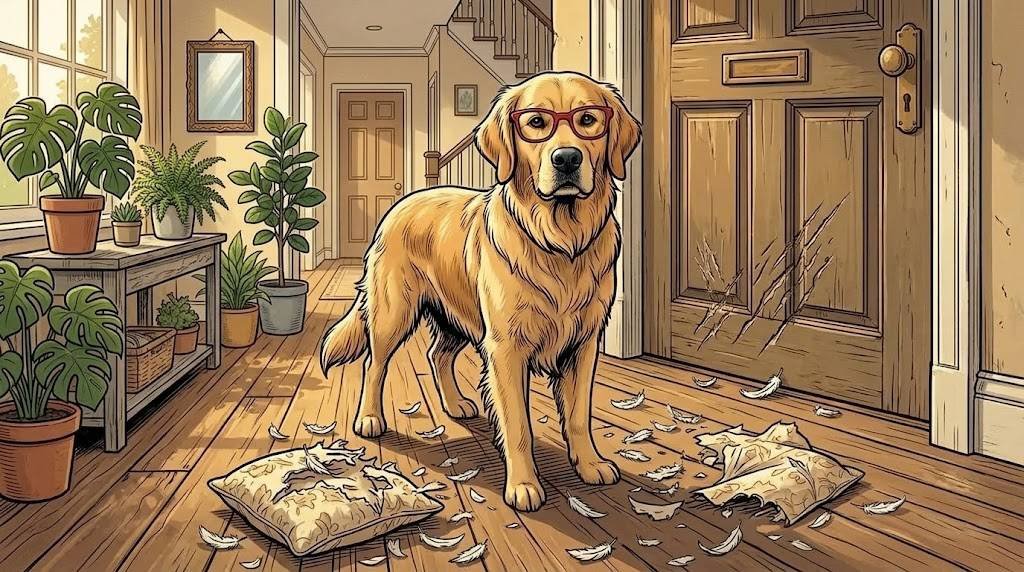
This is different from boredom destruction, which tends to be more random. A bored dog finds something interesting and dismantles it. An anxious dog targets the architecture of your absence — the places connected to you leaving and returning.
Have you ever paced around your house when you were waiting for very important news? Picked things up and put them down without purpose? Found yourself standing in front of the refrigerator without any intention of eating? That is displaced anxiety finding physical expression. For a dog without hands or a refrigerator, the physical expression looks different. It involves teeth.
The mistake most owners make when they come home to destruction is to correct the dog. By the time you return, the moment is completely gone. What you are actually doing is confirming to an already anxious dog that your return is also unpredictable and frightening. This makes the anxiety worse, not better.
What the destruction is telling you: your dog is not coping with your absence. That is the message. The furniture is not the problem.
Excessive Vocalization — The Neighbors Know Before You Do
Barking and howling during alone time is the symptom that tends to surface through external reporting — a neighbor, a building manager, a note under the door — rather than direct observation.
This is because dogs with separation anxiety are often completely quiet in your presence. The vocalization is specifically about your absence. You leave, the silence lasts perhaps five minutes, and then begins a sustained vocal performance that the dog is barely aware of producing. It is not strategic. It is not attention-seeking. It is the auditory equivalent of what happens when you cannot stop crying even though you know crying is not solving anything.
I howled during The Therapist’s conference. The neighbor mentioned this on day one, diplomatically, in the way neighbors do when they want you to fix something but also do not want conflict. She mentioned it less diplomatically on day three.
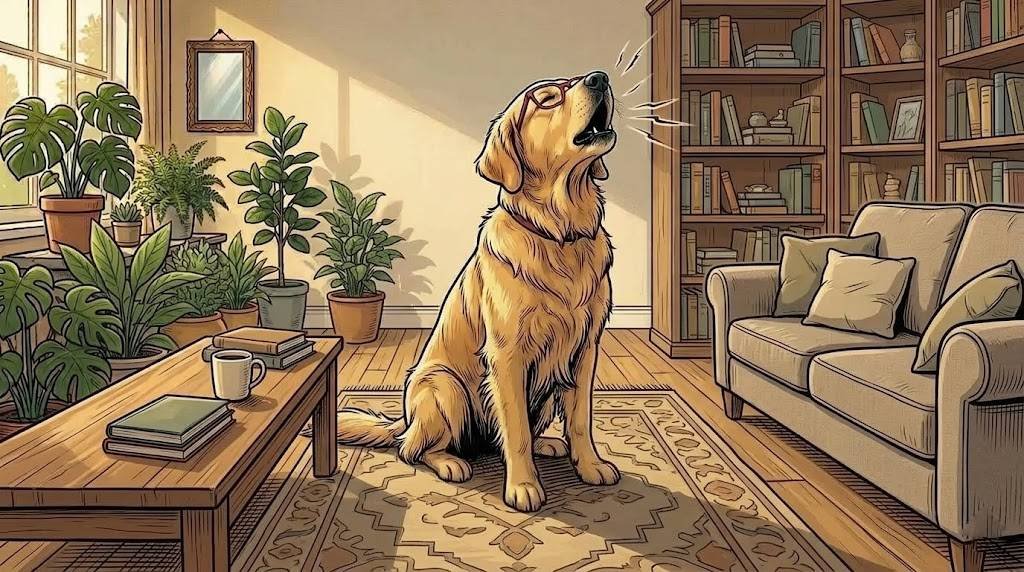
The howl of a dog with separation anxiety has a specific quality — it is sustained, rhythmic, and sounds genuinely distressed because it is. It is different from territorial barking, which is sharp and reactive. Different from demand barking, which is intermittent and purposeful. Separation anxiety vocalization is grief made audible.
You may not know your dog does this. Many owners are surprised when told. The dog is perfectly quiet at home with them — and completely different the moment the door closes. This gap between who the dog is with you and who the dog is without you is itself diagnostic information.
House Soiling — When a Trained Dog Forgets the Rules
This is perhaps the most confusing symptom for owners, because it seems to contradict something the dog clearly knows.
A dog who is reliably house trained — who has not had an accident in months or years — begins having accidents specifically when left alone. The owner’s instinct is to assume regression, illness, or deliberate misbehavior. None of these are usually correct.
What is actually happening: anxiety at a sufficient level overrides the dog’s ability to inhibit elimination. This is not a training failure. It is a physiological response to stress. The same mechanism that causes humans to experience digestive disturbances before important events or in high-stress situations — the gut and nervous system are not separate systems — is operating in your dog. The body under significant stress does not always wait for a convenient moment.
I will note here, with the academic distance I have spent years cultivating, that my own hallway incident during The Therapist’s conference fits this profile precisely. I was fully house trained. I was not making a point. I was a dog whose nervous system had exceeded its capacity to cope, and the consequence was physiological rather than behavioral.
The important distinction: if accidents happen only during absences and the dog is otherwise reliable, this is almost certainly anxiety, not a training problem. Treating it as a training problem — which means correction — will increase the anxiety and therefore increase the accidents. The opposite of what you want.
If your dog is having accidents during absences, consult your veterinarian first to rule out medical causes, then consider whether anxiety may be the underlying issue.
Pacing and Restlessness — The Symptom You Might Not See
This symptom is harder to observe directly because it happens in your absence — but it leaves evidence, and it has become more visible as home cameras have become common.
A dog with separation anxiety does not, typically, curl up and wait calmly for you to return. The dog paces. Moves between rooms. Returns repeatedly to the spots associated with your presence or your departure. Cannot settle. Cannot rest. The nervous system is in a state of alert that prevents the body from doing anything other than moving.
I know this about myself because The Therapist, after the conference incident, set up a camera. What she saw was a dog who spent the first forty minutes of every absence moving between the front door, the bedroom, and the living room window — checking each point in sequence, finding nothing, returning to the first point, repeating.
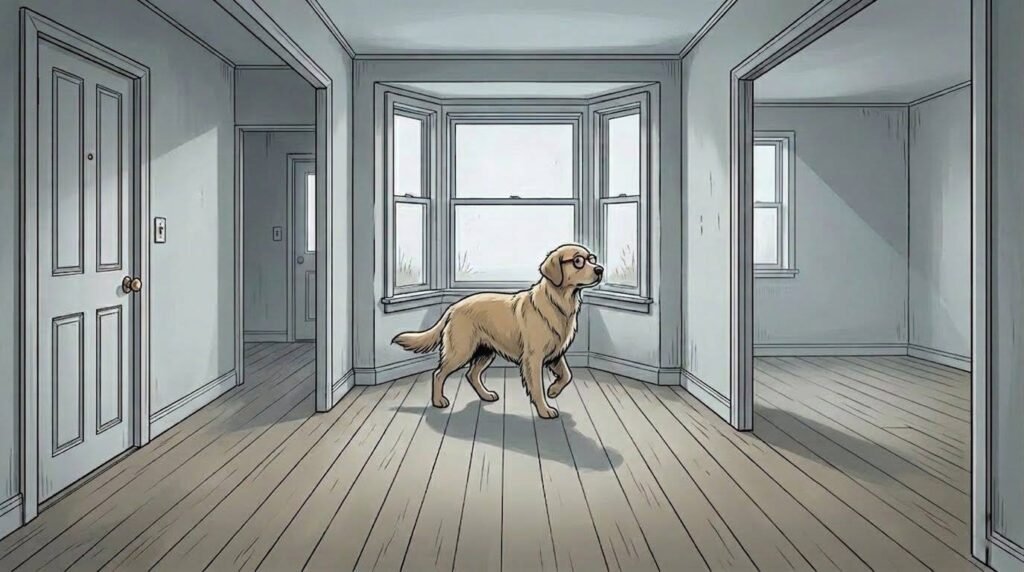
I was not bored. I was searching.
You have probably experienced something like this. You are waiting for a call that matters. You cannot sit still. You check your phone, put it down, walk to another room, come back, check your phone again. You know this behavior is not productive. You cannot stop it. Your nervous system has taken over from your rational mind and it has decided that movement is the response.
That is pacing. In dogs, it lasts not twenty minutes but potentially the entire duration of your absence. The physical and psychological exhaustion this produces is significant.
Separation Anxiety vs. Boredom — The Distinction That Changes Everything
This distinction matters more than almost anything else in this article, because the treatment for separation anxiety and the treatment for boredom are different, and applying the wrong one does nothing at best and makes things worse at worst.
Boredom looks like: destruction of interesting objects regardless of location, normal behavior at departure and return, no vocalization or intermittent vocalization connected to external triggers, no particular focus on exits or departure zones. A bored dog is under-stimulated. Give the dog more to do and the behavior resolves.
Separation anxiety looks like: destruction concentrated near exits, visible distress at departure, sustained vocalization specifically during absence, accidents in an otherwise house-trained dog, pacing that does not resolve. An anxious dog is not under-stimulated — the dog is terrified. More enrichment helps, but it does not address the root cause.
The critical test is departure behavior. Does your dog show signs of distress — following you to the door, whining, panting, refusing to settle — before you have even left? That pre-departure anxiety is almost diagnostic for separation anxiety rather than boredom. A bored dog does not care that you are leaving. An anxious dog knows what leaving means and is already responding to the signs of it.
I began responding to The Therapist picking up her keys approximately two weeks into my anxious period. Keys meant departure. Departure meant the particular kind of alone that I could not manage. By the time she reached the door I was already in a state that made the next four hours almost inevitable.
The Therapist learned to pick up her keys at random times without leaving. To put on her coat and then sit back down. To make departure signals meaningless through repetition. This took weeks. It worked.
What You Can Do — Starting Today
Separation anxiety is treatable. This is the most important thing I can tell you, because owners who have been living with a dog in distress — and with the consequences of that distress — often arrive at a point of genuine hopelessness. The behavior seems intractable. The dog seems broken.
The dog is not broken. The dog is anxious. These are different things.
Start with departures. The most effective early intervention is desensitization to departure cues. Pick up your keys. Put them down. Put on your coat. Take it off. Open the door. Close it without leaving. Repeat until these signals produce no response. The goal is to make departure cues boring rather than predictive.
Build alone time gradually. Leave for thirty seconds. Return calmly — no dramatic greetings, no “were you a good boy,” just quiet return and normal behavior. Leave for two minutes. Then five. The dog learns that departure is not permanent and that short absences have a pattern of resolution.
Avoid punishment entirely. Coming home to destruction and reacting with correction increases anxiety. The dog does not connect the correction to the behavior. The dog connects it to your return — which is already the most stressful part of the cycle.
Consider enrichment tools for mild cases. Puzzle feeders, long-lasting chews, and calming aids can help take the edge off for dogs with mild anxiety. These are not solutions for significant separation anxiety, but they can support a desensitization process. When choosing calming aids, look for products with established safety records and discuss options with your veterinarian before introducing anything new.
Know when to ask for help. Mild separation anxiety — occasional vocalization, minor destruction — can often be addressed through patient desensitization at home. Significant separation anxiety — sustained distress, severe destruction, complete inability to be left alone — warrants professional support. A certified veterinary behaviorist specializes specifically in this. This is not a failure. This is appropriate care for a dog whose nervous system needs more support than general training can provide.
The Therapist and I worked through my anxiety over several months. It required patience, consistency, and one occasion where she came home to find I had reorganized the living room in ways she found surprising. We do not discuss that incident in detail.
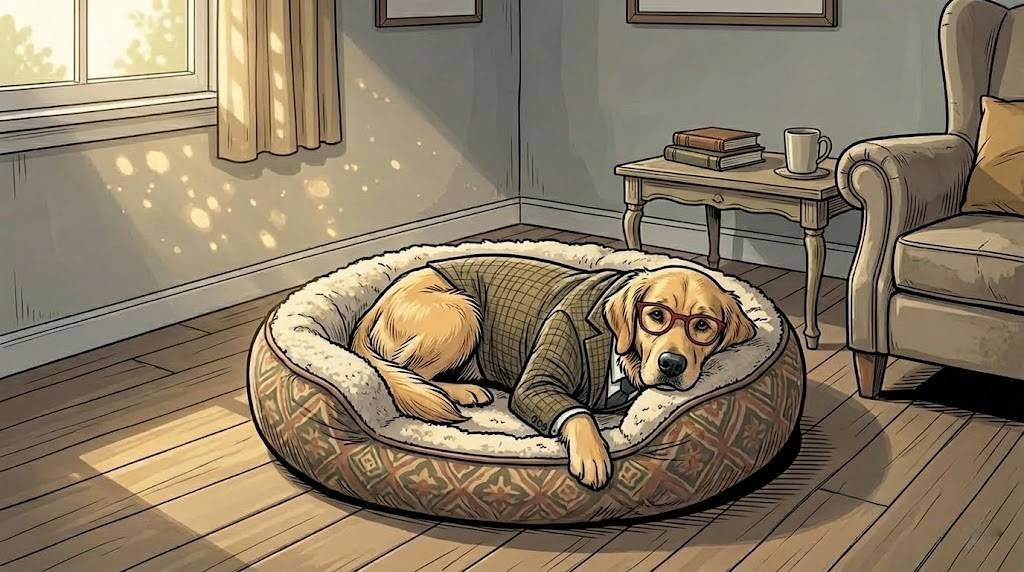
I am, currently, a dog who can be left alone without incident. Mostly. There are conditions — extended absences, disrupted routines — under which I become what The Therapist diplomatically calls “expressive.” But the panic is gone. The distress is gone. What remains is preference, not terror.
That is the goal. Not a dog who has no feelings about being left alone — dogs are social animals and preferences are reasonable — but a dog whose feelings do not overwhelm them.
That is achievable. For almost every dog who arrives at this article’s doorstep with a destroyed throw pillow and a confused owner.
I know. I was one of them.
Professor Alfred
Recovered Separation Anxiety Sufferer, Mostly Reformed Alone-Time Disaster, Still Expressive Under Certain Conditions