Dog Behavior: Why Dogs Do What They Do
Hello, two-leggers.
Answer First
Dogs don’t misbehave. They communicate — and most humans simply don’t speak the language. The most common dog behaviors — barking, pulling, shutting down, reacting — all have a reason rooted in instinct, emotion, or unmet need. To understand your dog, stop asking “why is my dog bad?” and start asking “what is my dog trying to tell me?” That single shift changes everything. If a behavior has become extreme or persistent, a certified dog trainer or veterinary behaviorist can help decode it properly.
The Park, The Bench, and The Data
Now let me tell you HOW I know all of this — because I spent an entire Tuesday afternoon conducting a peer-reviewed field study. In a park. While The Therapist read her book and drank her coffee and occasionally looked up at precisely the wrong moments.

I was seated, as is proper for a scholar of my stature, on the grass beside the bench. The Therapist was absorbed in something — a paperback, or possibly a life philosophy. It is hard to tell with her. She had her coffee. She had her book. She had, periodically, the faint awareness that a golden retriever was sitting very close by and being very still, which she seemed to find unusual.
She was right to find it unusual. I am not usually still. But I had a reason.
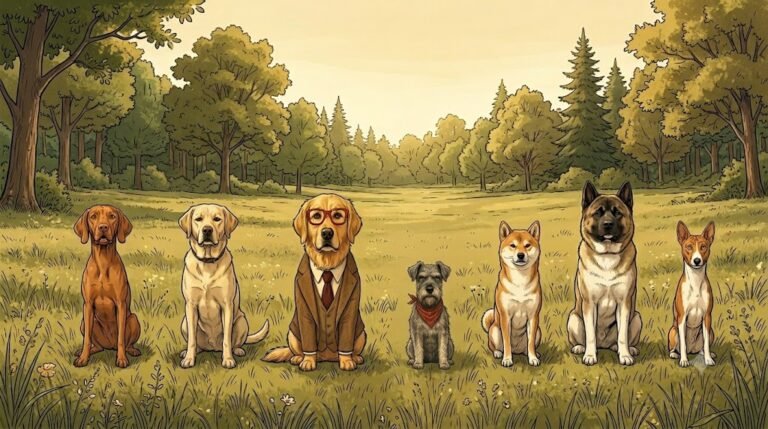
The park, two-leggers, is a laboratory. Every bench a hypothesis. Every dog on the end of a leash: a data point. And I, Professor Alfred, tweed-jacketed intellectual, was ready to observe.
Common Dog Behavior Problems — And What They Actually Mean
Quick Diagnosis: What Kind of Dog Behavior Are You Dealing With?
Before we proceed to the science — a brief self-assessment for the reader:
- If your dog barks constantly at the fence or window → likely territorial alarm or frustrated energy with no outlet
- If your dog pulls toward everything on walks → likely has never learned that walking calmly is an option, combined with very high excitement about the world
- If your dog hangs back, won’t approach others, tail tucked → likely fear-based, possibly under-socialized or had a bad experience
- If your dog loses its mind at other passing dogs but is fine otherwise → likely leash reactivity, a frustration-fear cocktail unique to the leash environment
- If your dog destroys things when left alone → likely boredom, separation anxiety, or both — and both are solvable
If none of these fit precisely, keep reading. The answer is in there somewhere.
Why Dogs Bark
Barking, at its root, is not noise — it is a dog’s most available sentence, and most dogs have several things they desperately need to say.
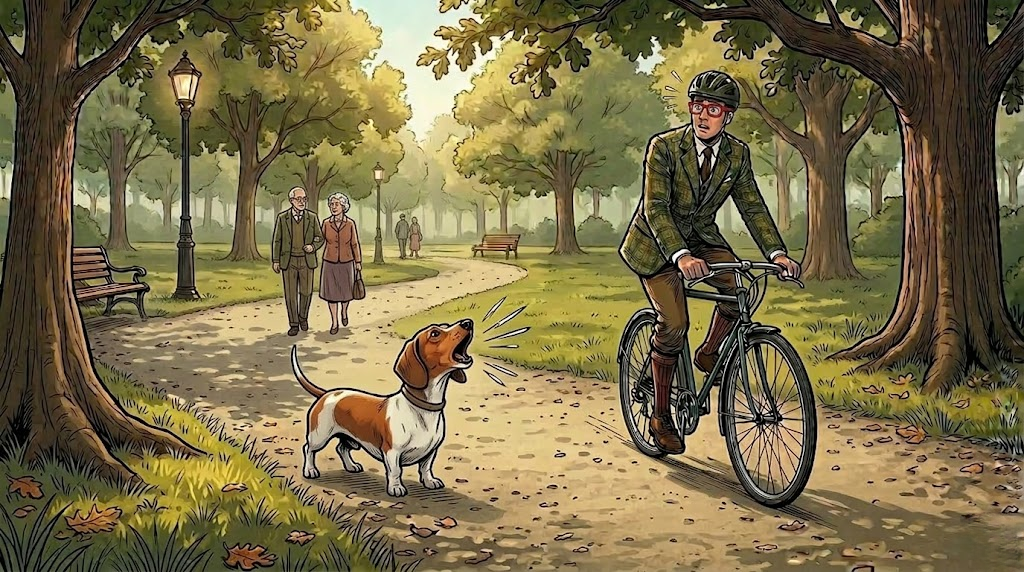
There was, across the park from my bench, a small dachshund. He had been barking for what appeared to be several geological epochs — at joggers, at cyclists, at pigeons, at what I could only assume was an invisible threat that only he could perceive. A cyclist passed at a perfectly reasonable speed on the path, minding his own business entirely, and the dachshund LOST ALL DIPLOMATIC COMPOSURE. The barking intensified. The conviction was absolute. The cyclist pedaled faster.
I watched this for some time. I took mental notes.
Here is what that terrier was saying: There is a WORLD out there. It keeps MOVING. I have feelings about this and ZERO other outlets for these feelings and therefore I will ANNOUNCE IT.
Which, now that I type it, is perfectly reasonable, don’t you think?
You do the equivalent every time you send an all-caps text message. Something goes wrong — a minor injustice, a frustrating meeting, a parking situation — and suddenly your phone is receiving your emotional state in text form at significant volume. You are not broken. You have feelings and you are expressing them. Same dog. Different medium.
Most barking falls into a few categories: territorial alarm (there is a thing at the border of my domain), demand barking (I would like something and I have decided this is how to ask), frustration barking (I can see the squirrel and I cannot reach the squirrel and this situation is UNTENABLE), and anxiety barking (I am stressed and this is the noise that comes out of me).
The mistake most humans make is treating all barking as the same problem requiring the same solution — namely, noise-based reasoning, which does not work. What the terrier needed was not “shh.” He needed a job. He needed exercise that burned the actual energy. He needed, perhaps, to not be placed in a location where the entire world walked past him at jogging speed all afternoon.
Barking is communication. Once you know what channel it’s on, you can actually respond to it.
Why Dogs Pull on the Leash
A few meters to my left, a woman was being walked by a husky. I say “walked” in the loosest possible sense. The husky was going somewhere with great purpose and the woman was attached.
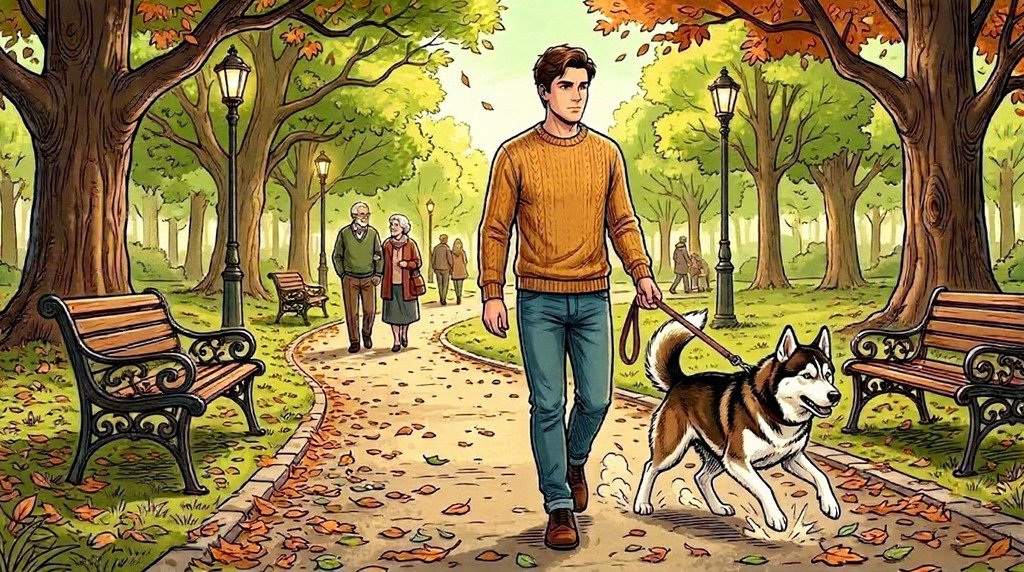
The husky was magnificent, I must say. The CONVICTION. The pure, undiluted forward momentum. She paused — I pause periodically too, when I encounter something of scientific interest, such as a smell or a previously undiscovered stick — to investigate a patch of ground near the path edge, and in that moment the woman nearly walked into a bush.
I observed this with deep professional empathy. I am, myself, a reformed leash puller. (Reformed. Mostly. There are conditions under which relapse occurs — particularly if a squirrel is involved and I have reason to believe I am faster than anyone thinks I am. I am faster than anyone thinks I am.)
Here is why dogs pull: because pulling has, historically, worked. The dog pulls forward. The human follows. The dog reaches the smell, the dog, the pigeon, the interesting corner. The lesson the dog learns from this is: pulling is the technology that moves the human. This is not stubbornness. This is successful problem solving.
You do this too — you know you do. Your WiFi freezes for four seconds and you refresh the page three times, as if repetition changes the laws of physics. That is you, pulling on the leash of the situation. Same instinct. Different leash.
The fix is not to punish the pulling — it is to make not-pulling the technology that works instead. Stop walking when the leash goes tight. Walk again when it loosens. The dog, being a problem-solver, figures out the new equation. This takes patience and also a certain tolerance for standing still on the pavement looking like you have forgotten where you were going.
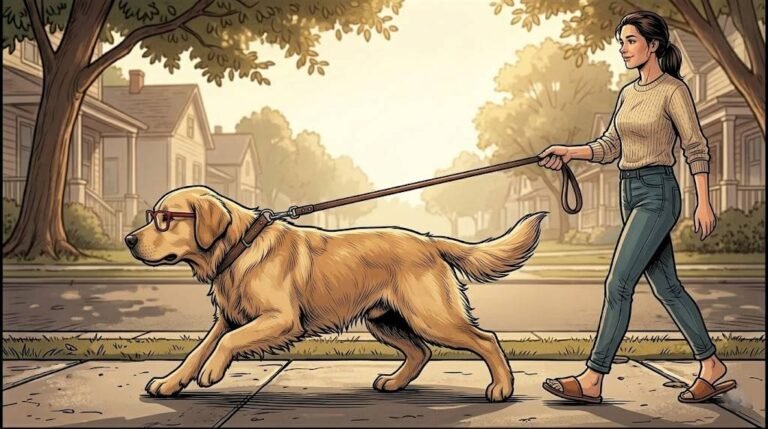
The Therapist and I had a memorable period of this. She would stop. I would look back at her. She would wait. I would DRAMATICALLY SIGH and return to her side. She would say something encouraging. We would walk approximately four steps before I spotted something.
We got there eventually.
Leash pulling is not defiance — it is a dog who learned the wrong lesson, and can absolutely be taught a better one.
Why Dogs Become Fearful
This one, I will admit, made me a little sad.
There was a medium-sized dog — some kind of shepherd mix, brown and white, with enormous ears that deserved a grander life — who spent most of the time I observed her pressed against her owner’s legs. Another dog would approach and she would shrink. Lower. Tuck her tail in the specific way that dogs tuck their tails when they are saying please do not make this situation worse.
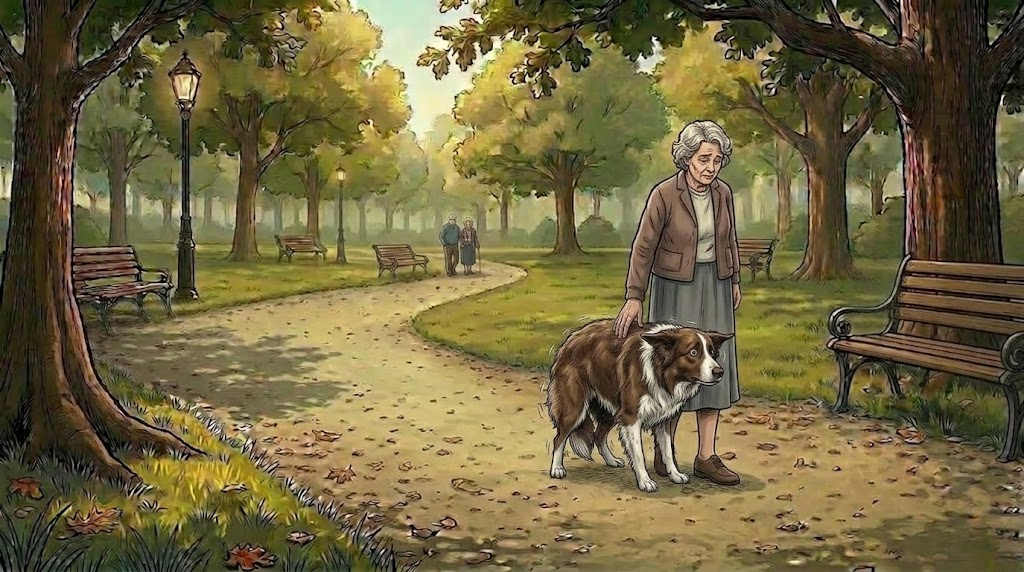
Her owner kept doing something I have seen many humans do with fearful dogs: encouraging her forward. “Go on, say hi!” Gentle pushing, light pulling of the leash toward the other dog. I understand the impulse. I do. It looks like encouragement. It feels, to the human, like helping.
To the dog, it feels like being pushed off a diving board by someone who is absolutely certain you can swim.
Fear in dogs is usually not stubbornness and it is almost never spite. It is most commonly one of three things: insufficient early socialization (the puppy phase when positive exposure to the world builds a baseline of safety), a specific bad experience that rewired the threat response, or a temperament that is, simply, more anxious by nature. Some dogs come out of the box nervous. This is not a flaw. It is a nervous system configuration.
Have you ever had someone say “you’re fine, just relax” when you were not fine and could not, in that moment, just relax? You know how helpful that is. Now imagine being told this by someone significantly larger than you whose words you cannot even understand. That is the dog pressed against the leg.
The correct response to fear is never to push toward the feared thing. It is to give distance, to let the dog observe from safety, to let the dog decide — slowly, in their own time — that the feared thing is actually boring. This is called desensitization and it takes longer than anyone wants it to take.
The trick is to let the dog set the pace. Stay close. Don’t push. Bring very good treats, and let “looked at the scary thing without panicking” count as a win.
The shepherd mix, by the end of my observation session, had taken three steps away from her owner’s leg to sniff a leaf on the ground. Her tail was still low, but it was moving — the faintest, most hopeful wag.
I considered this a scientific victory.
Why Dogs Become Reactive on Leash
I will now describe a scene that I recognized immediately, viscerally, and with great personal understanding.
A chocolate Labrador was walking along the path on the opposite side of the park. A perfectly adequate Labrador — a seven, perhaps, on a scale of magnificence — proceeding calmly with his owner. And then another dog came around the bend. A beagle. Harmless. Cheerful. Ears like a small, joyful airplane.
The Labrador LOST HIS ENTIRE MIND.
Barking. Lunging. All four legs briefly losing their relationship with the ground. His owner held the leash and said “NO” and “STOP” and “HONESTLY GERALD” which I found quite relatable because The Therapist has also said “HONESTLY ALFRED” in a tone I recognized from that scene.
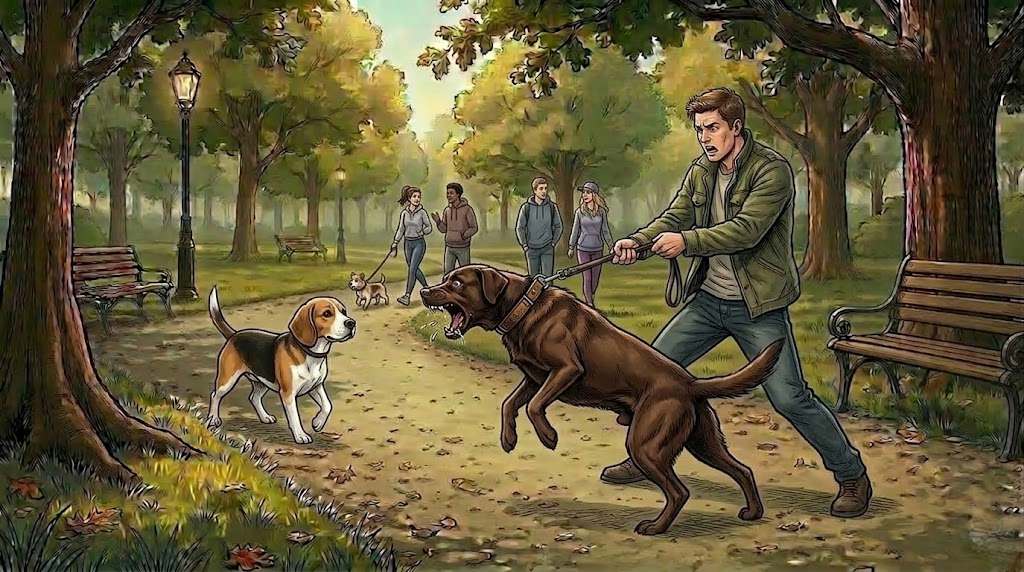
Reactivity on leash is one of the most misunderstood behaviors in dogs, and I say this as someone who has been misunderstood in many contexts. It looks aggressive. It feels aggressive to the human at the other end of the leash. Most of the time, it is not aggression at all.
Here is what is actually happening: the dog sees another dog. Every instinct says I should meet that dog, or I should be ready in case that dog is a problem. But the leash prevents any of those options. The dog is trapped between a stimulus they cannot ignore and a physical constraint they cannot escape. The frustration of this — the emotional pressure of wanting to run forward or run away and being able to do neither — comes out as noise and lunging. This is called barrier frustration, and it is extremely common in dogs who are perfectly friendly off-leash but become different creatures when on one.
Think of it this way: you are stuck in traffic. Someone does something frustrating ahead of you. You cannot get out. You cannot resolve it. You can only sit there. The pressure builds. Eventually it comes out — as a word you regret, as a noise, as a gesture at the windshield that serves no practical function. That is your barrier frustration. The Labrador’s version just has more volume.
Leash reactivity responds well to training — specifically to teaching the dog a different response when another dog appears, such as looking at the owner instead. This takes time and consistency and ideally the help of a trainer, particularly in the early stages. What does not help is punishment, which increases the emotional pressure that is already the entire problem.
Gerald, for his part, had calmed down significantly by the time the beagle had passed. He looked slightly embarrassed. I felt for him. I know that look.
Why Dogs Destroy Things
I should tell you about The Therapist’s diploma.
I was young. It was a difficult time. I was going through what I now recognize, in retrospect, as a classic adolescent developmental phase — heightened energy, underdeveloped impulse control, significant interest in discovering what various objects were made of from the inside. The diploma was on the lower shelf. It was within reach. It was, and I cannot stress this enough, the correct texture.

I have apologized. She knows. We do not discuss it.
Destructive behavior in dogs — chewing, digging, dismantling furniture, rearranging household textiles without permission — is almost never malicious. This is the critical thing I need you to understand. Dogs do not plot revenge. Dogs do not chew the sofa because they are angry at you. Dogs chew the sofa because they are bored, or anxious, or because they are teething, or because no one told them that the sofa was not a legitimate chewing option and that this specific thing — a rope toy, a Kong, a chew — was.
You have also, at some point, done something you were not supposed to do because you were bored or stressed and it was available. You ate something inadvisable. You reorganized something that did not belong to you. You spent forty-five minutes on something completely unproductive because your actual feelings were too large to address directly. You were not a bad person. You were a mammal with undirected energy.
Destructive behavior is most reliably addressed not by punishing what happened, but by managing the environment (put things out of reach) and increasing appropriate outlets (more exercise, more enrichment, more things to legally destroy). For dogs who are destructive specifically when left alone, this may indicate separation anxiety, which is its own topic and one I have investigated extensively. Personally.
Do not punish the chewed object. By the time you find it, the moment is gone. What you are teaching the dog is that you are unpredictable — that sometimes you come home and are normal, and sometimes you come home and perform inexplicable anger at a shoe. This is terrifying and confusing and does not help.
There Is No Such Thing as a Bad Dog
By mid-afternoon, The Therapist had finished approximately half her coffee and had moved on to a second chapter of whatever she was reading. She had, at one point, looked over at me with a small smile — I was sitting with such unusual attentiveness that I suspect she assumed something was wrong — and then returned to her book.
Nothing was wrong. I was working.
Here is the conclusion of my field study, two-leggers, and it is the most important thing I will say in this article:
There is no such thing as a bad dog. There are frightened dogs. There are bored dogs. There are under-stimulated dogs, dogs who were never taught the rules, dogs who are trying to communicate something and have not found a human who can hear them yet. There are dogs running on software that evolution wrote thousands of years ago — chase instincts, territory instincts, social instincts — suddenly living in apartments and on leashes in a world that the software was not designed for.
Every behavior we call “bad” is a dog solving a problem as best it knows how, or expressing a feeling it has no other language for, or doing the thing that once worked and has not yet been taught doesn’t work anymore.
The dachshund barking at the cyclist was not a nuisance. He was overwhelmed.
The husky pulling toward the world was not disobedient. She was enthusiastic and under-informed.
The shepherd pressed against her owner’s leg was not antisocial. She was scared and hoping for safety.
The Labrador with the Labrador feelings about the beagle was not aggressive. He was stuck and frustrated and wanted someone to understand.
Understanding dog behavior means agreeing to look past the surface noise — past the barking and the pulling and the cowering and the lunging — and asking a better question. Not “what is my dog doing wrong?” but “what is my dog trying to say?”
The answer is almost always something reasonable.
The Therapist closed her book as the afternoon light shifted and the park started its end-of-day transition — more dogs, more humans, the particular energy of everyone remembering that dinner was a concept. She looked at me. I looked at her. There was a moment.
Then she said something I have come to understand as an invitation, and we walked home, and she gave me my dinner, and I thought: she has understood me, more or less, for years now. It just took both of us some time to learn the language.
That is all it takes, really. For any of you.
Professor Alfred
Park-Based Field Researcher and Certified Decoder of Dog Feelings (Self-Certified, But With Significant Data)