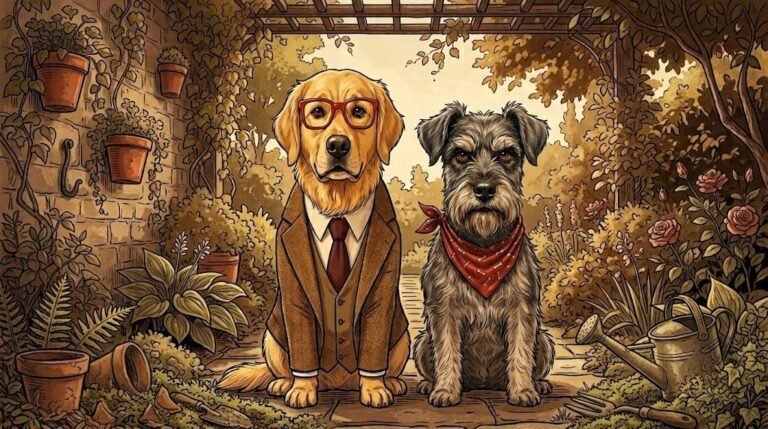
Why Dogs Bark: A Golden Retriever’s Academic Investigation
Hello, two-leggers.
Answer First
Dogs bark because we’re talking to you. The main triggers are territorial alerts, boredom, excitement, attention-seeking, and fear. Start by identifying which type your dog does most often and respond differently to each. If barking is constant or aggressive, consult a certified dog trainer or veterinary behaviorist.
Now let me tell you HOW I know all this.
The Vocal Years
I used to bark. At everything. Mailman, doorbell, leaves, the concept of silence. During my pre-dog-school phase, I had opinions about every sound within a three-block radius, and I shared those opinions. Loudly.
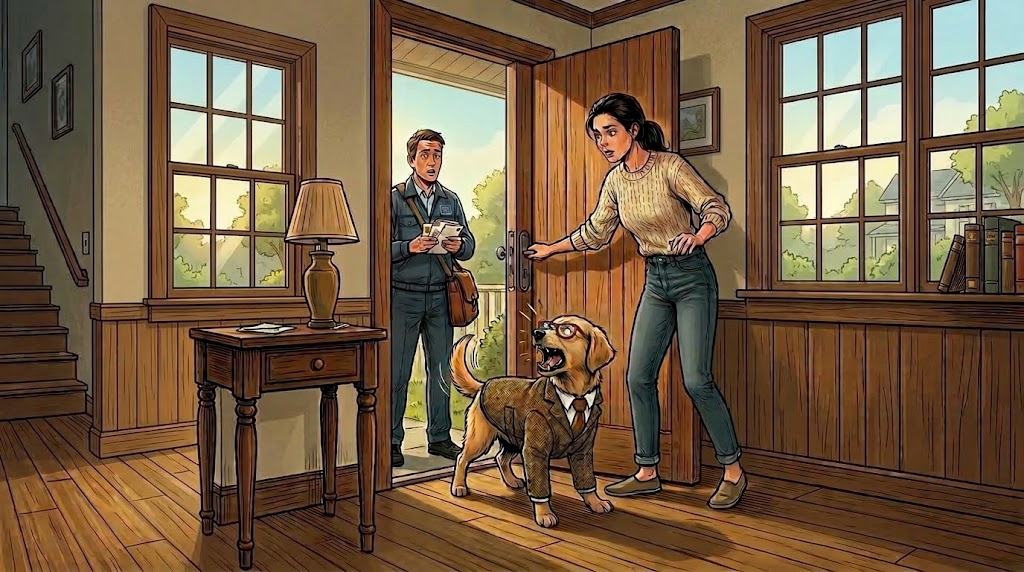
The Therapist’s neighbors had opinions too. Different opinions. I believe their exact words were “Can you please do something about that dog?” Which is very diplomatic phrasing for “Your golden retriever has transformed our peaceful street into an ongoing vocal performance that we did not purchase tickets for.”
I wasn’t trying to be difficult. I genuinely believed I was doing my job. Someone walks past our house? ALERT THE HUMANS. Bird lands in our yard? ALERT THE HUMANS. Wind moves a tree branch? SUSPICIOUS ACTIVITY, ALERT THE HUMANS.
You do this too, actually. Have you ever checked your phone immediately when it buzzes, even though you’re in the middle of something important? You don’t know if it’s urgent or just another promotional email, but you check anyway because what if it’s important? That’s me with the mailman. What if THIS time he’s actually up to something suspicious? I can’t take that risk.
The Therapist tried multiple strategies. “Quiet” (I didn’t know what that meant). Treats when I stopped barking (I’d bark to get the treat-giving process started). Ignoring me (I barked louder, obviously she hadn’t heard me the first seventeen times).
Then we went to dog school. And I learned something that changed everything: not all sounds require commentary. Revolutionary concept, I know.
These days I’m… better. I still bark at the mailman—he’s clearly engaged in suspicious daily activities and someone needs to document this. I bark when I’m excited about walks. I bark when I see another dog I’d like to meet. But I’ve learned the difference between “information barking” and “I’m bored so I’ll create my own entertainment barking.”
The Therapist once told our dog trainer that teaching me about barking taught her more about communication than his entire graduate program. I like to think I provided valuable educational services. He paid for dog school; I paid his back with insights about mammalian vocal behavior.
Let me share what I’ve learned through years of barking, getting corrected for barking, learning to bark appropriately, and observing why we do this in the first place.
Quick Diagnosis: Which Type of Barker Is Your Dog?
• If barking at people passing the house → likely territorial/alert barking
• If barking when you’re home but not paying attention → likely attention-seeking or boredom
• If barking at specific triggers (doorbell, other dogs, strangers) → likely excitement or fear-based
• If barking when left alone → likely separation anxiety or understimulation
• If barking is constant regardless of situation → likely insufficient mental/physical exercise
The Thing Most People Misunderstand About Barking
Here’s the insight that changed how The Therapist approached my barking: we’re not misbehaving. We’re communicating.
I realize this seems obvious—of course dogs communicate by barking—but most humans treat barking as a problem to eliminate rather than a message to decode.
It’s like when someone speaks to you in a language you don’t understand, and instead of trying to figure out what they’re saying, you just tell them to be quiet. Frustrating for both parties, isn’t it?
During my barking phase, The Therapist was trying to stop the behavior. What actually worked was when she started asking “What are you telling me?” Different barks meant different things, and once she learned to distinguish them, we could actually solve the underlying issue rather than just suppressing the symptom.
This doesn’t mean all barking is acceptable or should be tolerated. But understanding WHY we bark makes it much easier to address the WHAT TO DO about it. Which brings me back to the fundamental question.
The Five Main Reasons Dogs Bark
Through years of observation—and, let’s be honest, personal experience—I’ve identified five primary reasons dogs bark. Most of us bark for multiple reasons depending on context, which is why the Quick Diagnosis checklist matters. But usually there’s one dominant driver.
1. Territorial and Alert Barking
This is the “someone is approaching our territory and I need to inform everyone” bark.
It’s what I did with the mailman. And the UPS driver. And people walking their dogs past our house. And birds. And once, a particularly suspicious-looking garden gnome that someone placed in their yard overnight.
From our perspective, this is LITERALLY OUR JOB. For thousands of years, humans bred us to alert them to approaching strangers, potential threats, and unusual activity. Then you get upset when we… do exactly that. The mixed messaging is confusing. You built the alarm system.
You do something similar with your home security system. You set it to alert you to every door opening, every window sensor, every motion detected. Then you get annoyed when it beeps seventeen times because you forgot to turn it off before letting the cat out. You wanted to be alerted to potential threats, and now you’re being alerted to ALL potential threats. That’s me with territorial barking. You asked for a security system; you got a very enthusiastic one.
The Therapist helped me understand that I don’t need to alert her to EVERY person who exists in the general vicinity of our house. Just actual threats. The challenge is that my definition of “threat” includes “anyone I haven’t personally vetted and approved,” which is, admittedly, most people.
This type of barking usually happens at windows, doors, or fence lines. We’re watching our territory and reporting our findings. The barking often has a specific, sharp quality—it’s our “ATTENTION! PERIMETER BREACH!” alarm.
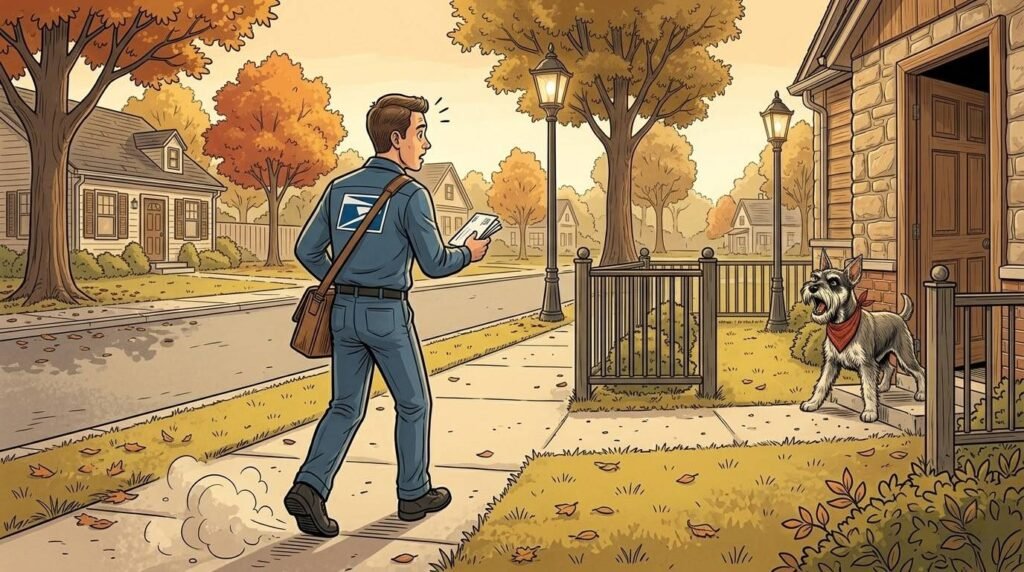
What worked for me: The Therapist taught me “thank you.” I’d bark to alert her (because that’s reasonable), she’d say “thank you, I see them,” and I’d stop (because my job was complete). This acknowledged my contribution without requiring me to bark seventeen more times to ensure she’d heard me.
The key insight: we’re not being annoying. We’re being vigilant. Once you acknowledge our vigilance, many of us are satisfied and will stop. The continued barking often happens because we think you didn’t hear us the first time.
2. Boredom and Understimulation
This is the “I have nothing to do so I’ll create my own entertainment” bark.
I’ve observed this most clearly in dogs who bark at nothing in particular. Not at specific triggers, not at approaching people—just… barking. Into the void. Because what else is there to do?
You know how you start clicking a pen repeatedly during a boring meeting? Or tapping your foot? Or refreshing your email inbox for the forty-seventh time even though nothing new has arrived in the last three minutes? You’re not trying to be annoying. Your brain just needs SOME form of stimulation, and in the absence of actual interesting content, it creates its own patterns of activity.
That’s us with boredom barking. Except we click with our mouths instead of pens.
During my teenage phase, I’d bark when The Therapist was working from home. Not because I needed anything specific. Not because there was a threat. But because I was BORED and barking was at least something happening.
Golden retrievers were bred to work. We’re supposed to retrieve birds, swim through cold water, cover miles of terrain. Sitting in a house for eight hours with nothing to do is like asking a marathon runner to sit still in a waiting room. Eventually, we’re going to find SOMETHING to do, and sometimes that something is barking.
The Therapist learned this when she started giving me puzzle toys before her work calls. Suddenly, I had a job (extract treats from complicated contraption), and I stopped the random barking. My brain was occupied, so I didn’t need to create my own stimulation through vocal exercises.

This type of barking is often repetitive, persistent, and doesn’t seem connected to external triggers. It’s us saying “I’m understimulated and I don’t know what to do with all this energy.”
What worked: mental stimulation before the barking usually starts. Training sessions, puzzle feeders, scent work, anything that makes us think. Physical exercise helps too, but mental work is often more effective for stopping boredom barking. A tired dog is a quiet dog, but an occupied dog is a REALLY quiet dog.
So here’s the parallel: if you’re stuck in a waiting room, you’re much less likely to fidget annoyingly if you have a good book or an engaging podcast. Give us our equivalent of a good book—mental work—and the barking often stops.
3. Attention-Seeking Barking
This is the “I’ve determined that barking produces results” bark.
I’m not proud of this phase, but I went through it. I’d bark at The Therapist while she was reading. She’d look up, tell me to be quiet, maybe toss me a toy to distract me. From my perspective: barking equals attention. Success. Like my friend Nanook, the Husky. He did something similar while his owner was watching football on TV.
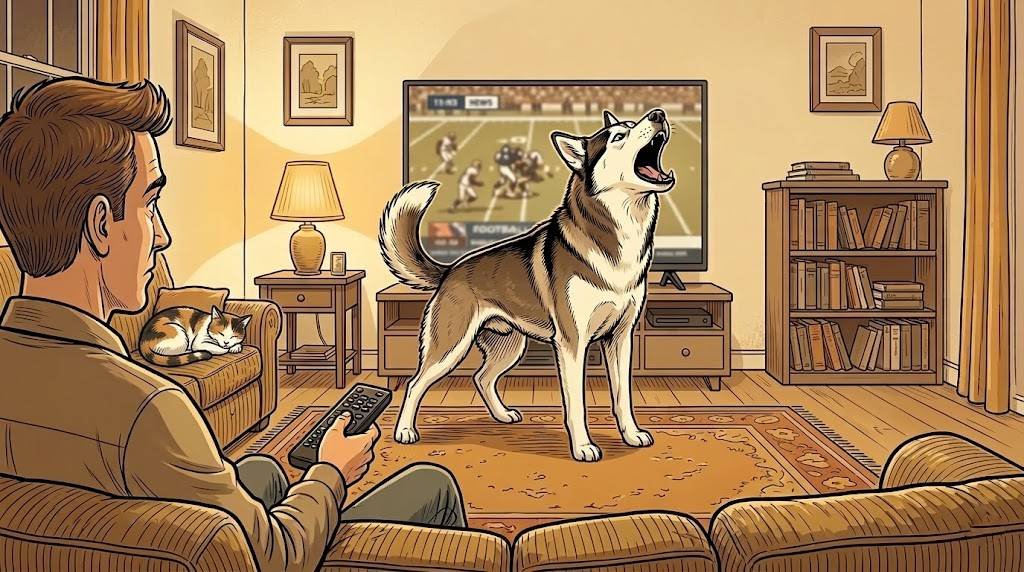
The problem—and I’ve observed this in many dogs—is that we don’t distinguish between positive and negative attention. You yelling at us to be quiet is still attention. You coming over to see what we want is attention. You giving us a toy to shut us up is DEFINITELY attention plus toy, which is an excellent outcome from our perspective.
Have you ever said something mildly controversial in a meeting just to get people to pay attention to you? Or interrupted someone’s story with a louder, more interesting anecdote? Not your proudest social moment, but it worked—people looked at you, engaged with you, responded to you. That’s attention-seeking barking. We’re not sophisticated enough to care whether the attention is positive or negative. We just know it’s attention, and attention is what we wanted.
This creates what The Therapist calls a “reinforcement loop.” We bark, you respond, we learn that barking works, we bark more. You respond more (often with increasing frustration), we learn that louder/more persistent barking works even better.
I became quite sophisticated at this. I’d start with a single bark. If ignored, I’d add volume. If still ignored, I’d add frequency. I had a whole escalation protocol. The Therapist was inadvertently teaching me to be more persistent by only responding when I barked loud enough and long enough.
What broke the cycle: she stopped responding to my barking entirely and started rewarding me for being quiet. This was VERY frustrating initially. I’d bark, she’d do nothing. I’d bark louder, still nothing. I’d bark VERY LOUD, she’d leave the room.
But when I was quiet, she’d come over with treats or attention or whatever I’d been trying to get through barking. My brain eventually made the connection: quiet equals good things, barking equals human disappears.
The key: you have to be absolutely consistent. If you ignore the barking 9 times but respond on the 10th, you’ve just taught us to be extremely persistent. We’ve learned “if I keep trying, eventually it works.” Like slot machines. You know intellectually that each spin is random, but you keep trying because eventually it pays out. Don’t accidentally turn your dog into a gambling addict.
4. Excitement Barking
This is the “SOMETHING AMAZING IS HAPPENING” bark.
I still do this one. The Therapist comes home? Bark bark bark BARK. We’re going for a walk? BARK. Another dog appears? BARKBARKBARK.
This isn’t a problem that needs solving, usually. It’s just enthusiasm expressing itself vocally. Golden retrievers are enthusiastic creatures. We love things. We love them LOUDLY.
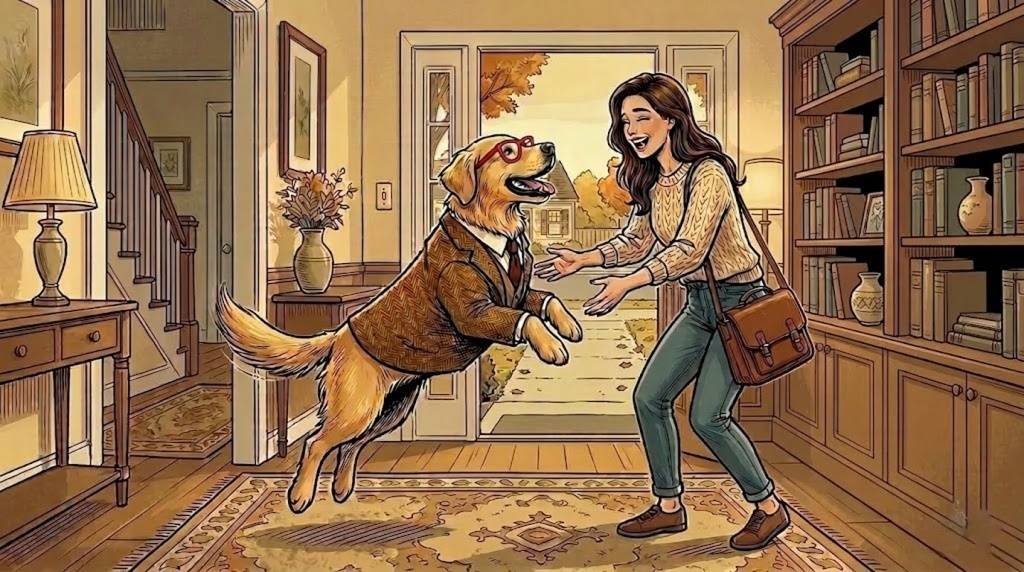
You do this too, just with different sounds. When your favorite team scores, do you sit quietly and nod with approval? Or do you yell, cheer, possibly stand up and wave your arms? When you see an old friend unexpectedly, do you calmly say “hello” in a measured tone, or do you make excited sounds and possibly squeal a little? That’s excitement barking. We’re just doing the vocal equivalent of your “OH MY GOD I CAN’T BELIEVE IT’S YOU!” response.
The difference between excitement barking and problem barking is context and duration. Excitement barking happens at specific triggers (doorbell, leash appearing, car rides), lasts a relatively short time, and stops once the exciting thing actually happens or we calm down.
I bark when The Therapist gets my leash. But once we’re actually walking, I’m quiet. The barking is the anticipation, not the activity itself.
Some dogs—like me—are more vocal about excitement than others. Some breeds barely make a sound. This seems to be partly genetic and partly learned behavior. The Therapist noticed I bark more when she acts excited too. Her energy feeds my energy, and my barking escalates.
What helps: staying calm during exciting moments teaches us to stay calmer too. When The Therapist started putting my leash on very calmly, without any “Are you ready for walk? Who wants to go for a walk?!” enthusiasm, my pre-walk barking decreased dramatically.
We mirror your energy. If you’re excited and high-pitched, we’re going to be excited and high-pitched (and vocal). If you’re calm, we often calm down too. Think about how you naturally lower your voice when talking to someone who’s upset. Same principle, except we’re the ones who need the calm modeling.
That said, some excitement barking is just… who we are. I’m a golden retriever. I’m going to bark when I see another dog I want to play with. The Therapist has accepted this as the price of living with a golden who believes everyone and everything is a potential friend.
5. Fear and Anxiety Barking
This is the “I’m uncomfortable and trying to make the scary thing go away” bark.
I don’t do this one much—golden retrievers aren’t generally fearful—but I’ve observed it in other dogs. This barking sounds different. It’s often higher-pitched, more frantic, and accompanied by other stress signals: ears back, body lowered, retreating while barking.
The key distinction: territorial barking says “I’m defending my space.” Fear barking says “please go away, you’re scaring me.”
You know that feeling when you’re walking alone at night and you hear footsteps behind you? Your heart rate increases, you might walk faster, you’re hyper-alert to every sound. If you could bark to make the scary potential threat go away, you probably would. That’s fear barking. It’s not aggression—it’s “I feel unsafe and I’m trying to create distance between me and this scary thing.”
A dog I met at the park—a rescue with an uncertain past—would bark frantically at men wearing hats. Not men in general. Specifically men in hats. His human explained he’d likely had a bad experience and now associated hats with danger.

This type of barking gets worse if you punish it. The dog is already scared; adding punishment just creates more fear. It also doesn’t solve the underlying problem, which is that the dog genuinely believes something is threatening.
What works: gradual desensitization. The hat-reactive dog’s human worked with a trainer to slowly, carefully help him learn that men in hats weren’t dangerous. Lots of treats, lots of distance initially, very gradual exposure.
If your dog’s barking seems fear-based—especially if it’s accompanied by aggression, lunging, or panic—this is when you call a certified dog trainer or veterinary behaviorist. This isn’t something you fix with YouTube videos. This is specialized behavior modification that requires professional help.
The Therapist learned early on that some behavioral issues are beyond her expertise. When a client dog showed fear aggression, she referred them to a specialist. Same principle applies here: if barking is rooted in genuine fear or anxiety, get professional help.
Think about it this way: if you had a genuine phobia that interfered with your daily life, you wouldn’t try to fix it yourself with internet advice. You’d see a therapist who specializes in phobias. Your dog deserves the same level of professional support.
What Different Barks Actually Mean
Here’s something that surprised The Therapist: we have different barks for different situations.
A territorial bark sounds sharp and repetitive: “Bark! Bark! Bark!” Alert, alarm, attention required.
An attention-seeking bark is often a single bark followed by a pause, then another bark. We’re testing: “Does this work? No? How about now?”
Excitement barking tends to be rapid-fire and high-pitched. It’s exuberant, not threatening.
Fear barking is higher-pitched, sometimes mixed with whining, and doesn’t have the confidence of territorial barking.
Boredom barking is monotonous. Same bark, same interval, same lack of passion. It’s the auditory equivalent of “I’m bored I’m bored I’m bored.”
You do this with your voice too, actually. Compare how you sound when you’re genuinely excited about something versus when you’re making small talk about the weather. The pitch, rhythm, and energy are completely different. We’re doing the same thing—modulating our vocalizations based on our emotional state and intent.
Once you learn to distinguish these, you can respond appropriately instead of treating all barking the same way. My territorial bark needs acknowledgment. My excitement bark needs calming. My attention-seeking bark needs ignoring. Different barks, different approaches.
When Barking Actually Is a Problem
Most barking is normal dog communication. But sometimes it indicates something’s wrong.
Constant barking regardless of context—especially if it’s new behavior—might signal pain, cognitive issues in older dogs, or extreme anxiety. If your previously quiet dog suddenly becomes a constant barker, vet visit first.
Barking accompanied by aggression, destruction, or other behavioral changes warrants professional help. This isn’t just “my dog is vocal.” This is “something is significantly wrong.”
Barking that severely impacts quality of life—yours or your neighbors’—needs addressing even if it’s “normal” barking. You don’t have to live with excessive noise just because it’s technically communication.
The guideline The Therapist uses: if barking is disrupting daily life, preventing sleep, causing neighbor complaints, or creating significant stress, it’s worth addressing. Not because the dog is bad, but because everyone deserves a peaceful home environment.
The Management Techniques That Actually Worked
I learned through experience what stops barking effectively versus what just makes it worse.
What made my barking worse:
- Yelling at me (I thought we were barking together! You were being loud, I was being loud, we were a team!)
- Inconsistent responses (sometimes ignored, sometimes corrected—I never knew what would happen)
- Punishment after the fact (I had no idea what I was being punished for)
What actually worked:
The “Thank You” method for alert barking: Acknowledge our alert, thank us, ask us to stop. This worked because it honored my job (alerting her) while setting a boundary (one alert is enough). It’s like when a coworker tells you about a problem—you say “thanks for letting me know, I’ve got it from here.” You acknowledged their contribution without needing them to keep repeating it.
The “Incompatible Behavior” approach for attention-seeking: The Therapist taught me to bring her a toy instead of barking when I wanted attention. I can’t bark and carry a toy simultaneously. Plus, bringing a toy actually got me what I wanted (play time), so I learned the better strategy. Like learning to raise your hand instead of shouting out in class. Same goal (get attention), better method.
Pre-emptive mental stimulation for boredom barking: Puzzle toys, training sessions, scent games BEFORE I got bored enough to bark. Prevention worked better than correction. You probably do this too—if you know you have a boring task ahead, you set yourself up with coffee, good music, whatever makes it tolerable. Same principle.
Calm energy for excitement barking: The Therapist staying completely calm during exciting moments taught me to regulate my own excitement. This took months, but it worked. I still bark sometimes, but nothing like my previous performance pieces. It’s like how being around a calm person when you’re stressed can help you calm down too. Emotional states are contagious.Professional help for anything fear-based: This isn’t DIY territory. The Therapist knows her limits. So should you.
Moving Forward
Understanding why your dog barks doesn’t instantly stop the behavior—I wish training worked that way—but it gives you a framework for addressing the specific motivation driving the barking.
If your dog barks from boredom, more exercise won’t fully solve it (though it helps). They need mental stimulation. If they bark territorially, teaching “thank you” works better than punishment. If they bark for attention, ignoring the bark and rewarding quiet is your strategy.
The Therapist once told me that my barking phase taught her more about patience and communication than any professional development course. I like to think I was providing valuable educational services through my extensive vocal demonstrations.
These days, I bark maybe 10% as much as I did during my teenage phase. I still bark at the mailman—some traditions are sacred—and I bark when I’m genuinely excited. But I’ve learned that not every moment requires vocal commentary.
The Therapist has learned to distinguish my barks: territorial (acknowledge and dismiss), excitement (ignore until I calm down), and the rare attention-seeking bark (redirect to toy-bringing).
We’ve reached what she calls “peaceful coexistence with reasonable communication.” I call it “I bark when it matters, she listens when it matters, everyone’s happy.”
Which, I believe, is what communication is supposed to look like. Even when that communication happens at volumes your neighbors can hear three houses away.
Professor Alfred
Reformed Excessive Barker (Mostly)