
Puppy vs. Adult Dog: How to Actually Choose
Hello, two-leggers.
Answer first
A puppy and an adult dog are not easier or harder in general — they ask for different things at different times. A puppy costs you supervision, repetition, and ruined-object risk now, in exchange for shaping habits early. An adult dog costs less hour-by-hour supervision but asks for patience, decompression, and respect for an already-formed personality. Neither is the easier choice — they’re easier in different places. The real question is which cost your actual week can pay.
I arrived as a puppy myself, apparently through means my own eyes negotiated without consulting me beforehand, so I feel reasonably qualified to report on what that decision costs a household, having personally been the cost.
Quick diagnosis: which decision are you actually facing?
- If your week has real stretches of uninterrupted time and patience for repetition → a puppy may suit you.
- If your week is already full and you need a dog who arrives closer to finished → an adult dog may suit you better.
- If you want to shape habits from the start and don’t mind some chaos en route → puppy.
- If you want a known temperament and can offer patience instead of supervision → adult dog.
- If you’re leaning puppy because adult dogs feel “used,” or adult because they seem effortless → pause; both instincts hide the real cost.
What a Puppy Actually Asks of You
A puppy is, in functional terms, a new employee who has not yet read the handbook, does not know where anything is kept, and will absolutely chew through something important during orientation if left alone too long too soon. This is not a flaw in puppies. This is the entire nature of the position. You are not managing a finished product. You are managing the production process, in real time, for months, sometimes longer, depending on the dog and your own consistency — which, I say with the authority of someone who personally tested this, matters more than people initially assume.
I was, briefly, a puppy myself, though the phase lasted considerably longer than anyone in my household seemed to expect going in. Between roughly eight and eighteen months I barked at things, pulled at leashes with real conviction, conducted what I still consider a reasonably thorough structural review of a sofa, developed separation anxiety serious enough that The Therapist redesigned her entire morning around it, and attempted several escapes I privately regard as well-planned.
I was not difficult. I was academically under-supervised. Also, there was a sofa. The sofa knows what it did.
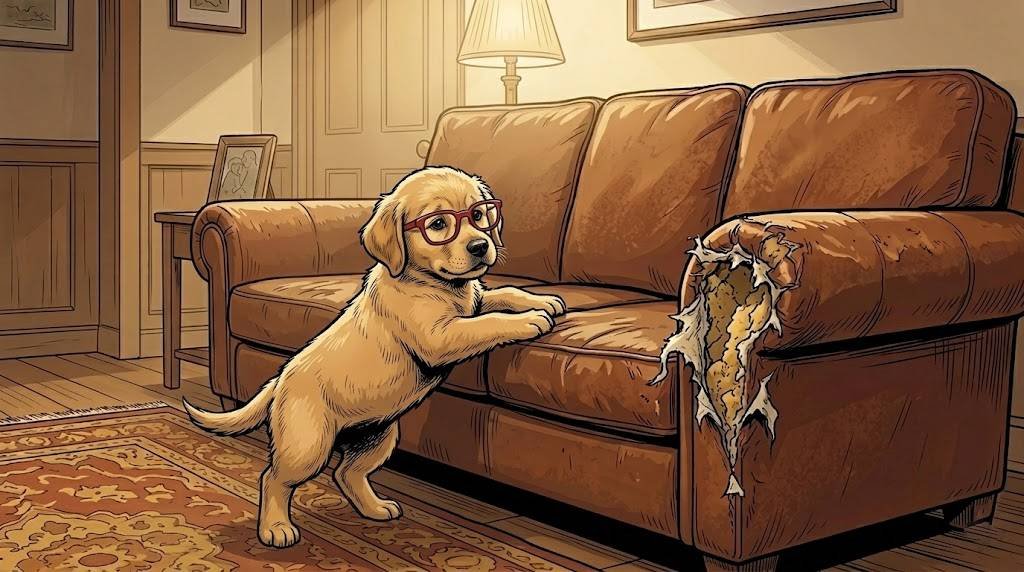
None of this happened because I was a bad puppy. It happened because I was a puppy, and puppies require supervision the way a new hire requires onboarding: constantly at first, with diminishing but real intensity for months afterward.
This is the same demand as accepting a job that requires close supervision for the first ninety days, where every hour you are not actually present produces a mistake that you, specifically, will be cleaning up later — not a colleague, not HR, you. The supervision is the job, not an inconvenient part of it.
If you’ve read my piece on separation anxiety, you already know what happens when that supervision gap opens before a dog has learned to tolerate it. A puppy hasn’t had time to learn anything yet. That tolerance gets built slowly, on purpose, mostly by you. What the first week with a puppy actually looks like, hour by hour, is its own subject. For now, the relevant question is simpler: do you currently have ninety days where you, or someone reliable, can be present enough to do this properly?
What an Adult Dog Actually Offers — and Still Asks of You
An adult dog arrives with a personality already assembled. This is the real appeal, and I don’t dispute it: you can generally tell, fairly early, whether this is a calm dog or an excitable one, a dog who likes other dogs or one who’d prefer not to discuss it, a dog who settles easily or startles at the dishwasher. My friend Ham arrived to Big Guy as an adult dog, not a puppy, and the personality he’d already developed came with him — he loved exactly two things, eating and barking, and made no particular effort to expand the list. This did not trouble Big Guy in the slightest. By every account I have heard, he was not hoping for a blank slate. He was simply glad that life — loud, food-obsessed, fully formed life — had finally moved into the house. You aren’t guessing at who this animal will become. You’re meeting who they already are.

This is the same advantage as hiring someone with a confirmed work history instead of training a graduate from nothing. You already know, roughly, what you’re getting — the strengths and the rough edges both — before you’ve committed to anything. There is genuine value in that. I was hired, so to speak, with no history whatsoever, and The Therapist has on occasion mentioned that prior documentation would have been useful.
But here is the part most “just get an adult dog, it’s easier” advice skips, and it matters: an adult dog is not automatically low-maintenance. A puppy needs supervision. An adult dog may need patience, decompression, and what I can only describe as habit-mapping — the slow work of figuring out which behaviors are preference, which are old coping strategies, and which are reactions to a history you weren’t present for and may never fully know. This takes time. It is a different kind of time than puppy supervision, spent differently, and it is not optional just because the dog already knows how to sit.
If the dog’s history is genuinely unknown — many rescue and shelter dogs fall into this category, which is its own decision with its own considerations — a trainer or veterinary behaviorist early on isn’t an overreaction. It’s the equivalent of reading the employee file before assuming you already understand the employee.
The Blank Slate Myth
There’s a persistent belief that a puppy is a blank slate and an adult dog is a damaged one. Neither half is accurate, and both halves push people toward the decision for the wrong reasons.
A puppy is not blank. A puppy already has a temperament, a breed history, and — depending on the individual animal — a baseline level of confidence or anxiety or independence that training will shape but will not invent from nothing. You are not writing on an empty page. You are writing on a page that already has handwriting underneath it, faintly, and your job is to write clearly enough that yours becomes the dominant text.
An adult dog, similarly, is not broken simply because they didn’t arrive as a puppy. Some adult dogs carry real history that takes real patience to work through. Many simply are who they are, the way most adult humans are mostly who they are, without that being evidence of prior catastrophe. Assuming an adult dog must be “fixed” is the same mistake as assuming a fresh notebook guarantees neat handwriting, or that a messy one means the person can never write clearly again. Both assumptions are about the object’s history. Neither tells you much about what happens next.
What happens next depends on you, on consistency, and on whether the dog’s actual needs — whatever their starting point — match what you can realistically provide.
Matching the Life Stage to Your Actual Week
I’ve written elsewhere about the importance of your real Tuesday , not your best day, not your Saturday, but the ordinary, slightly tired weekday that makes up most of your actual life. The puppy-versus-adult question is where that principle gets tested most directly, because the two paths bill you on different days.
A puppy costs you now, intensively, for a defined stretch — months of supervision, interrupted routines in the early weeks for some dogs, repeated correction, repeated patience, before the curve bends toward easier. An adult dog costs you less intensively but for longer, in a slower, quieter way — weeks or months of decompression and habit-mapping before you fully know what you have, and occasionally a harder edge to work around indefinitely.
This is the same logic as scheduling a renovation. You don’t start the kitchen during your busiest quarter at work, no matter how much you want the new kitchen now, because the disruption doesn’t disappear just because your calendar is full. You schedule it for the stretch where you can actually absorb it. A puppy is a renovation with a deadline. An adult dog is a renovation with no fixed end date, lower intensity, longer tail.
Look honestly at the next six months of your life — not the six months you’d prefer to have — and ask which kind of disruption, short and intense or longer and quieter, your actual schedule can absorb without everyone in the household, dog included, ending up worse off for it.
What Tends to Go Wrong With Each Choice
With a puppy, the failure pattern is usually the same one: the household underestimates the supervision requirement, the puppy is left alone too long too early, undesirable habits form during exactly the window when they were easiest to prevent, and by the time anyone notices, the household is managing a much larger problem than “puppy needs more attention.” I am, again, citing internal data. The sofa did not destroy itself. The opportunity did.
With an adult dog, the failure pattern is different but just as common: the household expects the dog to settle in within days, treats early caution or withdrawal as a permanent personality trait rather than decompression, and either gives up too early or pushes too hard, too fast, before the dog has had time to show who they actually are once they’re no longer stressed.
This is the same trap as buying a house from listing photos that looked finished, only to find the real problems after the inspection report — except by then you’ve already signed, the dog already lives with you, and “returning the house” was never how any of this works. The photos weren’t lying, exactly. They simply didn’t show you everything, because nothing does, on a first look, with a house or a dog.
The corrective in both cases is the same: time, honest observation, and a willingness to adjust your assumptions about what you’re actually dealing with, rather than insisting on the assumption you arrived with.
Puppy or adult dog isn’t a question with a correct answer sitting somewhere outside of you, waiting to be found. It’s a question about which kind of cost your actual life can absorb right now — the front-loaded kind, or the slower kind. One is not the discount option. They simply bill you on different schedules.
Alfred’s Rule: choose the bill you can actually pay, not the one that sounds smaller from a distance.
Professor Alfred
Reformed Puppy, Source Unconfirmed