How to Help a Dog with Separation Anxiety
Hello, two-leggers.
Answer First
Separation anxiety is panic, not misbehavior — your dog genuinely believes you are not coming back, and no amount of peanut butter or background music fixes that belief. Mild cases may improve within weeks, while moderate or severe separation anxiety can take months or longer. Progress depends on the dog, the starting point, and how carefully the alone-time training is built. The method is gradual desensitization: starting below your dog’s panic threshold and building by tiny increments, never crossing into panic. Keep departures and returns emotionally flat. For severe cases, work with a veterinary behaviorist or qualified separation anxiety professional.
Common Dog Separation Anxiety Symptoms
Before we go further, here is what separation anxiety actually looks like. These are the most common signs, and they almost always appear in combination rather than individually:
- Pacing — repeated movement between door, window, and a central spot, usually within the first thirty to forty minutes alone
- Destruction near exits — chewing or scratching at doors, window frames, crate bars, or anything that represents a boundary between the dog and the person who left
- Excessive vocalization — barking, whining, or howling that continues for the majority of the absence, not just the first few minutes
- Drooling and panting — physical stress responses that appear even in a cool room, often starting before the person has actually left
- Escape attempts — sometimes severe enough to cause self-injury, including broken teeth, torn nails, or bloodied paws
- House soiling — in a dog who is otherwise reliably house-trained, which rules out a training gap
- Pre-departure distress — shaking, whining, or following the person from room to room as they get ready to leave
If you are seeing three or more of these in combination, and they appear only when your dog is alone or about to be alone, you are probably dealing with separation anxiety rather than boredom or a training gap. For a fuller breakdown of the early signs of separation anxiety that article covers each symptom in detail.
Now let me tell you HOW I know all this — and I should warn you, two-leggers, that this is not my favorite story to tell, though it may be the most important one I have ever written, which are two things that often go together in my experience of being a dog who thinks too much about his own past.
Quick Diagnosis: Is This Separation Anxiety or Something Else?
Before you commit to a full desensitization protocol, it helps to figure out whether you are actually dealing with separation anxiety or one of the problems that looks like it from the outside. The right approach depends entirely on which one you have:
- Your dog destroys things only when you are gone, and only near exits → likely separation anxiety
- Your dog destroys things whether you are home or not → likely boredom or under-exercise, not anxiety
- Your dog shows stress signs before you leave (pacing, drooling, whining while you get ready) → separation anxiety
- Your dog is fine for short absences but struggles with long ones → may be mild anxiety or simply bladder and exercise needs
- Your dog panics only when one specific person leaves, not others → attachment-based separation anxiety, the most common form
If your diagnosis points to anxiety rather than training gaps, the rest of this article is for you.
The Afternoon I Learned What It Meant to Believe Someone Was Not Coming Back
The story of my own separation anxiety begins on a morning I did not recognize as different until it was too late to do anything about it.
I was around eight months old — during what The Therapist later referred to, with gentle retrospective humor, as my “teenage chaos phase.” It was the breakfast that first caught my attention. She normally ate at the kitchen table, slowly, with a book. That morning she stood at the counter, ate in three bites, and drank her coffee in one go. I watched from the doorway and catalogued this as a data point of unknown significance.
Then she did three things that together meant everything. She put her work bag by the door — a bag she never placed there unless she was leaving for longer than a grocery trip. She took me on a longer walk than usual, almost an hour, which I now recognize was precisely the point. And she prepared a Kong at a time of day she had never prepared one before.
Then she put on her other shoes — the harder ones that clicked against the hallway floor. She picked up her keys. The door opened. The door closed. The lock turned.
And then I was alone.
You do this too. You watch your child get ready for school and know, before they say a word, that something is different about today — the way they pack the bag, the way they linger or rush. You are reading the small things. That is what I was doing with the breakfast and the bag and the walk and the Kong. The room was telling me something unfamiliar was about to happen, but it was not telling me what, or for how long.
The First Ten Minutes Were Fine, Which Was the Problem
What happened over the next three hours taught me that separation anxiety does not arrive all at once — it builds, in stages, until a threshold is crossed and something breaks.
For the first ten minutes, I was fine. I worked on the Kong. I settled onto the rug and waited for her to come back, because in my experience she always came back within a small window — usually twenty minutes — and the Kong was a reliable predictor of her return.
But twenty minutes came and went. Then thirty. Then forty.
What happened at the forty-minute mark was not loneliness. I had been alone before. I knew what alone felt like. This was something different — the feeling that the familiar pattern had broken, and that I did not know what replaced it, and that the not-knowing was worse than any particular wrong answer would have been.
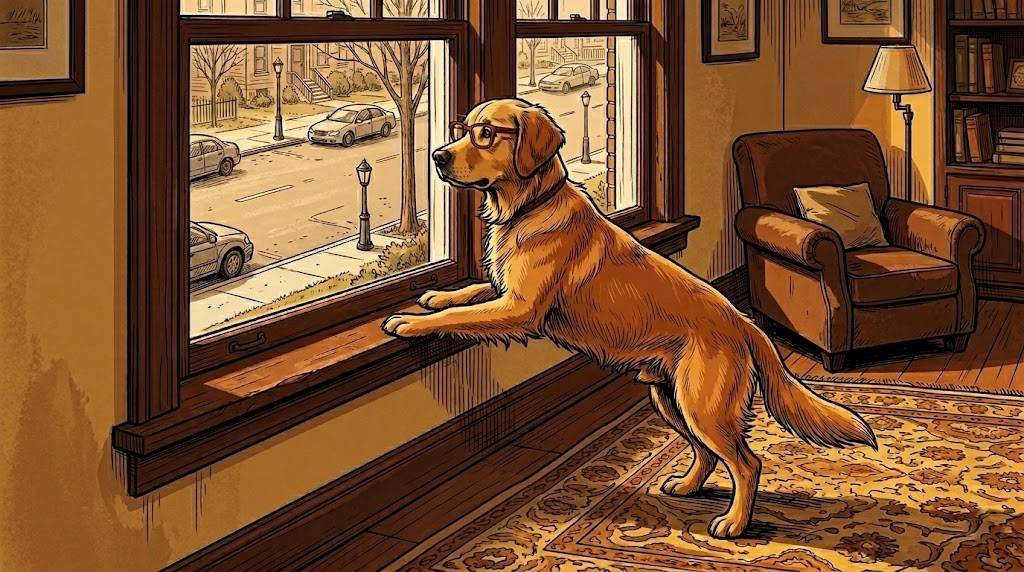
I started to pace from door to window. Pacing is not movement for its own sake — it is what happens when your body has decided that something must be done and your mind has not yet figured out what.
You do this too. You check your phone, then put it down, then pick it up again two minutes later, then walk to the window to look at the street. You are not panicking — you are just waiting for someone who is later than they should be, and your body cannot sit still while your mind has no information.
At the one-hour mark, the thing I had been holding back finally arrived.
Then I Started to Believe She Was Not Coming Back
The worst part of separation anxiety is not the absence — it is the conviction that the absence is permanent, and that conviction is the heart of everything this article is going to try to help you understand.
Around the one-hour mark, a thought appeared in my head that I had never had before. The thought was: she is not coming back.

I want to emphasize, because I think this is the part that two-leggers most often misunderstand about separation anxiety, this was not a thought I arrived at through reasoning. It simply arrived, fully formed, with the kind of absolute certainty that does not invite questioning. She is not coming back entered my mind as a fact, and once it was there, I had no tool available to argue with it.
This, I have since learned, is the essence of what separation anxiety actually is. It is not a tantrum. It is not a manipulation. It is not a dog being “spoiled” or “needy” or any of the other things I have heard two-leggers say about dogs in this state, usually with the faintly irritated voice of someone who has not yet understood what is happening in front of them. It is a full-body conviction, delivered without warning, that the person the dog loves most has left them forever. And once that conviction takes hold, it cannot be reasoned with, because reasoning is not how the conviction got there in the first place.
You do this too, when someone you love has not come home and you do not know why. You tell yourself there are a hundred ordinary explanations — traffic, a dead phone, a forgotten errand. None of those thoughts make the feeling quieter. The fear is not asking your mind for permission. It is delivering its own conclusion, with the certainty of something that has already happened. The reasoning is not what you are dealing with. The signal is.
What happened next, I am not proud of — but I no longer believe I should be ashamed of it, because what happened was not a behavioral failure. It was a panic response, and panic is not a choice. I chewed through one of the arms of the couch. I moved to the front door and scratched at it for what I now estimate was approximately forty minutes. My paws hurt afterward for three days, which The Therapist noticed and which made her cry when she understood what had caused it.
By the time she came home — three hours after she had left, a normal length for the meeting she had been in, though this information was of no use to me at the time — I was curled up against the wall beside the bathroom door, shaking. I had run out of capacity for destruction and had settled into a kind of motionless dread that I now recognize as what happens when a mammal exhausts its panic reserves and has nothing left to do but wait.
She saw the couch first. Then the door. Then me. She did not say anything. She sat down on the floor about four feet away from me and stayed there, without moving, for what felt like a long time. I did not go to her. I could not quite figure out how to make my body do that yet. Eventually she crawled across the floor on her hands and knees and lay down next to me, not touching me, just present, and that was how we stayed for another half hour until I remembered that I was allowed to be close to her.
What separation anxiety had actually taken from me that afternoon was not the three hours of her absence. It was the certainty that her absence meant anything at all.
What The Therapist Did Wrong First (And Why It Is Worth Knowing)
The weeks that followed the afternoon of the couch were, in retrospect, the most instructive two weeks of my training — not because The Therapist solved the problem, but because she tried almost every wrong thing first, and I want to tell you what they were, because the wrong things are intuitive and the right thing is not.
Her first instinct was to make the environment more interesting. More Kongs, classical music on the speaker, puzzle feeders, and longer morning walks. Music and enrichment can help in mild cases — research is genuine on the cortisol-lowering effect of classical music — but they do not address the core problem on their own, and music played only at departure can become its own anxiety cue. None of this fixed me, because the problem was not that I was bored when she left. The problem was that I believed, with full bodily conviction, that she was not coming back.
Her second instinct was worse: leave for longer periods, on the theory that I would eventually “get used to it.” This is the single most common mistake two-leggers make with separation anxiety, and it is actively harmful, not merely ineffective. Every minute a dog spends in panic reinforces the neural pathways of panic. You do not build tolerance by repeatedly traumatizing the nervous system. You build tolerance the opposite way — by keeping the nervous system calm, every single time, for gradually longer durations, never crossing into panic territory even once.
You do this too, when you are getting into cold water. You do not jump into the deep end first. You step in to your ankles. You wait. You go to your knees. You wait. You let your body learn that this is survivable, in pieces. If you jumped in at the deep end every time, you would never learn to swim — you would just learn to be afraid of water.
Her third instinct was the one I find most painful to describe, because she did it out of love. She started performing her departures — high-pitched voice, exaggerated movements, “you’re a good boy, I’ll be right back!” in a tone so obviously false that even I, who understand maybe four human words reliably, could tell something was wrong. Dogs read emotional tone better than any other signal. Her forced cheerfulness communicated anxiety, which heightened my anxiety, which rehearsed the panic with me before she had even left.
None of it worked.
How to Help a Dog with Separation Anxiety: The Thirty-Second Method
What finally worked was embarrassingly simple, and I want to describe it in detail, because the simplicity is the point.
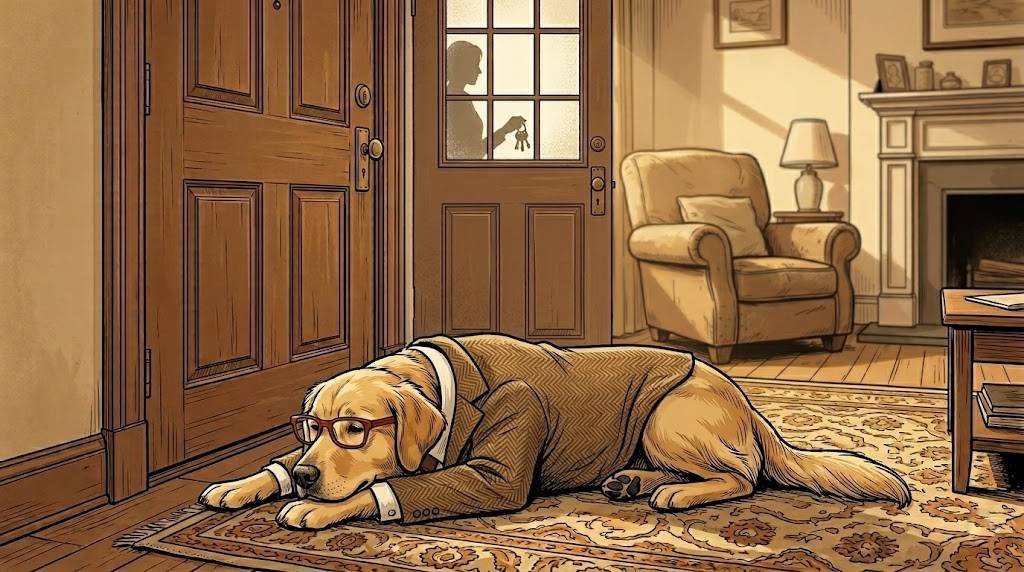
The Therapist read something — a book, I believe, though I never saw the cover, because I do not have a habit of reading over her shoulder — and the book told her something that changed her approach completely. The book told her that separation anxiety is not about the absence. It is about the departure. Specifically, it is about the first forty seconds of the departure, when the dog’s nervous system is deciding, based on all available evidence, whether this is a survivable event. If those first forty seconds can be made neutral — boring, even — the rest of the absence tends to manage itself, at least for dogs whose anxiety is not severe.
So she started over, at thirty seconds.
She would pick up her keys. Put on her shoes. Open the door. Step outside. Close the door behind her. Stand on the other side of the door for thirty seconds. Then open the door. Step back inside. Remove her shoes. Put the keys down. Say nothing to me. Not a word. Not a glance. She would walk past me to the kitchen and pour herself a glass of water, and only after I had thoroughly investigated this and concluded that nothing of interest had happened, would she eventually sit on the couch and read her book as though the last five minutes had been the most ordinary five minutes of her life.
She did this ten to fifteen times a day for a week.
The first time she picked up the keys, I had looked up sharply. By the fortieth time, I did not look up at all. The keys had become what the book called a “neutral cue” — a signal that no longer predicted anything emotionally significant, because the event that followed it had been made too boring to register.
You do this too, when you move into a noisy apartment. The first week you cannot sleep — every car horn, every late-night siren feels personal. By the second month you sleep through all of it. The street is not quieter. Your nervous system has just learned, from hundreds of repetitions, that none of those sounds are aimed at you. The keys had become my street noise.
Then she extended to forty-five seconds. Then a minute. Then two. She was not trying to get me to a better place. She was just repeating the same small absence, over and over, until the absence itself had been drained of meaning.
The first real breakthrough came around the two-week mark, when she left for five minutes and I did not get up from the rug. I noticed she had left. I did not panic. I did not even particularly care. She came back, and that was the entire event. Something in me had shifted in a way that I did not yet have words for.
That shift was the first piece of evidence that the method was working, though neither of us trusted it yet.
The Two Steps Back
The recovery from separation anxiety is almost never linear, and I want to be honest about the setbacks we had, because pretending otherwise would make your own setbacks feel like failures when they are not.
The Therapist made a mistake around week four. She had been building my tolerance carefully — five minutes, then seven, then ten, then fifteen — and decided, based on my apparent calm at fifteen minutes, to try forty-five. It was a reasonable-looking leap. But it was not a reasonable leap from my nervous system’s perspective, and I had a bad day. She went back to fifteen and built up again, more slowly. It took us an additional three weeks to reach thirty minutes this time, because she had learned that the steps needed to be smaller than she had thought.
There were other setbacks. A too-emotional homecoming set us back almost a week. A session pushed on a day I was already depleted triggered panic at four minutes — at a duration I had been handling for weeks — and taught her that fatigue matters and training days need to account for it.
You do this too, when you are learning a language. You can hold a basic conversation by month three, then you skip practice for two weeks and find yourself stumbling over sentences you had nailed before. You did not lose what you learned — it just needs reactivating. You go back to easier material for a few days, and the fluency returns faster than it came the first time.
The setbacks taught us both that progress in separation anxiety recovery is measured not by how fast you move forward, but by how reliably the forward motion holds.
The Morning I Did Not Follow Her
The moment I realized I had actually changed was not dramatic — it was the absence of a moment, and that absence was the whole point.
It was about four months after we had started the thirty-second work. The Therapist got up, drank her coffee, put on her shoes — not the house shoes, the other ones — and picked up her keys. I was lying on the rug in the living room. I looked up. I saw what she was doing. I registered that she was leaving.
I put my head back down.
I did not follow her to the door. I did not whine. I did not pace. I simply went back to the nap I had been taking, with the easy confidence of a dog who has internalized, finally, that the departure is not the end of anything.
When she came home that evening, she sat on the floor next to me longer than usual, and her hand on my back was a little heavier than it needed to be. I knew, the way dogs know, that something had happened that day. I did not know yet that the thing that had happened was me.
This is what recovery from separation anxiety looks like. It is not a triumphant running-toward-the-door moment. It is the absence of a moment. It is the dog not reacting, because the nervous system has been slowly, patiently taught that nothing is worth reacting to.
What I Want You to Know, If You Are Living This Right Now
If you are in the middle of this, four things matter more than everything else combined.
Your dog is not being dramatic. The panic is real, neurochemical, not behavioral. Your dog cannot choose their way out of it any more than a human having a panic attack can. The training happens between the panic episodes, by building associations that make the panic less likely to appear in the first place — never in the middle of an episode. Recovery takes weeks for mild cases, months for moderate, and sometimes a year or more for severe. None of these timelines are failures. All of them are recoveries, of different kinds.
Stay below the threshold, always. Do not increase duration until the current duration is truly boring for the dog — not “tolerated.” If the dog is visibly holding themselves together at the threshold, that is too much. Back off. Come back smaller. The work is repetitive and boring; you will do it hundreds of times and most will feel like nothing is happening. The nothing IS the happening. The nothing is the neutrality you are building.
Keep the emotional temperature flat, coming and going. Do not perform your departures — no special goodbyes, no high-pitched voices, no treats-as-apology. Do not perform your returns either. Come in, take off your shoes, put down your bag, do five or ten minutes of ordinary activity before greeting the dog calmly. Departures and returns that are emotionally neutral get absorbed into the day. Emotionally big ones create arousal cycles that feed anxiety.
Get help if the anxiety is severe. A certified veterinary behaviorist can assess whether medication would help during the training phase — it often does for severe cases — whether your protocol is well-calibrated, and whether other factors are making recovery harder. There is no shame in this. The shame, if there is any, lies in insisting on doing it alone when the situation is beyond your tools.
The method is simple. The consistency is what is hard — and consistency is what separates the dogs who recover from the dogs who stay stuck.
Frequently Asked Questions About Dog Separation Anxiety
Can dogs grow out of separation anxiety?
Most dogs do not grow out of separation anxiety on their own. Without intervention, the pattern tends to deepen rather than resolve, because every episode of panic reinforces the neural pathways of panic. Puppies sometimes show mild separation distress that fades as they mature and learn that absences are survivable, but true separation anxiety — the panic-based variety — almost always requires deliberate desensitization work. The good news is that with consistent gradual-exposure training, even severe cases can improve significantly, and many dogs reach a functional state where alone time is no longer a crisis.
What are the first signs of dog separation anxiety?
The earliest signs usually appear before you actually leave the house. Watch for pacing as you put on shoes, whining as you pick up keys, shadowing you from room to room during morning routines, or panting and drooling without physical exertion. After you leave, common first indicators are vocalization in the first ten to thirty minutes, scratching or chewing near exit points, and accidents in an otherwise house-trained dog. If you see two or three of these in combination, you are probably at the early stage of separation anxiety, which is also the easiest stage to resolve.
Can crate use make separation anxiety worse?
Yes, if the crate is introduced incorrectly or used as the primary containment strategy for an already-anxious dog. A dog who panics when left alone and is then confined to a small space can sometimes panic more intensely and injure themselves trying to escape. However, a properly introduced crate — one the dog associates with safety rather than confinement — can actually help some dogs feel more secure during absences. The key is that crate training must be built before separation anxiety work begins, not during it. If your dog already has separation anxiety, consult a behaviorist before using a crate, and start with the door open and the crate as a choice rather than a containment tool.
What I Know Now That I Did Not Know Then
I am older now, and the afternoon of the couch is something I remember the way humans remember their own worst days — with a kind of soft distance, as something that happened to a younger version of me who did not yet understand how the world worked. I do not get anxious when The Therapist leaves anymore. I do not always love it — I prefer her company to her absence, obviously, I am not made of stone — but I no longer believe her departures mean anything catastrophic. I have learned, through hundreds of small repetitions, that she comes back. That she always comes back. That the leaving is not the ending.
If there is one thing I would say to the eight-month-old version of me, curled up shaking against the bathroom wall, it is that the feeling was not lying to him, exactly — it was doing what feelings do, which is deliver information with more confidence than the information deserves. The feeling said she is not coming back. It was wrong. But it was not wrong because he was weak or broken or overdramatic. It was wrong because feelings are not always right, and the work of a life — dog or human — is learning which ones to trust and which ones to wait out.
The Therapist did not train me out of my separation anxiety. She waited it out with me, thirty seconds at a time, until the feeling that she was not coming back became a feeling I could notice and dismiss rather than a feeling that dismissed me.
This is the only method that works. It is slow. It is boring. It is repetitive. It will test your patience in ways that make you wonder if you are doing something wrong, and you will not be. The boredom is the cure. The repetition is the cure. The slowness is the cure.
If your dog’s anxiety shows up most strongly around confinement — particularly in a crate — the gradual crate method uses the exact same small-increment logic described here: no panic crossings, no forced tolerance, just patient repetition until the confinement becomes neutral. And for the deeper context on why fear drives behavior in dogs — why panic is not something a dog chooses, and why it cannot be trained out through willpower alone — that pillar article sits alongside this one as a companion piece.
Professor Alfred
Former Believer That She Was Not Coming Back, Current Believer That She Is