How to Handle Leash Reactivity
Hello, two-leggers.
Answer First
Leash reactivity is usually not the same as aggression. It often comes from fear, frustration, over-arousal, or feeling trapped on leash — but it still needs to be handled seriously.
The leash can make the dog feel like their normal options are gone, so barking, lunging, or spinning becomes the only strategy they know.
The method is simple in principle and slow in practice: keep your dog below the distance at which they react, pair the trigger with something good, and build tolerance in small increments. For severe cases or any dog that has made physical contact, work with a certified trainer or veterinary behaviorist before attempting home training.
Quick Diagnosis: Where Is Your Dog?
- If your dog reacts only at close range and recovers quickly → mild reactivity, often manageable with consistent home training
- If your dog reacts at moderate distance and takes several minutes to calm down → moderate reactivity, a certified trainer will help significantly
- If your dog reacts at long distance and cannot settle after → severe reactivity, professional support is not optional
- If your dog has made physical contact with another dog or person → stop here and contact a certified trainer or veterinary behaviorist before your next walk
- If your dog reacts on leash and off leash equally → off-leash behavior can give useful context, but it is not a complete test; get a professional assessment
For a fuller picture of what leash reactivity looks like and how to recognize it, see Dog Reactivity on Leash — What It Is and How to Help.
When This Needs a Professional
I want to say this clearly, before the method, before the story, before anything else.
If your dog has bitten, if the reactivity is escalating rather than staying stable, or if you have been working on this for months without any improvement — a certified dog trainer experienced in reactivity, or a veterinary behaviorist, is the right next step. Not because you have failed. Because these are complex problems and a professional can see things you cannot from inside the situation.
A veterinary behaviorist can also assess whether medication might help lower your dog’s baseline anxiety enough that training becomes possible at all. This is not a last resort. For some dogs, it is the thing that makes everything else work.
You do this too. If your back hurts for one afternoon, you stretch it out yourself. If it keeps getting worse for months, you stop guessing and call someone who knows what they are looking at. Reactivity deserves the same honesty.
If your dog is in the mild to moderate category and has never made contact, the rest of this article is for you. Keep the professional option on the table regardless.
The same gradual approach works for other anxiety-based issues too — including separation anxiety.
If you want a step-by-step written guide while you are building your plan, Patricia McConnell’s Feisty Fido is the foundational book on leash reactivity. McConnell is a certified animal behaviorist.
What’s Actually Happening
Here is the part that most owners find genuinely surprising: the leash itself is part of the problem.
A dog who is relaxed off leash but transforms when clipped in may be dealing with leash-related frustration or restraint pressure. That does not automatically make them aggressive — but it also does not mean you should ignore the risk. Off leash, a dog can approach, retreat, curve away, signal discomfort, disengage. On leash, none of those options exist. The trigger appears, the normal responses are blocked, and the only remaining strategy the dog knows is to make the trigger go away through noise and movement.
You have felt a version of this. Imagine you are in a difficult conversation, but you cannot leave the room — the door is locked, you are physically stuck. The frustration that builds in that situation, the way it escalates faster than it would if you could simply walk away — that is what the leash does to a reactive dog near a trigger. The leash does not cause the underlying sensitivity. It removes the exit.
This matters for training because it changes what you are trying to do. You are not teaching your dog to tolerate something terrifying. You are teaching your dog that the trigger predicts something good, at a distance where they can still think. Once your dog is over threshold, they cannot learn much. When they are far enough away to stay under threshold, they can.
What to Do on Your Next Walk
This is the part that matters most. Three things, in order.
1. Create distance before the explosion.
The single most important skill is seeing the trigger before your dog goes over threshold — and moving away before that happens. Not after the barking starts. Before. Cross the street, turn around, step behind a parked car. Distance is not retreat. Distance is the training environment. You cannot work below threshold if you keep walking into situations that push your dog above it.
You already do this with things that stress you out. You take a different route to avoid a difficult conversation, you leave a situation before it escalates, you step away before you lose your temper. Managing distance is not weakness — it is how regulated nervous systems work. Your dog needs you to do it for them, because they cannot do it themselves while on leash.
2. Mark calm noticing.
When your dog sees the trigger at a working distance — sees it, registers it, but has not yet gone over threshold — mark that moment and deliver something genuinely good. A word, a click, a piece of chicken. The sequence is: trigger appears → good thing happens. Repeat this across many walks and the dog’s nervous system begins to associate the previously alarming stimulus with the arrival of something worth having.
The goal is not for your dog to ignore other dogs. Ignoring is hard and produces a dog who is suppressing rather than improving. The goal is for your dog to notice the trigger and look back at you. That shift — from fixating on the trigger to checking in with you — is the sign that the association is changing.
3. Turn away before threshold, not after.
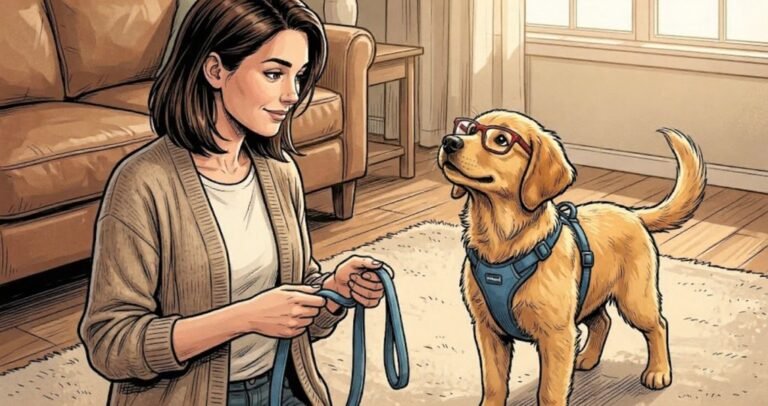
If the trigger gets too close, turn and walk in the opposite direction before your dog reacts. Not as punishment. Just: this distance is not workable, we are finding a better one. A smooth turn with a loose leash communicates calm. A panicked yank communicates that you are also alarmed, which confirms your dog’s assessment of the situation.
The loose leash matters more than most owners expect. Tension travels down the leash and tells your dog something is wrong. Every time you tighten up, you are sending a signal. Practice keeping your grip relaxed even when you are not relaxed. It takes time. It is worth it.
For a broader look at how dogs learn, Dog Training: What Actually Works and Why covers the underlying principles.
What Makes It Worse
Three things that reliably set progress back.
Tightening the leash when your dog reacts. Every instinct says to pull back. The tight leash tells your dog that you are also alarmed, that the situation is dangerous, and that there is no exit. It also holds the dog in the position producing the reaction. A loose leash in a difficult moment is one of the hardest things to learn and one of the most important.
Punishment at the moment of the trigger. A leash correction, a sharp word, anything aversive when the trigger appears teaches your dog that the appearance of the trigger produces both bad feelings and human anger. The association between trigger and bad experience deepens. Reactivity reliably worsens.
Pushing too close too soon. Bringing your dog up to the trigger and holding them there until they calm down does not produce learning. It produces shutdown — a dog who has gone emotionally offline. This approach is often called flooding. For reactive dogs, it usually makes the fear or frustration worse instead of creating calm learning.
Gerald
I want to tell you about a dog I know.
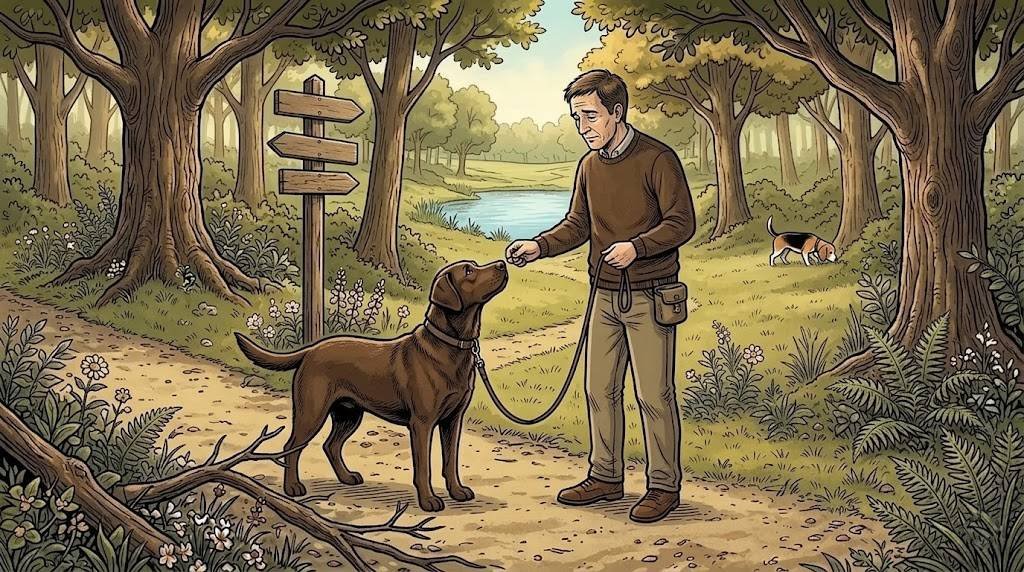
Gerald is a chocolate Labrador. His owner — a man in a brown sweater and khaki trousers — spent about a year working through moderate leash reactivity with him. I watched parts of it from across the park. The carefully managed distances. The treat pouch that was always full. The turned-around walks when something came around the corner too fast.
Six months ago, Gerald walked past another dog at ten meters and did not react. His owner handed him a piece of chicken and they kept walking.
That was the whole moment.
I spoke to Gerald afterward. He said the best thing that happened was the first time a dog walked past and he felt nothing except mild interest. He had assumed that feeling was something other dogs got to have. It turned out it was available to him too, after enough repetitions at the right distance with the right person.
You know this feeling too — the day something that used to overwhelm you becomes just a thing you notice. That is not magic. That is repetition working quietly over a long time.
The work is slow. The results are real. The dog underneath the reactivity is still there. To understand more about why dogs behave the way they do, Dog Behavior: Why Dogs Do What They Do is a good place to start.
FAQ
Can leash reactivity be cured?
Cured is the wrong word. Significantly reduced, manageable, and sometimes nearly invisible to outside observers — that is possible for many reactive dogs with consistent work. The goal is a dog who can have a normal walk and recover quickly from the occasional difficult moment.
How long does it take?
Some owners see small changes within weeks. Many cases take months. Severe cases can take longer, especially if the dog has been rehearsing the reactivity for a long time. Five short sessions a week is more effective than one long one. Setbacks are normal and are not signs of failure.
Is my dog aggressive or reactive?
Off-leash behavior can give useful context, but it is not a safe or complete test. If your dog has made contact, reacts intensely in multiple settings, or you are simply unsure — get a professional assessment. Do not rely on a single behavioral difference to rule out aggression.
What equipment helps?
A front-clip harness may help some owners manage pulling and create safer distance during training. It does not change the underlying reactivity by itself. Equipment supports the training — it does not replace it.
Should I let my dog meet other dogs to get used to them?
Not during active training. On-leash greetings are high-pressure for reactive dogs and often produce exactly the kind of over-threshold moment that sets progress back. Work at distance first. Controlled off-leash introductions can come later, when your dog is more stable.
Professor Alfred
Park Observer, Believer in the Dog Underneath