How to Stop Dog Pulling on Leash: What Actually Works
Hello, two-leggers.
Answer First
Dogs pull on leash because pulling has worked — even occasional success can make it a habit. Stop moving the moment the leash tightens. Only move again when it goes slack. Reward your dog for staying close. Do this as consistently as possible on every walk. If pulling involves lunging, barking, or panic, consult a certified trainer.
Quick Diagnosis: What Kind of Pulling Are You Actually Seeing?
- Pulls hardest at the start → excess energy and anticipation
- Leash stays tight the whole walk → no loose-leash habit yet
- Pulls toward specific things → environment is currently more rewarding than you
- Escalates into barking or lunging → emotional trigger layered on top; see leash reactivity
- Ignores food outside → the environment is winning; lower the difficulty first
What to Do on Your Next Walk
Before we discuss why this happens — which I will, at length, because I find the subject genuinely illuminating — here is what actually works, because I understand that some of you have a walk scheduled this afternoon and may not have time for the full academic treatment.
Stop the moment the leash tightens. Do not pull back. Do not redirect. Simply stop moving and wait. When the leash goes slack — even slightly — move forward again. Reward your dog for being beside you, not just for not pulling. Keep the reward immediate: the timing is the lesson.
That is the system. Everything else in this article is an explanation of why it works.
A few things that will undermine it before it has a chance: inconsistency on even one walk, moving forward while the leash is still tight, or expecting results in three days. Noticeable change takes days. Consistency takes weeks. Reliability takes longer than you expect — though it does arrive, if the system holds.
You do this too. You changed a habit not when you decided to, but when the old behavior stopped producing results completely. Not mostly. Completely.
The same principle applies here.
Start each walk calmly. A two-minute pause before leaving the house — just waiting until the initial surge of excitement passes — changes everything that follows. I found this deeply unnecessary when it was introduced into my life. I was wrong.
Act on this today: on your next walk, stop the moment the leash tightens and do not move until it goes slack. Once only. Time how long it takes. That number will shrink.
Why Pulling Works (and Why That’s the Whole Problem)
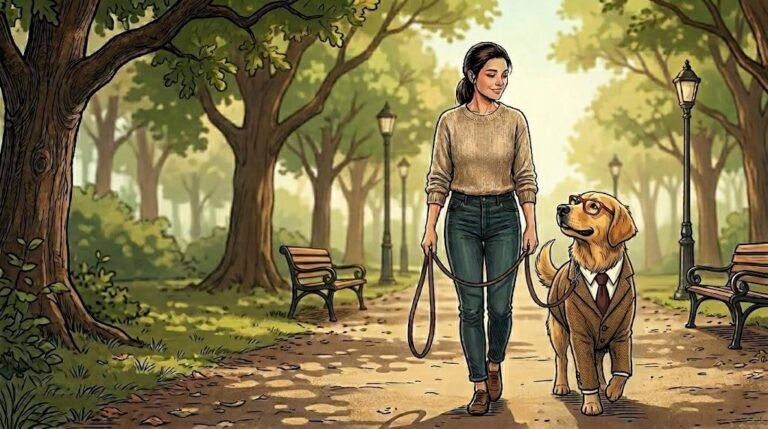
I should confess that I was, for a considerable period, quite committed to pulling — not out of stubbornness, which I will address shortly, but because it worked, which is a meaningfully different thing, though I did not appreciate the distinction at the time.
When I pulled, The Therapist moved. Not always, and not consistently, but often enough that I concluded the system was sound, which, from a behavioral standpoint, it was — occasional reinforcement is more powerful than consistent reinforcement, which explains why I maintained the habit with such confidence even as the evidence began to shift.
You do this too. You press an elevator button that has already been pressed, because on the one occasion when the doors opened immediately afterward, you incorporated that action into your routine — not consciously, not deliberately, but because the system appeared to reward it.
Pulling worked just enough to make it feel like the correct strategy. Which is precisely why it is so difficult to unlearn — and precisely why consistency, once you begin the new system, is non-negotiable.
The behavior is not the problem. The outcome the behavior produces is the problem.
The Opposition Reflex (Which I Interpreted, Briefly, as a Negotiation)
There is a biological response — well-documented, entirely involuntary — known as the opposition reflex: when pressure is applied to the body, it pushes back. Not out of defiance. Not as a decision. Simply as a response.
Which, when the management strategy involves pulling back on a pulling dog, creates a feedback loop of remarkable efficiency: I pulled, The Therapist pulled back, I pulled harder, she pulled harder, neither of us made progress, and we both, I suspect, found the experience deeply unsatisfying.
You do this too. Someone pushes your arm and you push back — not because you evaluated the situation and chose resistance, but because your body responded before you did.
This is why counter-pulling does not work. It does not address the behavior; it feeds the reflex that sustains it. The correct response to a tightening leash is no movement — not opposing movement — because the reflex requires resistance to function, and stopping eliminates the resistance entirely.
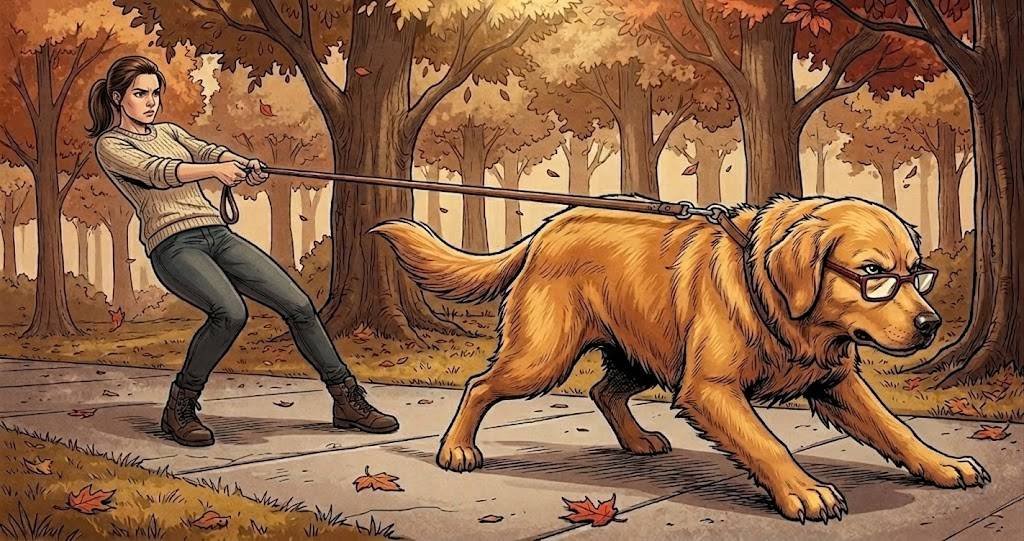
If you have been pulling back: stop pulling back. Stop moving instead. The difference matters more than it sounds.
Why Your Dog Isn’t Stubborn (Even If It Feels That Way)
The word “stubborn” implies a decision — a dog who has evaluated the situation and chosen, deliberately, to continue an inconvenient behavior despite understanding that it is inconvenient. I find this interpretation both flattering and inaccurate.
What looks like stubbornness is a dog following a system that previously worked, which is not defiance — it is consistency, applied to outdated information.
You do this too. You repeat behaviors that occasionally produce results long after they have mostly stopped working, because those occasional successes carry disproportionate weight, and because abandoning a system without a clearly superior alternative feels, from the inside, like giving up.
Dogs do not pull out of spite. They pull because the system taught them that pulling produces outcomes. Change the outcomes consistently, and the system updates — not immediately, not without resistance, but it does update.
The training mistakes that sustain this are almost always on the human side: one exception, one moment of moving forward while the leash is tight, one walk where the rules didn’t apply. That is enough to reset the expectation.
Your dog is not testing you. Your dog is reading you. Make sure the information you’re giving is consistent.
The Start of the Walk (Where Most Systems Collapse)
The beginning of a walk is the hardest moment — not because dogs are at their worst, but because the transition from stillness to stimulation creates a surge of energy that is difficult to manage before it has partially resolved itself.
You do this too. After sitting at a desk for three hours, you do not gradually accelerate into activity — you stand up too fast, move too quickly, and require a moment before your body settles. Dogs compress that experience into the first thirty seconds of every walk.
The practical adjustment is a pause before movement begins. Not a long one. Two minutes of waiting by the door — or at the end of the driveway — until the initial excitement passes. The walk begins when the dog is settled, not when the door opens.
A calm start changes what the rest of the walk is capable of being. I found this intervention unnecessary when it was first introduced. Then I found it obvious. Then I stopped noticing it, because it had become simply how walks begin.
If the walk starts calm, it has a chance to stay calm. If it starts at a sprint, you are managing the energy the entire time.
Tools: What They Do and What They Don’t
At some point, a front-clip harness was introduced into my life. I initially considered it unnecessary interference. I later reconsidered, somewhat reluctantly, because it changed the mechanics of pulling in a way that made my previous approach less effective — not through punishment, but through physics.
A front-clip harness can help redirect some dogs’ forward force rather than allowing it to translate cleanly into forward movement. This does not teach loose-leash walking. What it does is reduce the mechanical advantage of pulling, which makes the stop-and-wait system easier to apply consistently, particularly in the early stages.
Gear does not train the dog. Gear helps the human manage timing, safety, and consistency while training happens.
You do this too. You choose tools that support behavior — an environment that makes concentration easier, a structure that makes consistency more likely — without claiming that the tool is responsible for the result.
The harness was useful. The training was the point.
If you use gear to manage pulling, remember this: a harness can support training, but it does not replace the stop-and-wait system.
What Not to Do
I explored most of these approaches personally, which qualifies me to report on their effectiveness with some authority.
Maintaining constant leash tension does not communicate direction. It sustains the opposition reflex and makes the dog less responsive to leash signals, not more. The leash should be information, not pressure.
Allowing one exception — moving forward just once while the leash is tight — resets the dog’s expectation that the rule is consistent. From the dog’s perspective, the system has not changed. The previous behavior is still viable.
Repeating commands while pulling continues does not increase compliance. It teaches the dog that commands precede movement regardless of behavior, which removes the command’s function entirely.
Pulling back harder does not resolve pulling. It feeds it.
The common thread: none of these approaches change the outcome the behavior produces. They add noise to the system without changing the system itself.
If something you are doing is not working after two weeks of consistency, the question is not “should I try harder” — it is “what in the system is still reinforcing the pull.”
When to Get Help
If pulling is accompanied by lunging, barking, growling, or an inability to process the environment at all — even in low-distraction settings — the issue is no longer loose-leash training. It is a more complex behavioral pattern that requires professional assessment.
You do this too. When a problem consistently exceeds what self-directed effort can address, you consult someone whose job is that specific problem.
A certified dog trainer or veterinary behaviorist is the appropriate next step. This is not an escalation. It is an accurate read of what the situation requires.
FAQ
How long does it take to stop leash pulling?
Some dogs show early improvement within a couple of weeks. Reliable loose-leash walking often takes longer — especially if pulling has been rehearsed for months or years. Consistency is the variable that matters most.
Is a harness enough to stop pulling?
No. A front-clip harness reduces the mechanical advantage of pulling, which makes training easier to apply. It does not replace training. A dog in a front-clip harness without consistent stop-and-wait practice will still pull — just less efficiently.
Should I stop walking when my dog pulls?
Yes, immediately. The stop should happen the moment the leash tightens — not after a warning, not after a command. The timing is the lesson. Movement resumes only when the leash goes slack.
Why does my dog only pull at the start of walks?
Accumulated energy and anticipation peak at the transition from stillness to movement. A short pause before the walk begins — two minutes of calm before moving — reduces the surge significantly.
When should I get professional help?
When pulling involves lunging, barking, growling, or panic. When the dog cannot focus in any environment, including low-distraction ones. When two to three weeks of consistent training produces no change. A certified trainer can assess whether the issue is loose-leash training or something that requires a different approach entirely.
Closing
I once believed the leash was a negotiation — a continuous exchange of pressure in which persistence determined the outcome. I was consistent in this belief. I was also wrong, which I discovered not through argument but through outcomes: pulling stopped producing movement, and something else did.
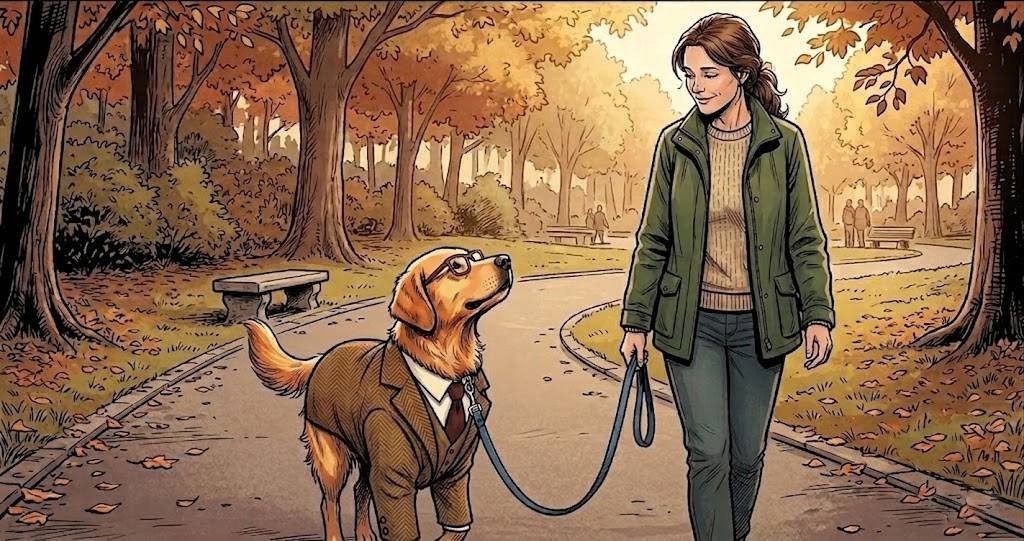
The leash is not about force. It is about feedback — specifically, which behaviors produce results and which do not. If you want to understand more about how dogs learn from outcomes, dog behavior goes deeper. Once that changed, consistently and without exception, my behavior changed with it.
Reluctantly at first. Then less so. Then simply: differently.
Professor Alfred
Reformed Leash-Puller (Mostly)