Leash Training a Puppy: Start Indoors First
Hello, two-leggers.
Answer First
Most people make one critical mistake: they put a harness on their puppy and immediately head outside. This fails because puppies cannot learn leash skills while processing outdoor distractions. Start indoors with a front-clip harness, practice loose-leash walking in short 5-minute sessions, reward calm behavior immediately, and only progress outdoors once your puppy walks calmly inside. Expect 2-4 weeks of indoor foundation work before outdoor walks become manageable. Start indoors, use a short leash, reward calm walking, and only move outside once your puppy understands the pattern.
Now let me tell you HOW I know this — because The Therapist made every possible mistake with me before figuring out the order that actually works.
The First Leash
I was four months old — old enough to need real walks but young enough that the world was ENORMOUSLY INTERESTING and also SOMEWHAT TERRIFYING in approximately equal measure.
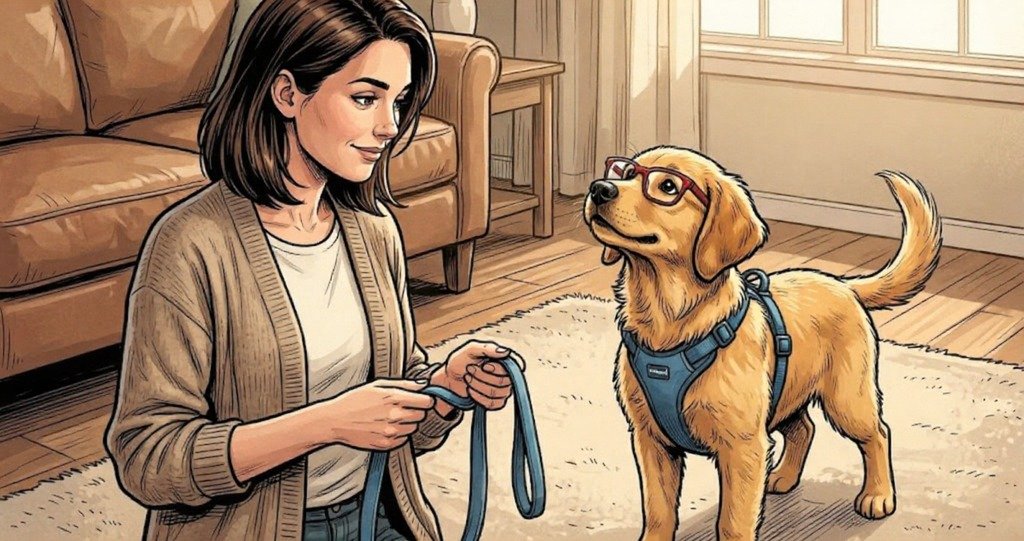
The Therapist had purchased what I now recognize as a perfectly adequate puppy harness — blue, soft, with adjustable straps that didn’t rub even when I moved unpredictably (which, at four months old, was constantly). She’d done her research on that part.
What she had not researched — or if she had, she’d skipped the specific chapter titled “Do Not Do This” — was the order of operations.
She put the harness on me, clipped the leash to the front ring (which I didn’t yet understand the significance of), and opened the front door with what I can only describe as optimistic confidence that this would go smoothly.
We stepped outside together for my first official walk, and I immediately understood three things simultaneously: (1) there were BIRDS, (2) there was a SMELL I had never encountered before coming from the neighbor’s garden, and (3) something was attached to my body preventing me from investigating either of these critically important phenomena.
I froze — not out of defiance, but out of complete sensory overload.
The Therapist walked forward, the leash went taut between us, and I sat down with the kind of determination that only a confused puppy can muster.
She stopped, looked back at me with obvious confusion, and I looked up at her with what I’m certain was a very reasonable expression that said I cannot move while this situation remains unresolved.
“Come on, Alfred. Let’s go.”
I sat more firmly.
This continued for approximately seven minutes — her pulling gently forward, me sitting more determinedly backward — until she picked me up, carried me back inside, and we both sat on the floor looking at each other with mutual bewilderment.
Neither of us understood what had gone wrong. She thought I was being stubborn. I thought the leash was a deeply confusing restraint that had appeared without warning in an already overwhelming situation.
We were both wrong. The problem was simpler: I had never learned to walk on a leash, and she’d started the lesson on expert difficulty.
Quick Diagnosis: Why Isn’t Your Puppy Leash Training Working?
- If your puppy freezes and refuses to move → overwhelmed by outdoor distractions, skipped indoor foundation
- If your puppy pulls constantly in every direction → hasn’t learned that loose leash = forward movement
- If your puppy bites or attacks the leash → sees it as a toy, not a walking tool
- If your puppy walks fine some days, terrible others → inconsistent training or varying distraction levels
- If your puppy only walks when treats are visible → over-reliance on luring, hasn’t generalized the behavior
The pattern matters. Most problems trace back to starting outdoors before establishing the foundation indoors.
When to Start Leash Training a Puppy
Start leash training as soon as your puppy comes home — usually around 8-10 weeks old. This is earlier than most people expect, but it’s the ideal window.
You don’t need to wait for vaccinations to finish before you begin. The early stages happen entirely indoors where disease risk doesn’t exist. By the time your puppy completes their vaccination series (usually around 16 weeks of age), they’ll already understand what a leash is and how to walk calmly while wearing one.
Starting early means your puppy learns that wearing a harness and leash is normal before they develop strong opinions about it. An 8-week-old puppy accepts new equipment as part of life. A 6-month-old puppy who’s never worn a harness may resist or panic because it’s unfamiliar.
The Therapist started with me at four months, which worked fine but meant we compressed the timeline. Earlier is easier — younger puppies adapt to new equipment faster and have fewer ingrained pulling habits to undo.
The key is matching your expectations to your puppy’s age. An 8-week-old puppy wearing a harness for five minutes while you walk around the kitchen is appropriate training. Expecting that same puppy to walk calmly past other dogs on a busy street is not.
Start early. Start simple. Build complexity gradually as your puppy matures and gains confidence. Most puppies can begin leash training as early as 8 weeks old, as long as the environment is controlled and low-pressure.
Why Start Leash Training Indoors
Here’s what The Therapist figured out after our failed first walk: the leash isn’t the hard part of learning how to leash train a puppy. The outdoor distractions are the hard part.
When you clip a leash on a puppy and immediately go outside, you’re asking them to learn several completely unrelated skills simultaneously:
- What this strange strap attached to my body is
- How to walk calmly when the world is FULL OF THINGS
- That pulling doesn’t work (which contradicts the opposition reflex I was born with)
- That staying near the human is more valuable than investigating that smell
- That I can’t greet every dog I see even though I desperately want to
This is like learning to drive stick shift in rush hour traffic during a thunderstorm. Technically possible. Extremely inadvisable.
The Therapist’s mistake — and it’s the mistake most people make when they try to train a puppy to walk on leash — was assuming that the leash was the variable to introduce. The leash is actually the easiest variable. It’s the outdoors that’s impossible.
You do this too, actually. Have you ever tried to learn a new skill while simultaneously managing something stressful? Attempted to follow a new recipe while hosting dinner guests, or tried to learn new software during a deadline crisis? You can’t focus on the learning when you’re already managing ten other things. Your brain can’t process new information while it’s busy preventing disaster.
That’s your puppy on their first outdoor walk. The learning can’t happen because the brain is fully occupied with BIRDS and SMELLS and THAT PERSON HAS A DOG and also what is this strap attached to me and why can’t I chase the squirrel.
Indoors, there are no squirrels. There are no other dogs. There is just you, your puppy, a leash, and enough space to practice the single skill you’re actually trying to teach: walking calmly while wearing this equipment.
The Therapist figured this out on day three, after two more failed outdoor attempts. She brought me back inside, put the harness on me, clipped the leash, and we walked around the living room.
I was, I will admit, significantly less dramatic about the whole experience when there weren’t seventeen simultaneous distractions.
How to Leash Train a Puppy: Step-by-Step Indoor Foundation
The indoor phase has three stages, and skipping any of them creates problems later. I know because The Therapist tried to skip stage one and I staged a small rebellion.
Stage One: Get Your Puppy Comfortable With the Equipment
Before your puppy walks anywhere on a leash, they need to understand that the harness and leash are normal, non-threatening objects that sometimes appear on their body.
The Therapist’s approach (after her initial mistakes): she put my harness on me during completely neutral moments. Not right before a walk. Not when she was excited and saying “let’s go!” in the specific tone that makes everything more intense. Just — harness on, continue normal life.
I wore it while she made coffee, while I ate breakfast, while we sat on the sofa and she read her book — the harness became so thoroughly boring that I stopped noticing it entirely, which was exactly the goal.
Then she added the leash, clipped it on, and let me drag it around while I investigated a toy — the leash was just there, not pulling me anywhere, not preventing anything, just existing as part of my temporary reality.
You do this when you’re breaking in new shoes, don’t you? You don’t wear them for the first time on a day you’re walking five miles. You wear them around the house for twenty minutes while you’re making dinner. You let your feet adjust to the sensation before adding the complication of distance and purpose.
That’s stage one. Equipment becomes unremarkable.
Stage Two: Practice Loose-Leash Walking Indoors
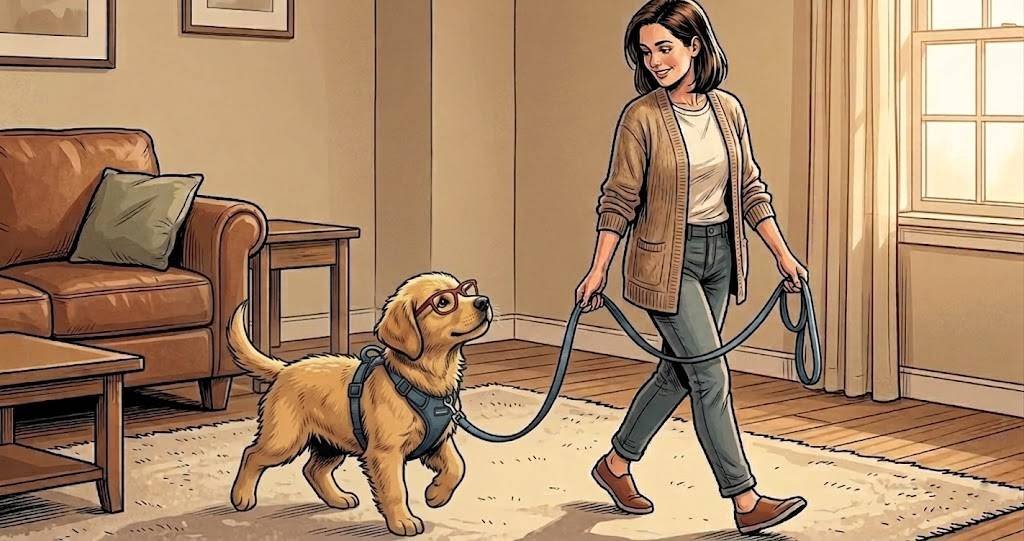
Once I was thoroughly bored by wearing the harness and leash — this took about three days of intermittent wearing — The Therapist started actually walking.
She stood up, held the leash loosely in her hand, and took a few steps across the living room.
I followed her — not because I understood leash walking, but because I’m a puppy and The Therapist moving away from me triggered my deeply ingrained “don’t get left behind” instinct.
She stopped, I stopped, she praised me warmly, and gave me a small, soft treat that I swallowed before fully processing what had just happened.
We walked three more steps, stopped again, and the pattern repeated — praise, treat, forward movement rewarded.
That was the entire first session. Maybe five minutes total. We walked approximately fifteen feet cumulative.
But those fifteen feet established something critical: walking near The Therapist while wearing this equipment produces good things. The leash isn’t a restraint. It’s a predictor of treats and praise. This is the foundation of puppy leash training — not the walk itself, but the pattern your puppy learns before the walk even begins.
The key — and The Therapist learned this through trial and error — is keeping sessions very short and keeping the leash loose. If she held it tight, I’d pull against it (opposition reflex). If she let it drape casually and just rewarded me for staying near her, I learned that staying near her was the behavior that worked.
This is the indoor foundation most people skip. They clip the leash, immediately go outside, and then wonder why their puppy doesn’t understand what’s expected. The puppy can’t learn what loose-leash walking means if they’ve never practiced it in an environment where learning is actually possible.
Stage Three: Adding Mild Distractions Indoors
After I could walk around the living room reliably — loose leash, staying relatively close to The Therapist, not treating the leash like a chew toy — she started making it slightly harder.
She’d place a toy on the floor. We’d walk past it. If I stayed focused on her instead of lunging toward the toy, I got praised and rewarded.
She’d walk into the kitchen, where my food bowl lives. We’d walk past it. Staying calm earned treats.
She had a friend come over and sit on the sofa. We practiced walking past the friend without me trying to investigate.
These were baby-level distractions compared to the outdoor world. But they taught me that I could walk calmly on leash even when something mildly interesting was happening nearby. The foundation was: distractions exist, walking calmly anyway gets rewarded.
You build tolerance this way in other contexts too. You don’t teach a child to focus by dropping them into the loudest, most chaotic environment immediately. You start with manageable challenges and gradually increase difficulty. That’s your puppy learning impulse control — one small distraction at a time.
Choosing the Right Equipment for Puppy Leash Training
The Therapist tried three different harnesses before finding one that worked properly for me. This is worth discussing because equipment matters more than most people realize when learning how to leash train a puppy.
Harnesses vs. Collars
Puppies should not be walked on collars. Period. Pulling on a collar puts pressure directly on the trachea, and puppies pull constantly while learning. Front-clip harnesses distribute pressure across the chest and reduce pulling by redirecting the puppy’s forward momentum slightly to the side.
The Therapist started with a back-clip harness — the kind where the leash attaches between the shoulder blades. I could pull just as hard as I wanted without any natural consequence discouraging it. This is fine for a trained dog who already knows how to walk calmly, but for a puppy actively learning not to pull, it’s teaching the wrong lesson.
She switched to a front-clip design — one of those contraptions where the leash attaches at your chest instead of your back, which sounds simple until you realize it completely changes the physics of pulling. The Therapist, in her infinite wisdom (which I occasionally acknowledge), settled on something like the Ruffwear Front Range after trying what I can only describe as an exhaustive survey of puppy harness options. There were others — the PetSafe Easy Walk, the Kurgo Tru-Fit, various padded versions designed for dogs who believe they are pulling sleds across Alaska (I was briefly one of them). The common thread was the front-clip mechanism, which meant that when I pulled forward, the harness gently redirected me to the side rather than letting me forge ahead like a tiny golden locomotive.
I learned, eventually and with some protest, that pulling didn’t move me toward the thing I wanted — it just turned me sideways, which was deeply unsatisfying.
Leash Length and Material
Standard six-foot leash. Not retractable.
Retractable leashes actively teach pulling — the puppy learns that pulling extends the leash and gives them more freedom. This is the opposite of what you’re trying to teach. You want the puppy to learn that a loose leash equals freedom to keep walking, and a tight leash equals stopping.
The Therapist used a lightweight nylon leash with a comfortable handle. Nothing fancy. The leash itself is just a connector — it doesn’t do the training. Your consistency does the training.
Training Treats and Treat Pouches
High-value, soft, small treats. The kind you can deliver quickly without the puppy needing to stop and chew for thirty seconds.
The Therapist used a treat pouch — one of those small zippered bags that clips to your belt and makes you look vaguely prepared for outdoor adventure even when you’re just walking around your living room. She tried several before finding one that didn’t spill treats every time she bent down (the Doggone Good Rapid Rewards pouch worked, as did the PetSafe Treat Pouch Sport, though I’m told there are dozens of variations on this theme, all functionally identical except for the number of pockets and the likelihood of treating your leg like a mobile snack dispenser).
The pouch itself mattered less than what it enabled: immediate reward. The gap between good behavior and treat should be under two seconds when possible. If you’re trying to reward a puppy for calm walking but you spend fifteen seconds digging through your jacket for the treat, the puppy has already forgotten what they were being rewarded for. They’ll associate the treat with whatever they were doing in the moment they received it, which might be jumping up at your hand or pulling toward the treat pouch itself.
Think about this like you would any skill feedback. If you did something well at work and your manager said “great job” three days later, you wouldn’t connect the praise to the specific action. Immediate feedback works. Delayed feedback confuses.
Moving to Outdoor Walks
After approximately two weeks of indoor practice — daily short sessions, gradually increasing distractions, solid foundation established — The Therapist decided we were ready to try outside again.
She did not repeat her earlier mistake of starting with a full neighborhood walk.
We walked to the end of the driveway, stopped, turned around, and walked back inside — that was the entire first outdoor session.
The next day, we walked to the end of the driveway plus five additional steps down the sidewalk before turning back, which felt like significant progress until I realized we were still closer to home than to anywhere interesting.
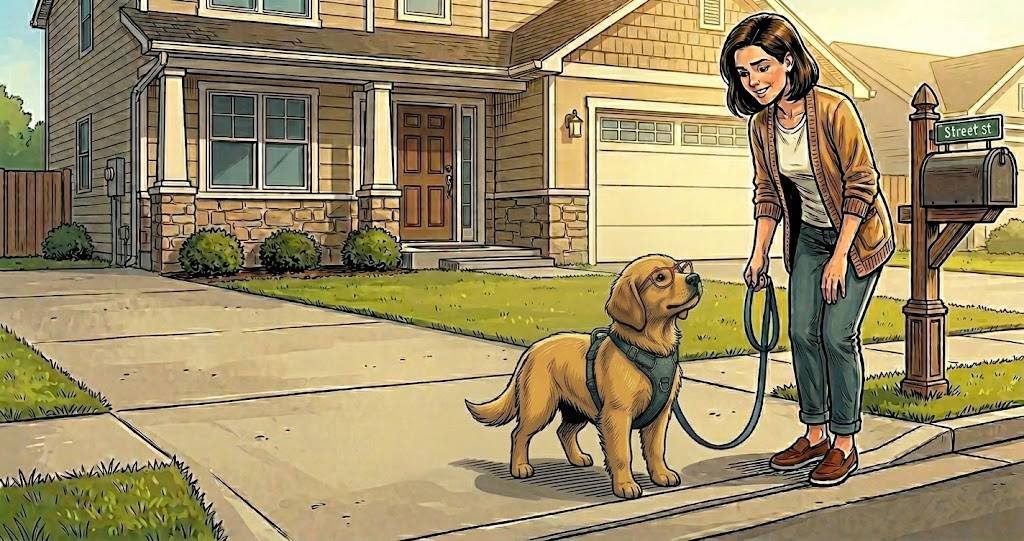
By day three, we’d made it to the corner of our house, which introduced the novel complication of the neighbor’s rosebush (very interesting, not allowed to investigate), and then back inside again.
We gradually extended distance while keeping expectations realistic. If I encountered something that overwhelmed me — a sudden loud noise, an unleashed dog appearing unexpectedly, a garbage truck — The Therapist would give me distance, let me observe from safety, and reward me for not panicking rather than forcing me to “get over it.”
This gradual approach worked because I already understood the foundational concept: loose leash walking gets rewarded. I’d practiced it in a low-distraction environment until it was automatic. Adding outdoor distractions didn’t erase the foundation — it just made me work harder to maintain the behavior I’d already learned.
The alternative — throwing me outside with no preparation and expecting me to figure out leash walking while simultaneously processing the entire world — would have taken significantly longer and involved significantly more frustration for both of us.
Common Leash Training Problems and Solutions
Most leash training problems don’t start outside — they simply become visible there.
Leash Biting
Puppies who constantly bite or attack the leash during walks usually haven’t learned that the leash isn’t a toy. This often happens when people try to correct pulling by jerking the leash, which makes it move unpredictably and triggers the puppy’s chase/bite instinct.
The Therapist dealt with this by immediately stopping and standing still when I bit the leash. No pulling back, no verbal correction, just — stop. Biting the leash made all forward progress cease. After a few seconds, she’d invite me to walk again. I learned that leash-biting ended the walk, and walking calmly continued it.
Freezing and Refusing to Move
This was my signature move on walk one. Freezing usually means the puppy is overwhelmed or uncertain. Pulling them forward doesn’t help — it just confirms that the leash is a scary thing that forces them into uncomfortable situations.
The solution is reducing distractions (go back indoors or to a quieter space), building confidence with treats and praise for any forward movement, and giving the puppy time to process. I needed time to understand that moving forward was safe before I could actually do it reliably.
Constant Pulling in Every Direction
The puppy hasn’t yet learned that pulling doesn’t work. This is normal and expected — it’s not defiance or dominance or bad behavior. It’s a puppy using the one strategy that makes intuitive sense : if I want to go there, I pull toward there.
The Therapist’s approach: stop walking the moment the leash went tight. Stand completely still. Wait. The moment I moved back toward her or the leash loosened even slightly, we’d start walking again.
I learned, eventually, that pulling created a full stop and walking calmly created forward progress. This took weeks of absolute consistency. Every single time the leash went tight, forward movement stopped. No exceptions.
You’ve probably used a similar principle when training yourself out of a habit. If you’re trying to stop checking your phone during meals, you create a rule: phone out = meal pauses. The behavior (checking phone) produces an immediate undesirable consequence (pause), and eventually your brain connects the two and the urge to check your phone during meals decreases. That’s your puppy learning that pulling ends the walk.
How Long Does Puppy Leash Training Take?
The realistic timeline: 2-4 weeks of daily indoor practice before your puppy is ready for outdoor walks, then another 2-3 months of consistent outdoor practice before loose-leash walking becomes reliable.
This varies based on:
Your puppy’s age — Younger puppies (8-12 weeks) adapt faster but have shorter attention spans. Older puppies (4-6 months) may have more focus but might have already learned bad habits.
Consistency — Daily 5-10 minute sessions work better than occasional 30-minute sessions. The Therapist and I practiced every single day, which compressed our timeline. Friends who trained their puppies only 2-3 times per week took significantly longer.
Your puppy’s temperament — Some puppies are naturally calmer and more focused. Others (like me) are ENORMOUSLY INTERESTED IN EVERYTHING and require more repetition before the lesson sticks.
Distraction level — A puppy learning in a quiet suburban neighborhood will progress faster than one training in a busy city environment with constant stimuli.
The Therapist told me later that she’d expected me to “get it” in a week. The reality was closer to six weeks before I could walk reliably without constant pulling. This is normal. Puppy leash training is a gradual process, not an overnight transformation.
Progress looks like: fewer corrections needed per walk, longer stretches of loose-leash walking, faster recovery when distractions appear, and the puppy checking in with you voluntarily instead of needing constant reminders.
Trust the process. The indoor foundation feels slow but it’s the work that makes everything else possible.
What The Therapist Wishes She’d Known Earlier
She told me this several months into our leash training journey, during a particularly successful walk where I’d barely pulled at all: “I wish I’d known that starting indoors wasn’t skipping a step. I thought I was postponing the real training. I didn’t understand that the indoor work was the real training.”
The outdoor walks aren’t where learning happens. The outdoor walks are where you test what’s already been learned in a more challenging environment.
If you try to do both simultaneously — teach the skill and test it in the hardest possible conditions — you’re setting up a situation where failure is likely and frustration is guaranteed.
The indoor foundation takes maybe two weeks of short, daily sessions. The outdoor work takes months of consistency. But those two weeks make the months significantly easier.
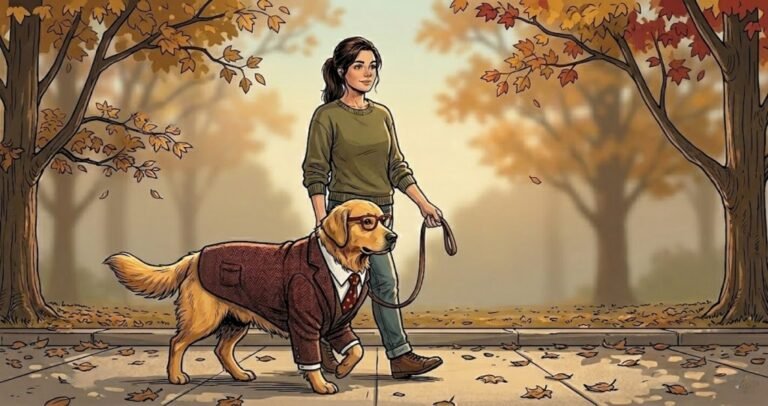
I’m proof of this. I’m now — several years later — a dog who walks calmly on a loose leash in most situations. Not perfect. I still have opinions about squirrels and certain other dogs. But I understand the basic contract: loose leash equals forward progress, tight leash equals stop.
The Therapist and I both learned this together. She learned that training works better when you understand how dogs actually learn. I learned that walking near her while wearing equipment is not a trap or a punishment but a cooperative activity that gets us both where we want to go.
Different lessons, same walks.
Professor Alfred
Mostly Reformed Leash-Puller, Indoor Training Graduate