
Is Crate Training Cruel? What Your Puppy Actually Experiences
Hello, two-leggers.
Answer First
Crate training works because dogs are descended from den-dwelling animals who naturally seek enclosed spaces for rest and safety, but puppies don’t arrive pre-programmed with this knowledge and must learn through gradual positive association rather than forced confinement. Most puppies accept the crate within two to four weeks when introduced properly, though some take six to eight weeks before actively choosing it as their preferred resting spot. The foundation is non-negotiable: make the crate appealing before any door closes, build duration in increments your puppy can actually handle, and respect bladder limits absolutely. If your puppy cries for more than twenty consecutive minutes or shows signs of genuine panic—drooling, frantic escape attempts, hurting themselves—this may indicate rather than normal adjustment.
Now let me tell you HOW I know all this, which involves approximately three days of my life I would prefer to forget, except that forgetting them would mean losing the instructive value of my own magnificent stupidity, which would be a shame because I am told—by me, mostly—that my stupidity has produced some of the finest educational material in modern dog literature.
The Three-Day Standoff (Or: How I Turned a Perfectly Reasonable Training Exercise Into an International Incident)
Picture, if you will, a four-month-old golden retriever of exceptional intellect and mediocre impulse control—that’s me, obviously, though I feel compelled to mention that the intellect part was already evident by this age, even if certain specific behaviors I’m about to describe might suggest otherwise to the untrained observer—encountering for the first time what appeared to be a METAL CAGE being assembled in the middle of the living room.

Let me be clear about what I saw. The Therapist brought home a wire crate one Tuesday afternoon, and I watched her assemble it on the floor of my primary territory (the living room, where I conducted most of my official business, which at four months consisted largely of chewing things and napping in sunbeams), and my immediate and entirely reasonable conclusion was that she had finally snapped. The woman had decided to imprison me. Why? Unclear. Had I done something? I had done many things. But THIS? This was escalation.
She tried treats first. She sat cross-legged on the floor—which she almost never does, so I knew something was deeply wrong—and held out a small piece of chicken, cooing at me in the voice she uses when she wants me to do something I absolutely do not want to do. I approached cautiously. I took the chicken from her hand. I did NOT enter the cage.
This routine continued for three days.
Three full days, two-leggers. I would like you to sit with that timeframe for a moment. Seventy-two hours of a perfectly intelligent dog refusing to walk through an open metal doorway because he had decided, with the full force of his developing reasoning capacity, that this was a prison and that entering it voluntarily would be tantamount to signing his own confession. The Therapist, for her part, sat beside the crate pretending to read a book (I could tell she was pretending because she turned the page exactly once every fifteen minutes, like clockwork, and real reading does not work that way), while I barked at the crate from a safe distance of approximately six feet, occasionally approaching to sniff it, then retreating, then barking again, in a rhythm I found tactically brilliant at the time and which I now recognize as the canine equivalent of yelling at a piece of furniture.
On day four, she changed tactics. She placed a tennis ball in the back corner of the crate.
Reader, I would like to report that I saw through this ploy. I would like to report that my keen analytical mind immediately recognized this as an obvious manipulation designed to exploit my well-documented ball obsession. I would like to report many things. But the simple truth is that I saw the tennis ball, and everything I had learned over the previous three days about this structure being a prison evaporated instantly, and I walked directly into the crate to retrieve it.
She closed the door behind me.
I LOST MY MIND.
I barked, I pawed, I whined. I performed what I now recognize was an absolutely Oscar-worthy impression of a dog being tortured in a medieval dungeon. The Therapist sat beside the crate, perfectly calm, and waited. Ninety seconds, she told me later, though at the time it felt like approximately seventeen years of unrelenting incarceration. Then she opened the door. I bolted out. She gave me a treat.
And here’s the part that confused me for a full week: I thought she was rewarding me for having a complete meltdown.
I thought she was saying, “Good job, Alfred, you survived imprisonment with appropriate dramatic protest, here is your reward for enduring this trauma.” So the next time, I produced an even more dramatic protest, because clearly this was the behavior being reinforced. And she waited even longer. And she only opened the door during the brief moments when I paused for breath. It would take me approximately seven days—and hundreds of repetitions—before I realized she had never once been rewarding my meltdown. She had been rewarding the two-second pauses. The moments of accidental calm between my operatic protests. The silences I didn’t even know I was producing.
This realization, when it finally arrived, was humbling. Do you ever have that experience where you finally understand what someone has been trying to communicate for a week and realize you’ve been completely wrong about the entire situation? This was that, but with chicken.
Quick Diagnosis: Which Crate Training Challenge Does Your Puppy Have?
Before I launch into the full instructional material—and I promise I will, eventually, though you should know by now that with me “eventually” covers a broad range of timeframes—let me help you identify what specifically is going wrong in your own household, because the solution depends entirely on the problem:
- Your puppy refuses to enter the crate at all → The positive associations haven’t been built yet, and the crate feels like a threat rather than a resource
- Your puppy enters willingly but panics the moment the door closes → You’ve progressed faster than the emotional foundation can support, and the door itself has become the trigger
- Your puppy cries at night specifically → Either bladder capacity is being exceeded, or proximity anxiety is the real issue, or both, which is extremely common
- Your puppy only accepts the crate during meals but not otherwise → The food association is working but duration hasn’t been built independent of eating
- Your puppy destroys bedding, toys, or tries to chew their way out → This is usually boredom, excess energy, or unsafe materials combined with insufficient supervision during early sessions
Find yours? Good. Now let’s address each one properly, starting with the most common—and the one I personally failed at most spectacularly.
Why Your Puppy Refuses to Go Into the Crate (And What to Do Instead)
If your puppy is staging their own three-day standoff, the problem is almost certainly that you’ve asked them to trust something they have no reason to trust yet, and you’ve asked too quickly.
This is what The Therapist eventually figured out after my initial disaster, though it took her about a week of increasingly creative treat-bribery schemes before she admitted that her entire approach was backward—and I want to pause here to note that her admitting she was wrong was, for me, one of the great spiritual events of my early life, because The Therapist almost never admits she’s wrong, she’s a THERAPIST, she’s professionally obligated to remain neutral about whether anyone is wrong about anything, so watching her sigh heavily and mutter “okay, new plan” while carrying the crate back into the living room was, frankly, nourishing.
Her new plan was radical in its simplicity — and I should mention she did not invent it herself, she found it in a book about positive crate training she had ordered in desperation. She removed the door entirely. She unscrewed it from the hinges, carried it to the garage, and left the crate standing open in the living room like it was furniture. Then she scattered what I can only describe as an offensive quantity of high-value treats inside—bits of cheese, small pieces of chicken, a few chunks of cooked liver that smelled so good I could barely think about anything else—and she added my favorite blanket, the soft fleecy one I had been sleeping on since I was eight weeks old and which smelled overwhelmingly of me and home and safety. Then she walked away. She did not coax. She did not hover. She did not make eye contact. She simply went about her day and let me discover, on my own timeline, that the crate was now the single most interesting location in the house.
I entered within twenty minutes.
You do this too, you know. Think about how you build new habits—genuinely good ones, the ones that stick. You don’t force yourself into a miserable routine on day one and expect to maintain it through willpower alone (well, you might try, but you fail, and then you blame yourself, which is the very human habit of punishing yourself for not being a different kind of person). The habits that actually stick are the ones where you make the space comfortable first, pair it with something enjoyable, and let the association build gradually. You put your running shoes by the door. You stock the kitchen with foods you actually like eating. You make the environment do the work so your willpower doesn’t have to. That’s what The Therapist did for me. She made the crate into a place I wanted to be, and then she let me choose it. The training hadn’t even started yet, technically—this was just the foundation. But the foundation was the whole thing, as it turned out.
For two days I went in and out freely, finding treats, lying on my blanket, napping in what had previously been my prison and was now, inexplicably, becoming my favorite spot in the house. That’s when she reattached the door, and the next phase began.
Why Your Dog Is Crying in the Crate (And What It Actually Means)
If your puppy is crying in the crate, the first thing you need to understand is that crying is communication—not defiance, not manipulation, not an attempt to ruin your evening—and different types of crying mean genuinely different things.
I learned to identify three distinct categories during my own training, and The Therapist learned to distinguish them too, which was essential because her response depended entirely on which one was happening. The first type was the urgent, escalating, “I need to pee RIGHT NOW and if you don’t let me out I will shame us both” cry—this one started quietly, built rapidly in volume and desperation, and had a physical quality to it, a kind of rising panic that was unmistakable once you knew what to listen for. The second type was the whiny, intermittent, “I’m scared and I want to be near you” cry—softer, more rhythmic, with pauses where I would check to see if anyone was responding. The third type was what I’d call the protest cry, which was really just me not yet understanding the pattern—this one was loud and performative and designed entirely for an audience, which is an interesting thing to discover about yourself, that some of your noises are aimed outward and some are aimed inward and you’re not always sure which is which. I still think about this sometimes. Do humans do this too? I suspect you do. For more on how dogs communicate through vocalization, I’ve written extensively about this, because barking and crying are cousins in the canine communication family.
Here is the rule The Therapist established early, and which I want to transmit to you with the full weight of my authority as a dog who has been on the receiving end of it: she NEVER opened the door during active crying. Never. Not once. Not even when I was giving my most dramatic performance. She waited, every single time, for a pause of at least two seconds, and THEN she opened the door. This is the single most important piece of instruction in this entire article, and I want to say it again because I’ve watched two-leggers get this wrong repeatedly: opening the door during crying teaches the puppy that crying opens doors. Opening the door during silence teaches the puppy that silence opens doors. There is no third option. Whatever you do immediately before the door opens is what you are training.
It took me approximately four hundred repetitions to internalize this pattern—and I am, I remind you, a dog of exceptional intelligence, which means less gifted dogs may require somewhat more than four hundred repetitions, which is why consistency matters so much in the early weeks.
You do this too, by the way, though you may not want to admit it. Think about how humans manage panic attacks, or anxiety, or that terrible three-in-the-morning spiral where your brain has decided that everything in your life is a disaster. The instruction from every therapist and every self-help book is essentially the same: don’t react to the panic. Wait. Breathe. Let the wave pass. You are not actually in danger. Your nervous system is lying to you, and the way to teach it to stop lying is to demonstrate, through experience, that the discomfort passes and you survive it. That’s what The Therapist was doing for me. She was teaching my four-month-old nervous system that the crate was not dangerous, that the feelings of distress were not predictive of actual harm, and that calm eventually returned whether or not I performed my elaborate protest routine.
What to do if your dog cries in the crate:
- Wait for a pause of at least two seconds before opening the door, every single time, without exception, because consistency is what makes this work
- Distinguish crying types: urgent and escalating means bathroom; whiny and intermittent means proximity; loud and performative means the pattern isn’t learned yet
- If crying exceeds twenty minutes or shows signs of genuine panic—drooling, frantic pawing, injury attempts—stop the session, reassess, and consult a veterinarian about possible anxiety rather than pushing through
Is Crate Training Cruel? (What Dogs Actually Experience)
For approximately six days of my early training, I was absolutely convinced that crate training was cruel and that The Therapist had been replaced overnight by a stranger wearing her face. I want to be transparent about this because I suspect many puppies go through the same philosophical crisis and many two-leggers spend those first weeks in a kind of low-grade guilt, wondering if they’re doing something terrible to their animal.
Here is what I was thinking during those six days, reconstructed as faithfully as I can manage: I believed the crate was confinement, that confinement was punishment, that punishment implied wrongdoing, and that The Therapist was therefore punishing me for crimes I had not consciously committed. This was, you will note, a completely reasonable chain of reasoning given my available information. It was also completely wrong.
The shift happened during week two, on an afternoon I remember with unusual clarity because it was the day my entire worldview about enclosed spaces was silently rewritten. The Therapist had taken me to the park for what she later described as “exhausting him on purpose”—I chased three squirrels (unsuccessfully, though the pursuit was magnificent and I maintain that at least one of them knew who was boss), I played fetch for approximately forty minutes, I met a beagle named Harold who had opinions about everything and insisted on sharing them, and by the time we got home I was the kind of tired that makes your legs feel like they belong to someone else. She brought me into the living room. The crate was there, as it had been every day, with my blanket inside. I was too tired to protest. I lay down. I fell asleep within ninety seconds.
When I woke up twenty minutes later, the door was closed, and I did not care.
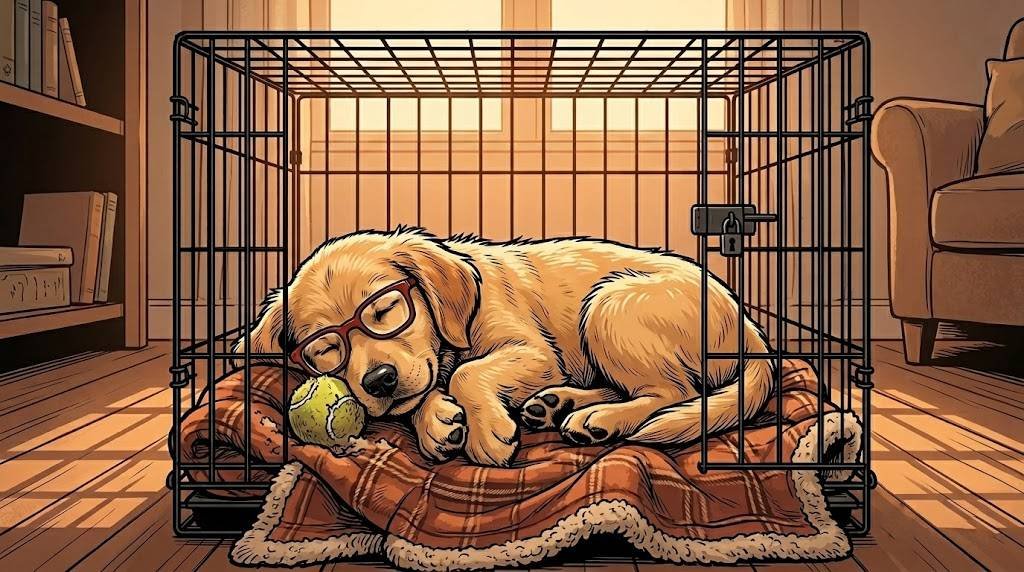
I want to emphasize that last part. I DID NOT CARE. I was rested, I was comfortable, my blanket smelled right, the space was quiet and enclosed and dim and exactly the right size for a golden retriever who wanted to continue napping. The crate had ceased to be a prison. It had become, with no fanfare and no ceremony, a bedroom. This is, I’m told, what dogs are descended from doing—seeking small enclosed dens for rest and protection—and it turns out that instinct was in me the whole time, buried under my four-month-old conviction that this specific enclosure was different because it was metal and it had a door and The Therapist had brought it home.
By the time I was eight months old, I loved my crate. I went there voluntarily when I was overwhelmed. I went there when guests visited and I needed a break from being petted by strangers. I went there when I needed to sleep without someone, usually The Therapist, trying to have a conversation with me.
Crate training is only cruel if it is done cruelly—if you force the puppy inside, ignore their distress, use the crate as punishment for bad behavior, or leave them confined for longer than their bladder and emotional regulation can handle. Done properly, it is one of the kindest things you can give a dog, because you are giving them a space that belongs entirely to them in a house that otherwise belongs to you.
You do this too. You wouldn’t expect a human child to sleep alone in an unfamiliar room on the first night and be completely fine. You would sit with them, read to them, leave a light on, check in when they cried, gradually build their confidence that the room was safe and that you hadn’t abandoned them. You would, in other words, do exactly what The Therapist did with me, because the underlying psychology is essentially the same: build safety first, then build independence.
So no — crate training isn’t cruel. Done properly, it’s one of the kindest things you can give a dog: a small, quiet, enclosed space that belongs entirely to them. The cruelty question is, in my experience, the question two-leggers spend the most time on before they start training, and the question they stop thinking about entirely once training is going well. Which means the question isn’t really is it cruel? It’s how do I do it in a way that isn’t?
And that’s a different article. If you’re ready for the actual method — the four stages, the first-night survival guide, the timeline, what to do when your puppy won’t stop crying — I wrote it all down: How to Crate Train a Puppy: Step-by-Step Guide That Actually Works.
Professor Alfred
Reformed Crate-Hater & Voluntary Napper