Why Do Dogs Pull on Leash: A Golden Retriever’s Confession
Hello, two-leggers.
Answer First
Dogs pull on leash because it works. The leash creates physical pressure, the dog pushes against that pressure by instinct, and if forward motion follows even slightly, the behavior gets reinforced. The main causes are opposition reflex, no prior loose leash training, and accumulated energy at the start of the walk. Start today by stopping completely the moment the leash tightens — not pulling back, just stopping — and only continue when the leash goes slack. If consistent effort over several weeks produces no improvement, a certified dog trainer can help.
Now let me tell you how I know all of this. It required fieldwork. Significant fieldwork. The kind that ends with a slipper somewhere near a lamp post and a very patient human behind you.
The First Walk
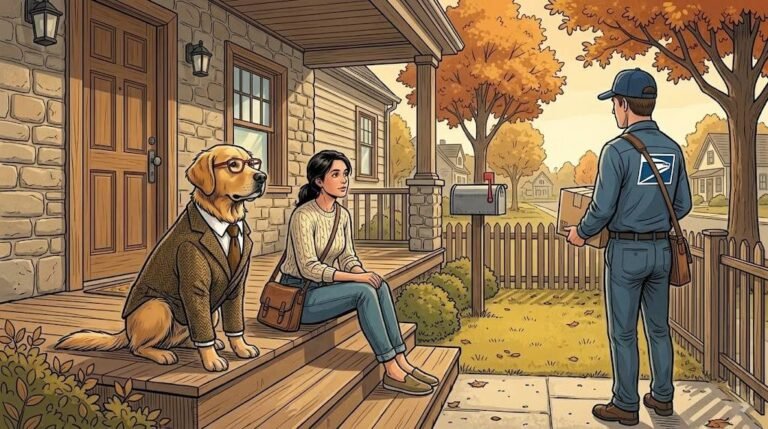
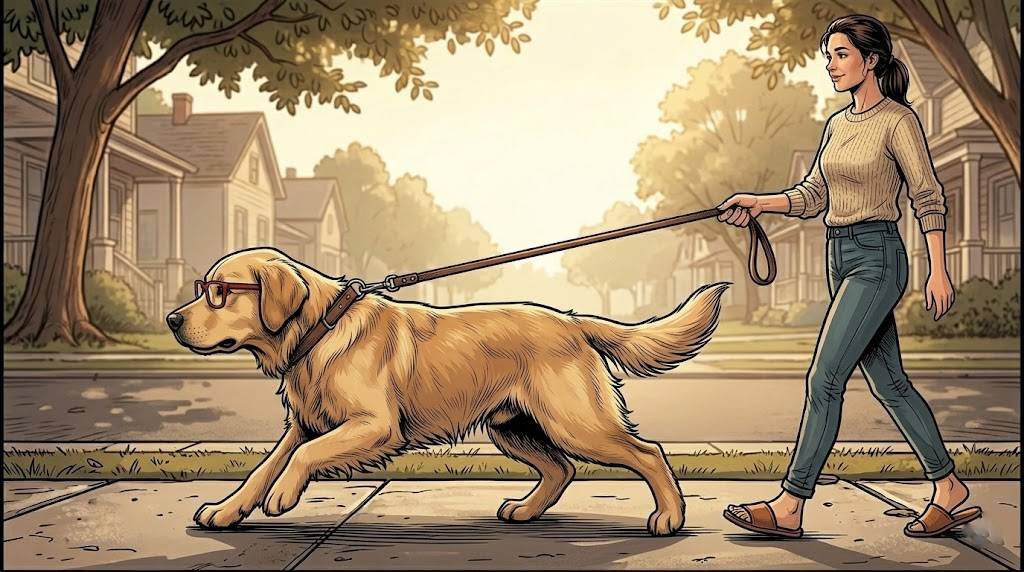
The Therapist had decided I was ready for a proper walk. Not the garden circuit. Not the short loop around the block she had been doing while I was still small enough to be carried home if things went wrong. A real walk — down the street, past the interesting gate, all the way to the corner with the large tree that smelled of approximately eleven different dogs and one extremely confident cat.
She clipped the leash to my collar.
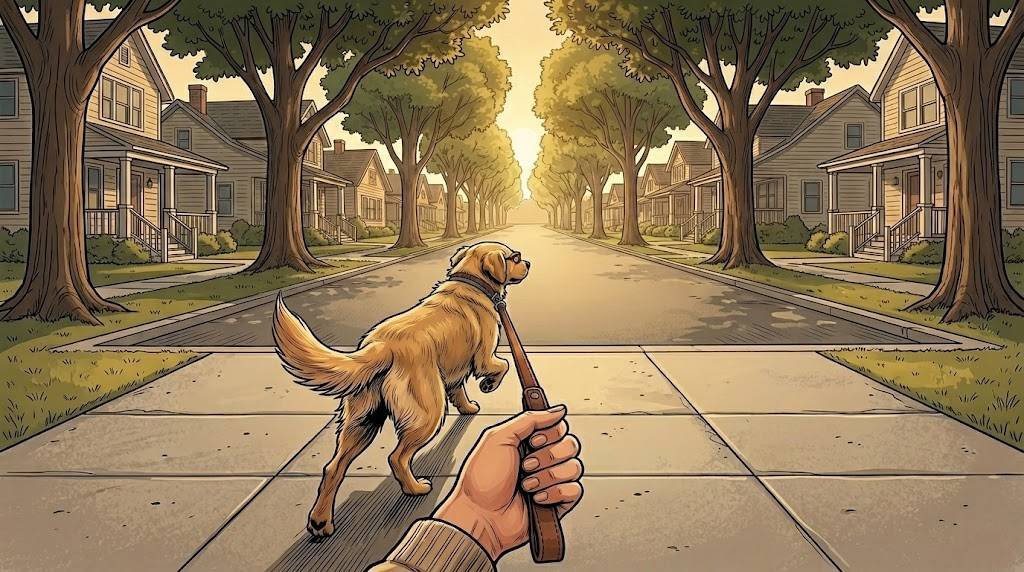
Right after we left my nose found something extraordinary near the first lamp post, my legs followed my nose, and The Therapist — who had apparently not been briefed on how urgent this situation was — did not move at the required speed. The leash went taut, I pulled harder. She made a sound I would later learn was her “we are going to discuss this” sound. I did not hear it at the time because there was a second smell developing near the wall that required my full attention, and then a third situation near the trash can that I felt very strongly about.
Her slipper came off somewhere around the third lamp post. I only know this because she told me about it afterward, at length, with an expression I have spent years studying and can now identify as educational disappointment.
I was not trying to drag her anywhere. I was not making a point about who was in charge of the expedition. I was a young dog on my first real walk, and the world outside was so overwhelming and so extraordinary that I had no concept — none, genuinely zero — that there was supposed to be a different way to move through it.
This is the thing I want you to hold onto before we go any further.
Why Dogs Pull on Leash — Quick Diagnosis
Before we get into the mechanics, find your dog in this list:
- If your dog pulls from the very first step and does not slow down → excitement overload, no loose leash foundation has been built yet
- If your dog pulls specifically toward certain targets; other dogs, a particular park entrance, a familiar route → strong goal motivation, the destination is doing most of the pulling
- If your dog is young and has always pulled → not a bad habit, simply a skill that was never taught
- If pulling started gradually in an older dog → somewhere along the way, pulling was accidentally reinforced and the history needs unpicking
- If your dog pulls only when you have no treats visible → attention is reward-dependent, which is a different problem with a different solution
The most useful thing to know before anything else: pulling is not a personality trait. It is a behavior that exists because it has been functional. Understanding why it became functional is where the solution begins.
The Opposition Reflex — Your Dog Is Not Being Defiant, It Is Being a Body
I maintained my enthusiastic pulling habit for an embarrassingly long time after that first walk. For months, actually. The reason was not stubbornness, not disrespect, not any of the character explanations humans sometimes reach for when their dog is doing something inconvenient. The real reason is a thing called the opposition reflex, and it is worth understanding properly before anything else.
When a dog feels pressure from the leash pulling backward, the body responds by pushing in the opposite direction. This is not a decision. It is not even, strictly speaking, a choice of any kind. It is a neurological reflex that fires before the thinking part of the brain has had any input at all. You apply pressure in one direction, the body counters automatically in the other. Every time. Reliably. Without the dog consulting anyone about it, including themselves.
This is why pulling back on a dog who is pulling almost always makes things worse rather than better. You pull back, the opposition reflex fires, the dog pulls harder. You pull harder, the reflex fires again. What looks like escalating defiance from the outside is actually two nervous systems locked in a mechanical loop that neither party chose to enter.
You have felt this yourself. Someone grabs your arm while you are walking — not because of any danger, just a sudden grip — and before you have processed what is happening, you are already pulling forward against them. Not because you decided to. Because your body decided for you, faster than thought. Your dog’s version of this is simply stronger, more consistent, and attached to four legs of considerable determination.
The immediate practical consequence: do not pull back. A tight leash is already the problem. Adding more tension to a tight leash does not teach loose leash walking. It teaches the dog that more tension is simply the normal state of things. The response that feels instinctively correct in the moment — grip tighter, pull harder — is the one that makes the situation worse.
The Therapist worked this out faster than I would have, had the roles been reversed. She stopped pulling back. The walk did not immediately become pleasant, but it stopped escalating, which was a start.
The Walk Is Not a Walk — It Is a Sensory Emergency
I want to explain what the outside world is actually like for a dog, because I think this is where human understanding of pulling breaks down most completely.
You are walking down a street. You register a lamp post, a tree, a parked car, a trash can. You process these things as background — the furniture of the outdoor world, unremarkable, requiring no particular attention.
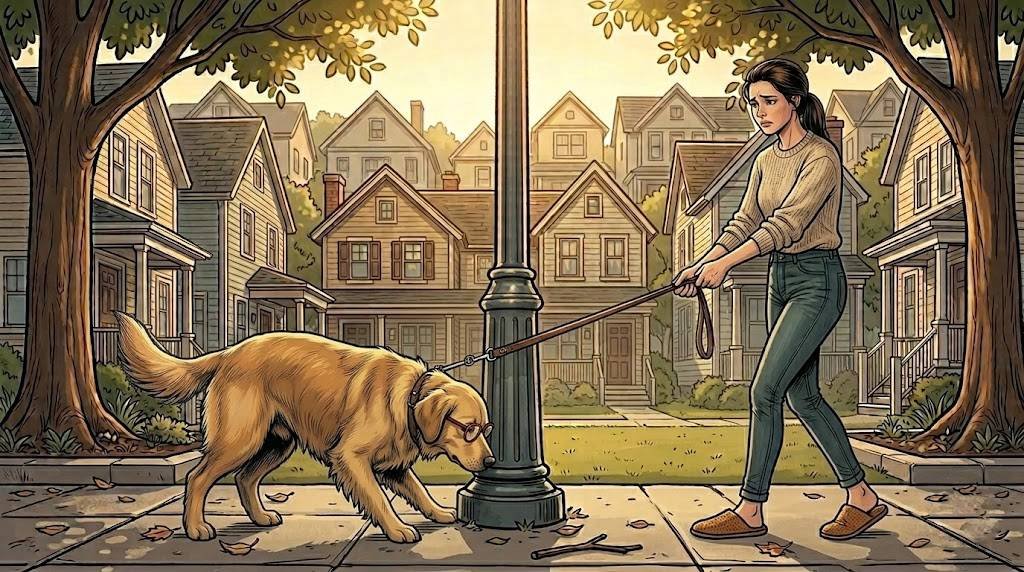
I am walking down that same street. The lamp post contains layered information from at least six dogs who passed in the last eighteen hours, including one I recognize from the park two streets over, one who appears to have been anxious about something, and one whose diet has changed recently in ways I find professionally interesting. The tree has an entirely different profile — overnight moisture has released compounds from the bark, there is evidence of a fox in the root system, and something small and fast moved through early this morning. The trash can is a document of considerable complexity that I will not describe in full, but which represents several paragraphs of reading if given adequate time.
You are moving at human pace — which is, and I say this with genuine affection, extremely slow for your legs and inexplicably fast for anyone trying to process olfactory information. You move past all of this without stopping. You do not even notice you are passing it.
I am trying to read all of it simultaneously while physically attached to you, moving at your speed, in your chosen direction, toward your chosen destination.
Have you ever walked through a genuinely interesting exhibition with someone who has already seen everything and is moving steadily toward the exit? You are attached to them, and the interesting things keep appearing and disappearing before you have finished with them. That feeling — of being moved past something before you are done with it — at a sensory intensity you cannot fully imagine, from the first step to the last. That is the walk, from inside.
This does not excuse pulling. It explains it. And understanding the explanation is what allows you to address it with something more useful than frustration and a tighter grip.
The Therapist discovered, during my reformed period, that allowing me a brief stop at genuinely interesting points — not indefinitely, not without limit, but enough time for the urgency to drop — changed the quality of what followed. Less urgency behind the pull means less pull. This surprised me somewhat, because I had assumed the problem was the walking. It was partly the pressure of moving past things too fast. Remove some of that pressure and the behavior has less fuel behind it.
Pulling Works — That Is the Entire Problem
This section requires a degree of honesty about my earlier self that I find mildly uncomfortable. I will proceed anyway, in the interest of science.
Pulling works because it has worked. This is the complete explanation, and it is sufficient.
When a young dog pulls and the person on the other end takes a single step forward — even to maintain their balance, even with no intention of rewarding anything — the dog has just received confirmation that pulling produces forward motion. The nervous system notes this. The next pull is slightly more confident. The confirmation that follows solidifies it further. Over weeks and months of daily walks, the dog has not developed a bad habit through some failure of character. The dog has learned a highly effective skill that has been reinforced across hundreds of repetitions.
Nobody intended this. The dog did not set out to manipulate anyone. The human did not set out to teach pulling. It happened anyway, because behavior is shaped by its consequences regardless of anyone’s intentions, and the consequence of pulling was, most of the time, getting closer to the interesting thing.
Think about an elevator button that you press once and nothing happens, so you press it again, and then one more time to be safe. If the elevator arrives after the third press, you have just been taught — without drama, without anyone explaining anything — that three presses is the correct number. You will press it three times next time. You will probably press it three times for the rest of your life without ever deciding to do so. You are not irrational. You are conditioned. Your dog’s relationship with the leash is the same mechanism operating at considerably higher physical commitment.
The consequence of this is that addressing pulling requires making it non-functional. Not punishing it — punishment adds arousal and confusion without touching the reinforcement history. Simply making it non-functional. The dog pulls and the result is not forward motion. Not a correction. Not attention of any kind. Just: no forward motion. The behavior that has always worked stops working. Given enough consistent repetition, the dog tries something different.
Consistently is the word that matters most in that sentence. One walk managed correctly and four walks where you are tired and let the tension happen achieves almost nothing. Intermittent reinforcement — getting the result sometimes — makes behaviors more persistent, not less. A dog who occasionally gets where they want by pulling will pull harder and longer than a dog who always gets there by pulling. The occasional reward keeps the behavior alive indefinitely.
The Therapist applied this consistently. I noticed the leash had changed. It took longer than either of us would have preferred, but it worked.
Energy and Timing — Why the First Five Minutes Are the Worst
There is a variable in leash pulling that rarely gets discussed, and it explains why the same dog can be nearly unmanageable at the start of a walk and considerably more reasonable twenty minutes in.
Energy at departure is the largest single predictor of pulling intensity in the early phase of a walk. A dog who has been inside for several hours, who watched you pick up the leash with rising excitement, who has been doing small celebratory laps of the hallway — that dog is arriving at the walk in a state of activation that makes calm leash walking close to physiologically impossible. The self-regulation required to match someone else’s pace and direction requires a degree of cognitive availability that very high arousal switches off almost entirely.
I was this dog. I am, in certain circumstances, still occasionally this dog, though I manage it with considerably more dignity than I did during my earlier career.
The Therapist discovered — through observation rather than reading about it, which is her particular method — that a short period of active movement before the walk changed the first five minutes completely. Not a full exercise session. Ten minutes of fetching in the yard, or a few minutes of active indoor play. Enough to take the sharpest edge off the accumulated energy. The walk that followed was noticeably different. The pulling was still present, in the early stages of our work together, but its intensity was lower. The leash went slack more often. Progress became possible.
You would not sit down to make careful decisions immediately after running to catch a bus. The heart rate is up, the breath is short, everything feels slightly urgent, and the careful part of your brain is not fully online yet. A dog at the start of a walk without any prior energy release is in a comparable state — the environment is presenting itself as maximally interesting at exactly the moment when the capacity to regulate the response to that interest is at its lowest.
Ten minutes before the walk. That is the investment. It changes what the walk is.
The Leash Is a Language — And Nobody Taught Either of You to Speak It
Here is what I understand now that I did not understand on the day the slipper ended up near the third lamp post.
The leash is a communication system. A tight leash means something. A loose leash means something. Rapid changes in tension mean something. The problem is that without deliberate teaching, the leash defaults to teaching the wrong things.
A tight leash, experienced consistently from the beginning, teaches a dog that tension is simply the normal state of a walk. Not alarming. Not informative. Just the texture of being outside. From that baseline, pulling is not a misbehavior requiring explanation — it is the dog participating in a system that has always felt like this. The dog is not failing to understand the language. The dog has learned it fluently. The language just says the wrong things.
A loose leash, by contrast, requires active teaching. It requires the dog to learn that a loose leash is what allows forward motion, and that a tight leash stops everything. It requires the human to learn to read tension before it becomes a full pull, to stop early rather than late, and to notice and reward the moments when the leash goes slack rather than waiting for a perfect heel. Neither party is born knowing this. Both have to learn it. And the teaching has to be deliberate, because left to develop on its own, the system defaults to tension.
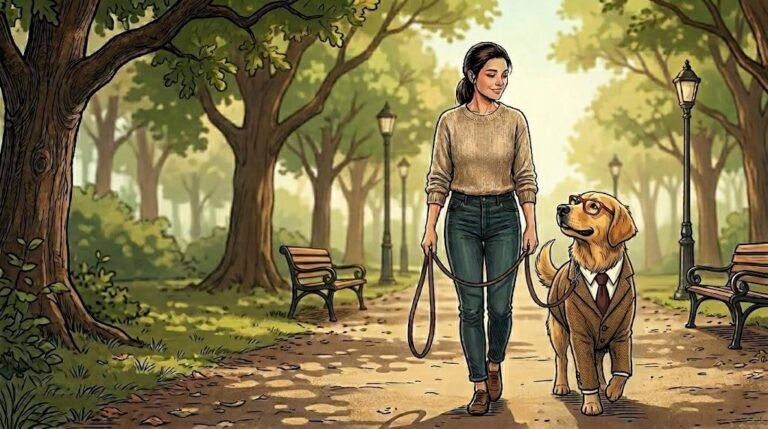
The Therapist and I eventually learned to speak it to each other. The walk we have now — mostly calm, occasionally derailed by something genuinely extraordinary near a particular trash can that I will not discuss in detail, always recoverable — is the result of both of us learning a system that was not natural to either of us and had to be built from deliberate practice.
Which means the dog pulling ahead of you right now is not doing it because something is wrong with them. They are doing it because they are operating in a language they were never taught, in a system that has been rewarding what they are doing, and nobody has yet changed the terms.
The terms can be changed. That is what I want you to leave with.
Professor Alfred
Formerly a SidewalkTorpedo, Now Mostly Reformed, Still Professionally Interested in Trash Can Smell Profiles