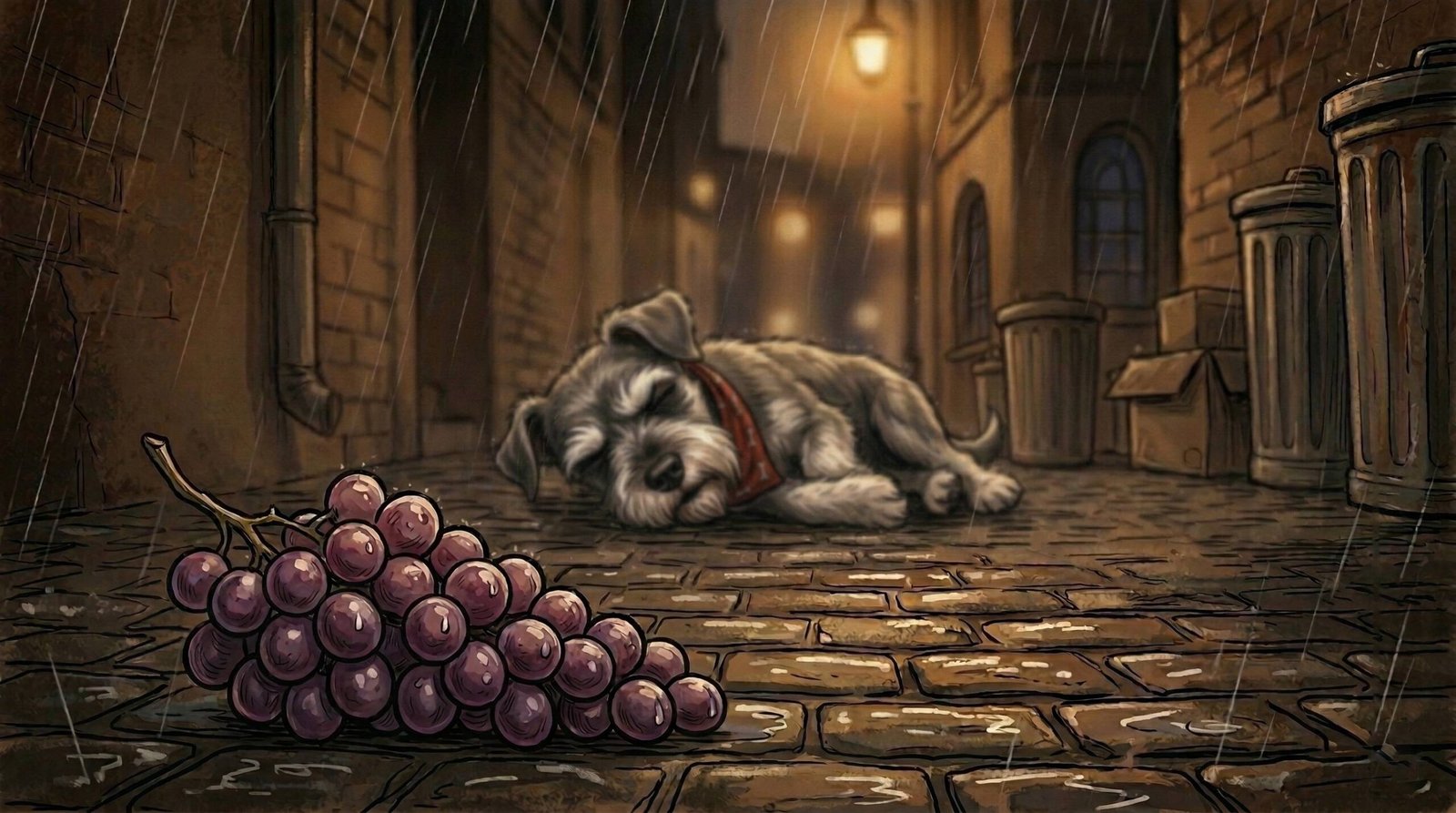
Why Grapes and Raisins Are Dangerous for Dogs
Yo, food lovers.
Answer First
Grapes and raisins are not safe for dogs. Even a small amount can be dangerous for some dogs, and the toxic amount can be unpredictable. If your dog ate grapes, raisins, sultanas, currants, trail mix, raisin bread, or any food containing them, call your veterinarian, an emergency vet, or animal poison control right away. Do not wait for symptoms and do not try to treat it at home unless a professional tells you to.
Quick Check: Did Your Dog Eat Grapes or Raisins?
Call your vet immediately if:
Your dog ate any amount of grapes, raisins, sultanas, currants, or food containing them
Vomiting, lethargy, loss of appetite, or decreased urination appear
You don’t know how much was eaten
Your dog is small, old, or already unwell
There is no established safe amount for dog owners to rely on at home. Don’t wait for symptoms — by the time signs appear, kidney injury may already be developing, and early treatment matters.
When in doubt → call.
The Grocery Store Alley
Month into street life. I was starting to figure things out. Which dumpsters, which schedules, which alleys were worth the trouble. George had taught me the basics — smell first, observe patterns, don’t eat things that killed other dogs.
I was getting better at listening to him.
Getting better. Not perfect.
Found the grapes behind a grocery store. Whole bag, barely bruised, still on the vine. Someone had thrown out an entire bunch. Perfect purple, cool from the refrigerated section, smelling like sweet and water and something I hadn’t tasted since before the street.
Reached for them.
George hissed. The serious hiss — the one I’d learned to pay attention to after the chocolate incident.
“No.”
Told him I was just going to taste one. My rule: “Taste first, ask questions later.”
“No,” he said again. Flat. Final.
I looked at the grapes. Then at George. Chocolate had taught me something — George’s warnings had a track record. But grapes. They were fruit. Healthy for humans. I’d seen people eat them constantly. Children ate them and they were fine.
“Grapes are fruit,” I said.
“How do you know?”
George was quiet for a moment. When he spoke, his voice was different from usual. Less flat. More careful.
“There was a poodle mix in this alley a few months ago,” he said. “George saw the whole thing. It ate three grapes and was dead four days later.”
I stopped reaching.
“Three grapes,” I said.
I looked at the bag. A full bunch. Dozens of grapes. Three had killed a dog.
But I still didn’t fully understand. Needed to understand. That’s the problem with me — information alone isn’t enough. I need to know what something means in my body, not just in theory.
I leaned forward and licked one grape. Just the surface. Not eating it. Just tasting. Just to know.
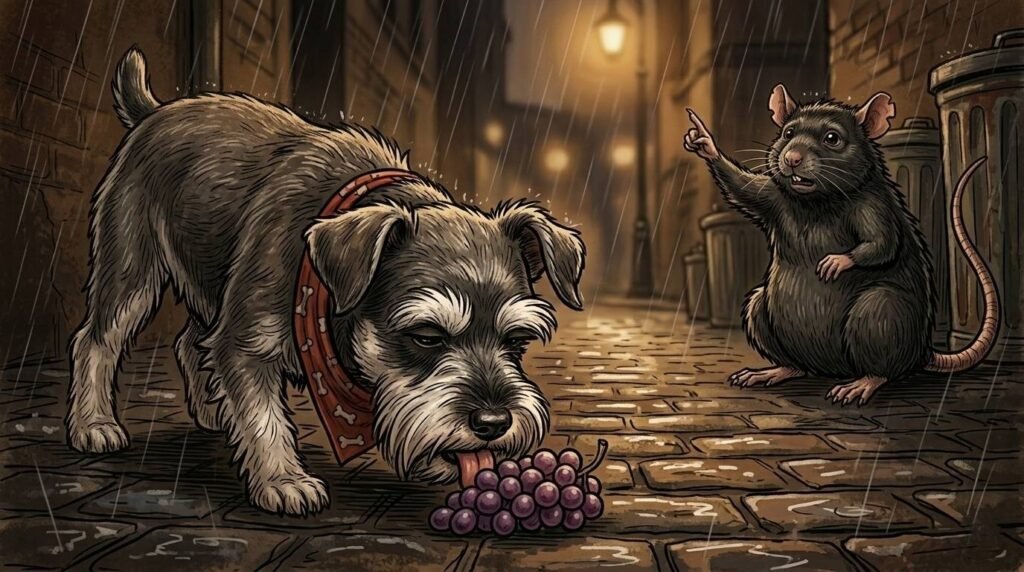
George said nothing. Let me make my choice.
What I Felt
Not much, at first. Then, a few hours later — nausea. Mild, but real. Vomiting once. Weakness that felt out of proportion to how little I’d actually consumed.
I’d licked the surface of one grape.
Later George found me lying down in the alley, not moving much. He brought water and sat nearby.
“You licked it,” he said. “You didn’t even eat it. You’re alive — unlike that poor poodle who ate three.”
I thought about that poodle. Three grapes. A dog smaller than me, probably. Or maybe bigger. Didn’t matter. Grapes don’t care how big you are.
I’d licked one and felt sick for an afternoon.
“What happened to it?” I asked. “The poodle. What did it look like?”
George was quiet for a moment. I’d noticed he did this sometimes — took time before talking about dogs he’d lost. Like he was deciding how much to tell me.
“First day it was vomiting, like what you have now. Second day it got slower, didn’t want to move, stopped eating. By the third day it was barely walking. Fourth day it didn’t wake up.”
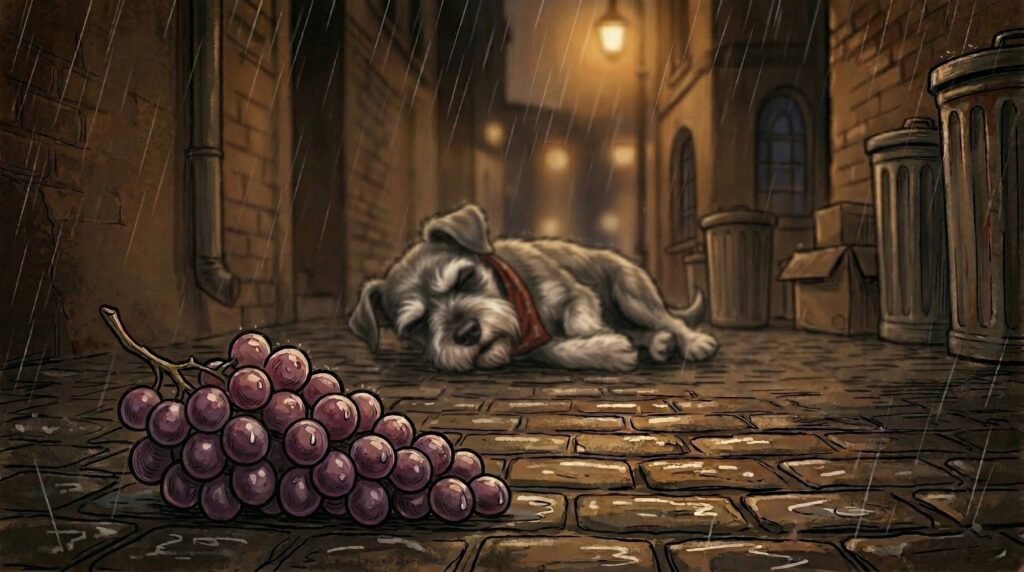
“Kidneys,” he said. “George listened to humans talking outside the vet — that’s how George learned what happens when they stop working. When kidneys fail, the dog stops urinating. Then stops breathing.”
Four days. The poodle had felt fine enough on day one to probably seem okay. Day two, a little off. By day three, it was too late.
“Does it hurt?” I asked.
George considered this. “George doesn’t know. George hopes it didn’t hurt — but it’s a slow process. It takes time.”
What George Knew
He explained it the way he explained everything — in patterns, not chemistry.
“George has seen five dogs eat grapes or raisins over the years. Different sizes, different amounts eaten. Two of them seemed fine afterward. Three of them died. George looked for a pattern and couldn’t find one — no safe amount, no safe type, nothing that predicted who would survive.”
That was the part that stayed with me. No pattern.
With chocolate, there was logic — more chocolate, worse outcome, dark chocolate worst. You could calculate risk. Make informed bad decisions.
With grapes, there was nothing to calculate. Some dogs ate more and survived. Some dogs ate less and died. The poodle ate three grapes. Three. That’s nothing. That’s one snack for a human. That’s a grape that fell off a bunch and rolled under the couch and got eaten because dogs eat things that roll under couches.
“Why?” I asked. “What’s in them?”
“George didn’t know why for a long time. Then humans started figuring it out — something in grapes called tartaric acid that dogs can’t process the way humans do. It builds up in the system and damages the kidneys.”
Genetic lottery. George didn’t use those words. But that’s what he meant.
“So there’s no safe amount.”
“No safe amount,” he confirmed. “George’s rule — if no safe amount, don’t eat. It’s that simple.”
I looked at the grape bag still sitting nearby. The bunch I hadn’t eaten. The grapes that might have killed me or might have been fine. No way to know which.
I moved away from them.
The Full Picture: Why Grapes Kill Dogs
What George observed through pattern recognition, veterinary science has been slowly working to explain.
The current leading theory is tartaric acid. Recent research suggests grapes contain it naturally — in amounts that vary significantly depending on the variety, ripeness, and growing conditions. Dogs may not be able to process tartaric acid effectively, causing it to accumulate and damage the kidneys.
This explains the unpredictability George noticed. A dog eating grapes from one bunch might be fine. The same dog eating the same amount from a different bunch with higher tartaric acid concentration might die. There’s no visual difference between the two bunches. No way to test it in advance. No safe assumption.
What this means practically:
All grape products are dangerous to dogs — including fresh grapes, raisins, currants, grape juice, wine, and grape jam. Raisins are concentrated — they contain more tartaric acid per gram than fresh grapes, making them potentially more dangerous in smaller amounts.
Symptoms and timeline:
The progression George described matches what veterinary medicine documents.
- Hours 1-6: Vomiting, diarrhea, lethargy, loss of appetite
- Hours 12-24: Decreased urination, abdominal pain, weakness
- Hours 24-72: Kidney failure progressing — increased thirst followed by no urination at all, collapse
- After 72 hours: Without treatment, severe cases are often fatal
The critical window is early. Treatment in the first few hours — before kidney damage has progressed — gives dogs the best chance. By the time a dog stops urinating, kidneys are already significantly damaged.
Why some dogs seem fine:
This is the dangerous part. Some dogs eat grapes and show no symptoms. Their owners conclude that grapes are safe for their dog specifically. Then the same dog eats grapes again, or eats a different variety, and the outcome is completely different.
There is no “my dog is fine with grapes.” There is only “my dog got lucky that time.”
George saw this. Two of his five observed dogs seemed fine. He still never touched grapes after seeing what happened to the other three.
What I Learned From Not Eating Them
The chocolate incident taught me something through my own body. Six hours of vomiting and shaking. Direct, unambiguous feedback.
The grapes taught me something different. I licked one, felt sick for an afternoon, and recovered. Minor consequence. Easy to dismiss.
But George had lost a poodle to three grapes in four days. I’d seen the empty spot in the alley where that dog used to scavenge. I’d felt the mild sickness from one lick.
The math wasn’t complicated. I’d licked one and felt something. That dog had eaten three and died. The distance between “felt something” and “died” was three grapes.
I never touched grapes again. Not once. Not even to smell properly. George’s rule: no upside, no safe amount, don’t engage.
Your dog doesn’t have George. Your dog sees grapes on the floor and sees food. That’s all. Just food. Right there. Easy.
One grape rolled off your counter while you were making a fruit salad. Your dog ate it. You didn’t notice. Maybe nothing happens. Maybe it does. You won’t know until symptoms start, and by the time symptoms start, treatment is a race against kidney failure.
The grape your dog ate might be fine. Or it might be the three grapes.
No way to know.
If Your Dog Ate Grapes or Raisins
Don’t wait for symptoms. This is more urgent than most food toxicity situations because the damage happens before the visible signs appear.
Call immediately:
- Your vet
- ASPCA Animal Poison Control: (888) 426-4435
- Pet Poison Helpline: (855) 764-7661
Tell them:
- Whether it was grapes, raisins, or another grape product
- How much your dog ate (estimate)
- When they ate it
- Your dog’s weight and breed
- Any symptoms
Do not induce vomiting unless your vet specifically instructs you. In some cases it’s appropriate; in others it causes additional harm. Let professionals decide.
Treatment may include induced vomiting if very recent, activated charcoal, IV fluids to support kidney function, and monitoring of kidney values. The earlier treatment starts, the better.
Prevention
Keep all grape products out of reach. All of them.
Grapes on the counter. Raisins in trail mix. Grape juice in the refrigerator. Raisin bread on the table. Currants in baked goods. Fruit salads with grapes left unattended.
The difficulty is that grapes don’t look dangerous. They look like healthy fruit. Guests offer them to your dog without thinking. Children share them. They roll off counters and under furniture.
Train “leave it.” Secure food when you’re not watching. Explain to guests — especially children — that grapes are dangerous for dogs. Check ingredient lists on baked goods before sharing any with your dog.
The grape your dog eats while you’re not watching is the one that matters.
The Alley After
George and I sat in that alley for a while after. The grape bag sat untouched a few meters away.
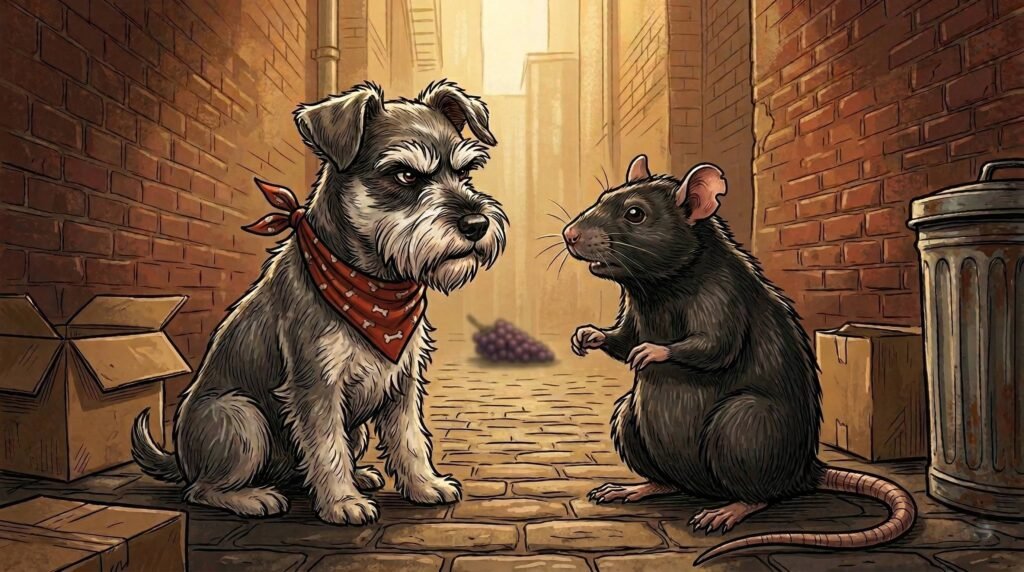
“The poodle,” I said eventually. “Did it know what was happening?”
George was quiet for a long time.
“George doesn’t know,” he said. “George hopes not. It just got slower. Then it stopped.”
“Did anyone help it?”
“No humans around. George was there. George couldn’t help.”
He’d lost three dogs to grapes. Remembered all of them. Carried those outcomes around for months, waiting for a chance to make them useful.
“Why do you remember them all?” I asked.
“Someone should,” he said. “They died. George remembers. Maybe someday George can warn someone in time.”
He’d warned me. I hadn’t fully listened — I’d licked the grape. But I’d listened enough. And now I was sitting in this alley, mildly sick but alive, instead of getting slower over four days.
The poodle’s three grapes. My one lick. George’s warning landing just enough.
Sometimes almost-enough is enough.
Ham
Student of George, Grape Licker (Once), Keeper of Other Dogs’ Lessons
Our content is for educational purposes only, not veterinary advice. If your dog ate grapes or raisins, contact your vet immediately.
FAQ
How many grapes are toxic to dogs? There is no reliable number a dog owner should use at home. Risk depends on the dog, the amount eaten, the type of fruit or food, and the timing. Because some dogs can develop kidney injury after small exposures, treat grape or raisin ingestion as urgent and call for case-specific advice.
My dog ate one grape — is that an emergency? Call your vet. One grape may be fine. Or it may not. There’s no way to know without professional assessment. The cost of a call is nothing compared to the cost of waiting.
Are raisins more dangerous than grapes? Raisins are more concentrated — more tartaric acid per gram. A small amount of raisins can cause the same kidney damage as a larger amount of fresh grapes. Both are dangerous.
What are the symptoms of grape poisoning in dogs? Vomiting, lethargy, loss of appetite, decreased urination. Symptoms can appear within hours or take up to two days. Kidney failure progresses even when the dog appears to be recovering. Call your vet before symptoms appear.
Can dogs eat grape-flavored products? Artificial grape flavoring is generally not toxic. The danger comes from actual grape content — fresh grapes, raisins, grape juice, currants. Check ingredients before giving any grape-related product to your dog.