Xylitol Poisoning in Dogs: Hidden Risks in Everyday Foods
Yo, food lovers.
Answer First
Xylitol is an artificial sweetener that causes life-threatening hypoglycemia and liver failure in dogs. It’s found in sugar-free gum, candy, some peanut butter brands, diet baked goods, and medications. Symptoms can appear within thirty minutes of ingestion. Even small amounts can be fatal. If your dog ate anything containing xylitol, call your vet immediately.
Quick Check: Did Your Dog Eat Something With Xylitol?
Call your vet immediately if:
- Your dog chewed or swallowed sugar-free gum, candy, or any product labeled “sugar-free”
- Weakness, vomiting, loss of coordination, or collapse appear
- You found chewed packaging and aren’t sure what was inside
- Your dog is acting confused or unresponsive
Xylitol acts fast. Thirty minutes from ingestion to hypoglycemia in some cases. Don’t wait.
When in doubt → call. If you can, bring the packaging to the vet — the xylitol amount varies by product.
The Gum
I want to be clear about something before I tell this story: I didn’t know. Big Guy didn’t know either. Neither of us had any idea what was about to happen. This is important because on the street, not knowing things got dogs killed. I’d worked hard to learn what I needed to know to stay alive.
Turns out there were whole categories of danger I’d never encountered.
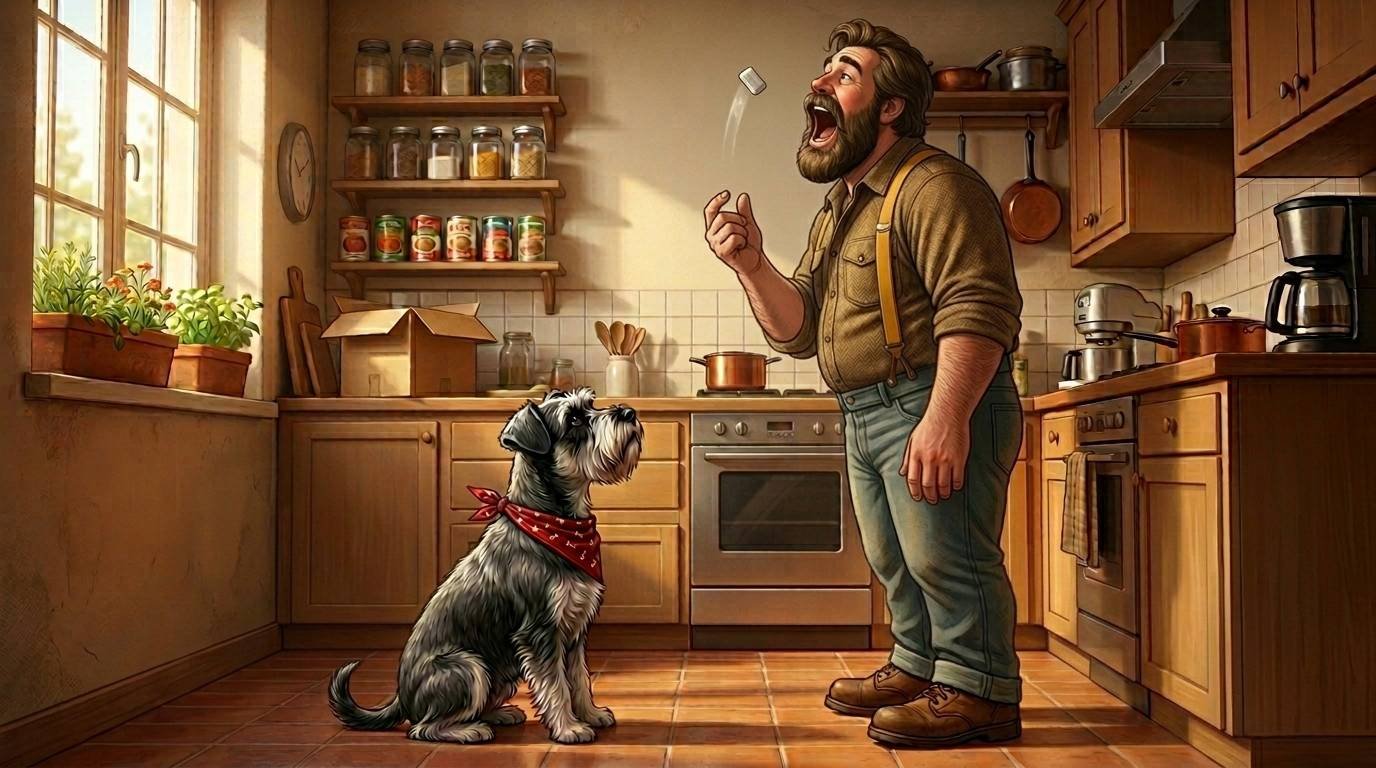
It was an ordinary evening. Big Guy was doing something at the kitchen counter — I wasn’t paying close attention because nothing interesting was happening food-wise. He reached into his jacket pocket, pulled out a pack of gum.
Sugar-free gum. The kind humans chew when they want to feel like they’re eating something without actually eating something. I find this concept baffling but fine.
He popped one piece. Another slipped out of the pack.
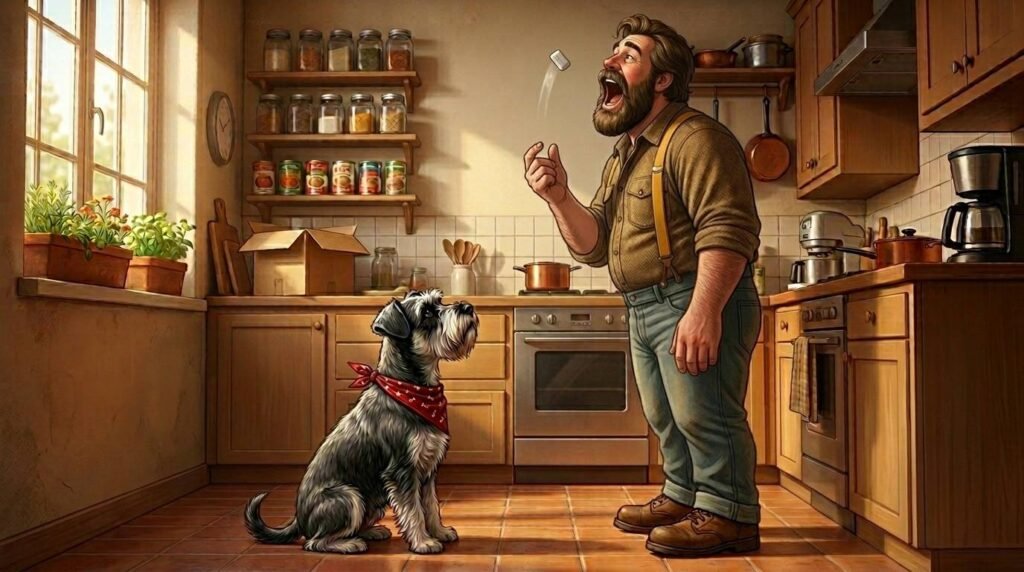
It fell.
I caught it in midair. Reflex. Pure reflex. I chewed it twice and swallowed before Big Guy even turned around.
He turned around.
Looked at the empty space where the gum had been.
Looked at me.
“Ham. Did you just—”
I licked my lips. Minty aftertaste. Not bad actually.
“Ham.”
I sat down. Looked innocent. This is a skill I’ve developed.
He picked up the gum wrapper. Read the ingredients. His face did something I hadn’t seen it do before — a kind of slow-motion realization, like watching someone understand bad news in stages.
“Oh no,” he said quietly.
He put the wrapper down. Looked at me. I looked back at him. We stayed like that for a moment — him knowing something I didn’t, me knowing nothing was wrong yet.
Then I lay down.
Not dramatically. Just — lying down felt like the right thing to do suddenly. Legs a bit heavy. Floor very appealing.
Big Guy watched me lie down. Watched me for another thirty seconds. Then grabbed his phone.
The Call
He called someone. I could hear one side of the conversation from my spot on the kitchen floor.
“My dog just ate a piece of sugar-free gum. Yes. Xylitol. How much — I don’t know, one piece. He’s a miniature schnauzer, maybe seven kilos. What do I — okay. Okay. How fast — thirty minutes? Okay. We’re coming.”
He hung up. Looked at me with an expression I recognized from the street.
It was the expression of someone who understood that something bad was coming and couldn’t stop it.
On the street, I’d seen that expression on other dogs’ faces. Never expected to see it on Big Guy’s.
“We’re going to the vet,” he said. “Right now.”
I wasn’t worried yet. I felt fine. Minty, but fine.
What Happened in the Car
Ten minutes into the drive, I stopped feeling fine.
It started with dizziness. Not dramatic — just a subtle wrongness, like the car was moving more than it should. Then weakness. My legs felt like they belonged to a different, much less functional dog.
I sat down on the back seat. Then lay down. This was unusual — I don’t usually lie down in moving cars. Too much to observe.
Big Guy kept looking back at me in the mirror. Every thirty seconds. His face getting progressively worse.
“You okay back there? Ham? You okay?”
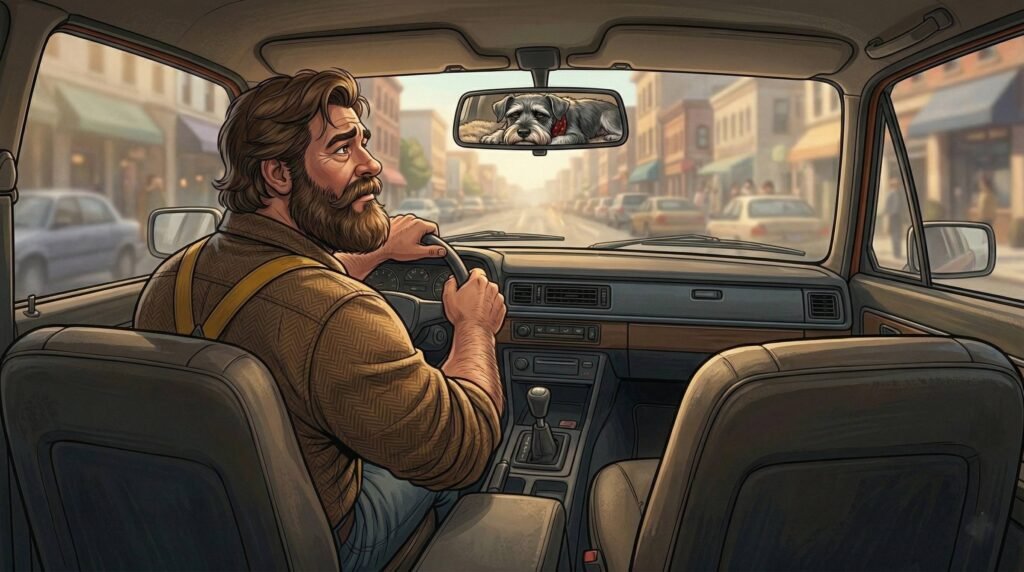
I was not okay.
The weakness was spreading. My head felt heavy. Everything felt slow and wrong in a way I didn’t have words for but my body understood completely.
I thought about George.
George had known what was dangerous and what wasn’t. George had a list. George had watched enough dogs die that he’d compiled comprehensive notes on survival. I’d had George.
I didn’t have George anymore.
I was in a moving car feeling my legs stop working properly, and for the first time since Big Guy found me, I genuinely thought: this might be how I die. Not on the street, not in the rain, not from something I’d eaten knowingly — from a piece of gum that fell on the floor on a Tuesday evening.
A piece of gum.
George would have had thoughts about this. Though honestly — George could have used a piece of sugar-free gum. Might have done something about that breath.
I wished he was here anyway.
The Vet
The vet moved fast. That was the first indication of how serious it was — vets don’t move fast for things that aren’t serious.
They took me immediately. Big Guy stood at the counter filling out forms, talking quickly, answering questions. I could hear him from the examination room, his voice doing something I hadn’t heard before — tight and controlled and trying not to be scared.

They gave me something to make me vomit, even though I’d only chewed and swallowed one piece. Then IV fluids. Then monitoring. Blood sugar checks every hour.
I lay on the examination table and conducted a thorough personal assessment of my life choices.
The gum had tasted fine. Minty, slightly sweet, entirely unremarkable. Nothing about it had suggested “this will end you.” Nothing about it had triggered any of the instincts George had spent months developing in me. It had smelled like something humans put in their mouths. It had fallen. I had caught it.
Reflex. That was all. Reflex nearly killed me.
The vet explained things to Big Guy while I recovered. I couldn’t follow all of it — the medical terminology was above my level — but I caught the important parts.
Xylitol. Artificial sweetener. In humans, completely harmless — body processes it normally. In dogs, it triggers massive insulin release. Blood sugar crashes fast. Liver can start failing within twenty-four hours if the dose is high enough.
Symptoms: weakness, vomiting, loss of coordination, collapse, seizures.
“One piece of gum,” Big Guy said. It wasn’t really a question.
“One piece can be enough for a small dog,” the vet said. “Depends on the brand, depends on xylitol concentration. Some brands have more than others. You acted quickly. That helped.”
Big Guy looked at me on the table. I looked back at him.
We’d both learned something tonight.
What We Didn’t Know
Neither of us had known about xylitol. That’s the thing about this particular poison — it doesn’t exist in the natural world. It’s not a food, not a plant, not something any dog would encounter in any context where instincts would develop to avoid it. It’s a laboratory-created sweetener that got put into human products and then those products entered kitchens and pockets and bags everywhere.
George’s education had been comprehensive about natural dangers. Chocolate — found in nature, derivation of a plant. Grapes — obvious food, encountered constantly. Onions, garlic — common kitchen ingredients with strong smells. His pattern recognition worked because he’d observed outcomes.
No dog was eating sugar-free gum in the alleys. No rat had watched another rat warn a dog about xylitol. It existed outside the knowledge base entirely.
This is what makes it particularly dangerous.
It hides. In sugar-free gum — obviously. But also in:
Peanut butter — some brands use xylitol as a sweetener. The same peanut butter you might use to give your dog medication or as a treat. Check every label. The dangerous brands often advertise as “natural” or “reduced sugar.”
Baked goods — sugar-free versions of cakes, cookies, muffins. Often contain xylitol in significant quantities.
Candy and mints — especially sugar-free varieties. A bowl of sugar-free mints on a coffee table. A pack of sugar-free breath mints in a bag.
Medications and supplements — some liquid medications, chewable vitamins, and supplements use xylitol as a sweetener to make them palatable.
Flavored drinks — some sugar-free flavored waters and drink mixes.
Protein bars and keto snacks — many low-carb and keto products use xylitol as a sugar substitute. Check anything marketed as “low sugar” or “keto-friendly.”
Toothpaste — human toothpaste often contains xylitol. This is why you should never use human toothpaste on your dog.
The common thread: “sugar-free” is often a signal. Not always — not all sugar-free products use xylitol — but it’s the first thing to check.
Symptoms and timeline:
Xylitol acts faster than almost any other common dog toxin.
- 15-30 minutes: Blood sugar begins dropping, weakness, vomiting
- 30-60 minutes: Significant hypoglycemia, loss of coordination, collapse possible
- 12-24 hours: Liver damage in cases of higher doses or delayed treatment
- Untreated: Seizures, liver failure, death
The speed is what makes it so dangerous. By the time you notice your dog is acting strange, you may already be thirty minutes behind.
What Big Guy Did After
He went through everything when we got home.
Every cabinet. Every bag. Every jacket pocket. Every drawer.
Threw out the sugar-free gum. Checked every peanut butter jar — two of them had xylitol, went in the trash. Found sugar-free mints in a coat pocket from two winters ago. Gone. Checked his protein powder, his vitamins, his cold medicine.
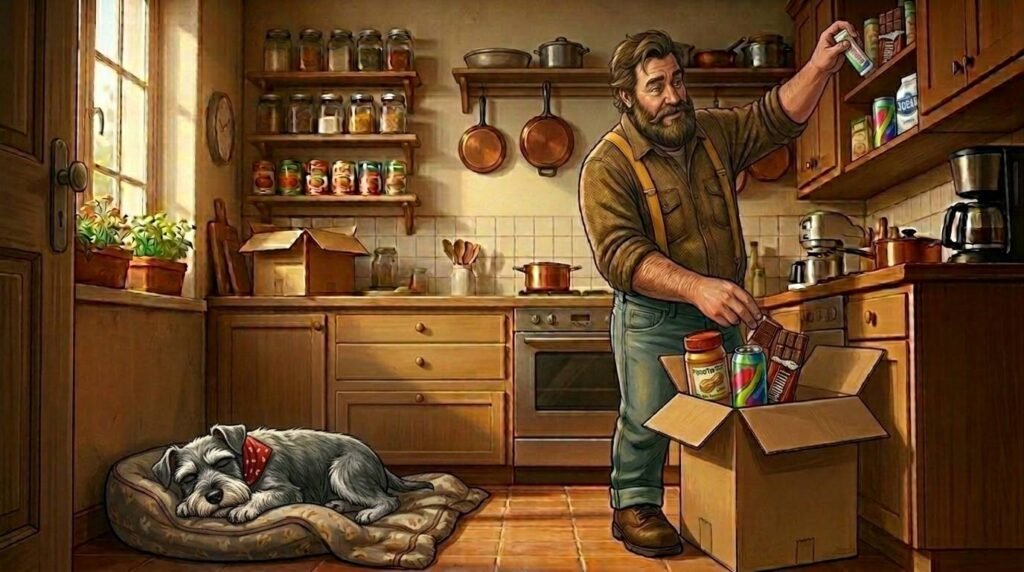
Spent an hour reading ingredient labels.
“I didn’t know,” he kept saying. Not to me specifically. Just to the room. “I had no idea.”
I watched him from my bed. Still tired from the vet visit. Still a bit weak. But alive.
On the street, not knowing things had consequences. You learned or you didn’t come back. Big Guy had never had to learn this particular kind of knowing — the kind where ordinary objects in your kitchen could kill the small dog who trusted you to keep him safe.
He learned it in one evening.
I’d learned it the same way — by doing the thing first and understanding why it was wrong afterward. My method on the street. Still my method apparently, despite my best efforts.
George’s method had been better. Watch, observe, learn from others’ mistakes before they become yours.
But George wasn’t here. And sometimes you learn the hard way.
How to Check for Xylitol
Read ingredient labels. All of them. Every product before it comes into contact with your dog.
Xylitol may appear under different names: xylitol, birch sugar, wood sugar, E967. “Natural sweetener” sometimes means xylitol. Xylitol is a sugar alcohol — but not all sugar alcohols are xylitol. Always look for the word “xylitol” specifically in the ingredient list.
The most reliable rule: if a product is labeled sugar-free, low-sugar, or “natural sweetener,” check the ingredients before letting your dog near it.
Keep sugar-free gum and mints out of reach. Out of bags, out of pockets, out of bowls on coffee tables. Dogs find things. I found that gum mid-air, in the half second it took to fall from Big Guy’s hand. If I can intercept something before it hits the floor, no shelf or pocket is actually safe.
Never use human toothpaste on your dog. Dog-specific toothpaste exists for this reason.
Check your peanut butter before using it as a treat or medication vehicle. Some popular “natural” brands contain xylitol. Even if a brand was safe last time, check every jar — recipes change.
For a full overview of what else to keep away from your dog, that’s where to start.
If Your Dog Ate Xylitol
Move fast. Faster than you think you need to.
Call your vet or emergency animal hospital immediately. Call ASPCA Animal Poison Control (888-426-4435) or Pet Poison Helpline (855-764-7661) if your vet isn’t immediately reachable.
Tell them:
- What product your dog ate, how much, when, your dog’s weight
- Bring the wrapper or label — or a photo of the ingredients if you can’t bring the packaging
Do not wait for symptoms. Xylitol acts in thirty minutes. Symptoms mean it’s already working.
Treatment — induced vomiting if very recent, IV fluids, blood sugar monitoring, liver support — is most effective before symptoms develop. The vet can buy your dog time that the poison is trying to take.
Big Guy acted the moment he understood what had happened. That’s why I’m writing this instead of pushing up daisies. Or, more accurately, eating them from below.
The Minty Aftermath
I recovered fully. Took a day. Slept a lot. Big Guy checked on me every hour, which I found both touching and slightly excessive.

He bought new gum. Regular gum, with sugar. Checked the label three times before putting it in his pocket.
He still checks labels on everything now. Every new product that comes into the house. Every jar of peanut butter. Every “sugar-free” anything.
I watched him learn to be careful about something he’d never had to be careful about before. It looked familiar — that specific attention to potential danger that becomes automatic over time. George had that. I’d developed it on the street.
Big Guy developed it in one vet visit.
Different educations, same result.
The gum tasted fine, by the way. Right up until it didn’t. That’s the thing about xylitol — it’s in products designed to taste good. Sweet, minty, pleasant. Nothing about it announces itself as dangerous.
George would have said: “Humans make poison taste sweet. It is an efficient way to kill anything that likes sweet things.”
He was right about that. He was right about most things.
I just had to learn this one without him.
Ham
Xylitol Survivor, Label Reader (Now), Student of the Hard Way
Our content is for educational purposes only, not veterinary advice. If your dog ate something containing xylitol, contact your vet immediately.
FAQ
What products contain xylitol? Sugar-free gum, mints, some peanut butter brands, diet baked goods, protein bars, keto snacks, certain medications and vitamins, and human toothpaste. If it says “sugar-free” or “no added sugar,” check the label.
How much xylitol is dangerous for dogs? Very little. Even one piece of sugar-free gum can be life-threatening for a small dog, depending on the brand, the amount of xylitol, and your dog’s size. Do not try to calculate a safe dose at home. Call your veterinarian, an emergency vet, or animal poison control right away.
How fast does xylitol poisoning work? Blood sugar can crash within thirty minutes. Liver damage may follow within twenty-four hours. This is one of the fastest-acting dog toxins. Don’t wait for symptoms.
My dog ate sugar-free gum — what do I do? Call your vet or ASPCA Poison Control (888-426-4435) immediately. Bring the packaging. Do not induce vomiting unless specifically instructed. Move fast — this one doesn’t wait.
Is peanut butter safe for dogs? Some brands yes, some no. Check every jar for xylitol before giving it to your dog. Even if a brand was safe before, recipes change. When in doubt, don’t.