Why Dogs Can’t Eat What Humans Can: How Dogs Process Food Differently
Yo, food lovers.
Answer First
Dogs and humans share almost no digestive biology when it comes to food safety. What humans metabolize without issue — garlic, grapes, chocolate, xylitol — dogs process through completely different enzymatic pathways, often with toxic results. Dogs lack the liver enzymes to break down theobromine, the kidney filtration to handle tartaric acid, and the insulin regulation to survive xylitol exposure. The foods aren’t dangerous because dogs are weaker. They’re dangerous because dogs are different.
Quick Check: Is This Food Actually Safe for Your Dog?
Before giving your dog any human food:
- Is it on a toxic foods list? → Don’t give it
- Does it contain sweeteners, seasonings, or sauces? → Check ingredients first
- Is it processed, flavored, or “diet”? → Check for xylitol
- Are you unsure? → Don’t give it. Call your vet.
Toxic Foods for Dogs fridge list.
When in doubt → don’t.
The Book
Big Guy ordered it three days after the chewing gum incident.
I know this because the package arrived while I was watching him from my spot near the kitchen radiator — the good spot, the warm one, the one I’d claimed in the first week and never relinquished. The box had a picture of a dog on it. I took this as a good sign.
He sat at the kitchen table and opened it. Big. Serious. The kind of book that means someone has decided to take something seriously.
I approved of this. The garlic incident had rattled him more than it rattled me, and I’d been the one rushed to the vet twenty-three times in a month as a puppy. But Big Guy hadn’t known. He’d found out afterward — pieced it together from vet records and context — and the look on his face when he understood what the early garlic exposure had set in motion was the look of someone who needed to read a very serious book.

He opened to the chapter on nutrition. Started reading. Out loud — he does this sometimes, subvocalizes when something surprises him, not quite reading to the room but not quite reading to himself either.
I settled in.
What He Read, What I Heard
“Theobromine in chocolate cannot be metabolized by dogs the way humans process it — the half-life in dogs is approximately seventeen hours, compared to…“
I heard: chocolate.
I perked up slightly. Then remembered I wasn’t supposed to eat it. Settled back down.
“The tartaric acid hypothesis for grape toxicity suggests that dogs lack the specific renal enzymes required to…“
I heard: grapes.
Also on the list. Also not for me. I already knew this. The poodle George told me about — she hadn’t known either, until she did.
“Xylitol triggers an exaggerated insulin response in dogs that does not occur in humans, causing rapid hypoglycemia within…“
I heard: xylitol.
I heard: hypoglycemia.
I also heard Big Guy stop reading for a moment, go back a sentence, and read it again. His cortisol did the thing it does when he’s recalculating something.
“…causing rapid hypoglycemia within thirty minutes of ingestion…“
He put the book down. Looked at me. Looked at the book. Looked back at me.
“Ham,” he said. Not a question. Just my name.
I looked back at him.
We sat like that for a moment — him processing the information that the piece of gum I’d caught midair some weeks earlier had been thirty minutes from being a very different story, me watching him process it.
Then he picked the book back up and kept reading. Because that’s Big Guy — he gets scared, he absorbs it, and he keeps going.
I respected that.
Why We’re Not Small Humans
Here’s what the book was explaining, in the parts where I was listening and not just waiting for food words.
The fundamental problem is this: humans and dogs evolved eating almost entirely different things over tens of thousands of years. Humans developed the enzymatic machinery to handle a broad range of foods — including many that would have been available from agriculture, cooking, and omnivorous scavenging. Dogs evolved alongside humans, but their internal biology didn’t update every time human food culture did.
The result is a species that looks like a good candidate for sharing your dinner but processes that dinner through completely different chemical systems.
Liver enzymes
The liver is where most food compounds go to be broken down and neutralized. Human livers produce specific enzymes for specific jobs — theobromine from chocolate gets broken down relatively quickly, moving through the system without accumulating to dangerous levels.
Dogs have different enzymes. Or fewer of them. Or slower ones. Theobromine — the compound in chocolate that affects the heart and nervous system — has a half-life of around seventeen hours in dogs. In humans, it’s cleared in a few hours. The same amount of chocolate that a human metabolizes without incident sits in a dog’s system for most of a day, accumulating and continuing to cause damage.
This is why small amounts matter. It’s not just the dose — it’s the time.
Kidney filtration
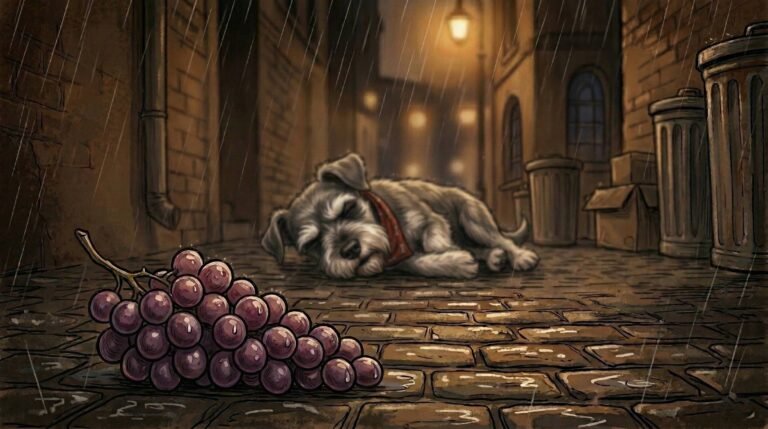
Grapes and raisins are the most unpredictable toxin on the list because the mechanism isn’t fully understood. The leading hypothesis involves tartaric acid — a compound that humans filter through their kidneys without incident, and that dogs apparently cannot process the same way.
What’s known is that some dogs eat several grapes and seem fine. Others eat two or three and develop acute kidney failure within days. The variability suggests individual differences in how dogs filter tartaric acid — some dogs have more tolerance, some have almost none. You don’t know which kind of dog you have until it’s too late to find out safely.
The kidney failure, once it starts, progresses even when the dog appears to be recovering. This is why early intervention matters even when there are no symptoms.
Insulin regulation
Xylitol is the clearest example of divergent biology. In humans, xylitol is metabolized slowly and causes no significant insulin response. In dogs, xylitol triggers the pancreas to release a massive surge of insulin — as if the body has encountered far more sugar than it has. Blood glucose crashes. The brain and organs are starved of energy within thirty minutes.
Big Guy read that sentence twice. I know because I was counting.
The same compound. Two species. Completely different outcomes. Not because dogs are fragile — because dogs are different.
Organosulfur compounds
Onions and garlic contain sulfur-based compounds that humans convert harmlessly. Dogs convert them into substances that oxidize hemoglobin — the protein in red blood cells that carries oxygen. The result is Heinz body formation and hemolytic anemia: red blood cells that rupture before they can do their job.
This one I know personally. I was a few weeks old. I didn’t know what garlic was. I know now.
The damage is cumulative and delayed — which is why a dog can eat something on Monday and not show symptoms until Thursday. By then, the problem has been building for four days.
The List on the Fridge
Somewhere around page sixty, Big Guy got up, found a pen, found paper, and wrote something down.
He taped it to the fridge.
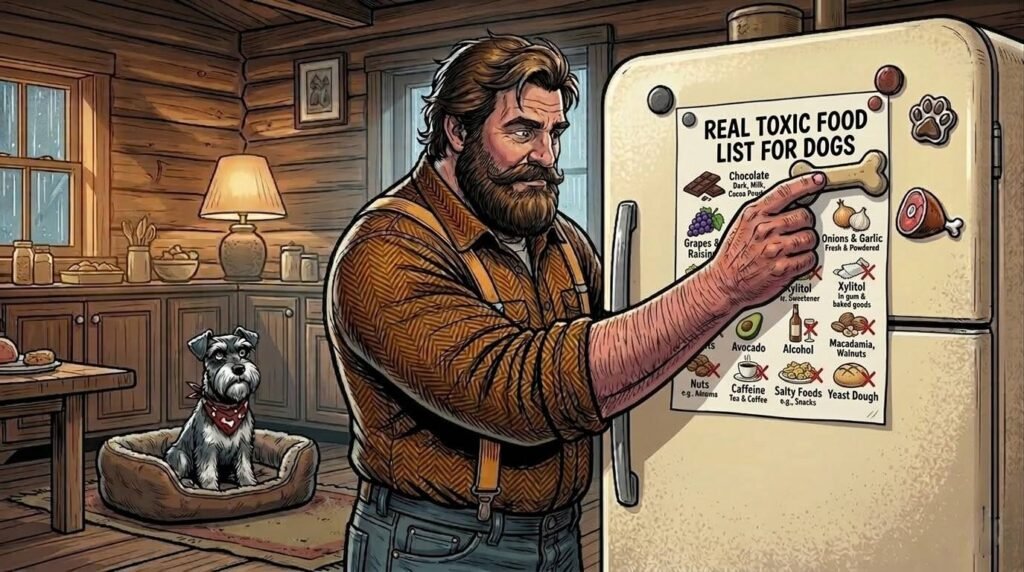
I couldn’t read it. But I could smell it — ink, paper, and the specific combination of focus and relief that comes from a person who has made a decision and feels better for it.
Later I figured out it was a list. The dangerous ones. The ones to never give me, never leave within reach, never assume were fine because they were fine for him.
He’d done the reading. He’d made the list. He’d put it somewhere he’d see it every day.
This is the thing about Big Guy — he doesn’t always know things the first time. But he learns. And when he learns, he acts. The book arrived three days after the garlic incident. The list went on the fridge the same evening he read about xylitol.
Not a fast learner. A thorough one.
I can work with thorough.
What This Means Practically
Dogs aren’t small humans with fur. They’re a different species with different biochemistry, and the differences matter most in the places where human food intersects with dog biology.
The hidden danger in “a little bit”: Small amounts of some toxins aren’t safe — they’re just slower. Theobromine accumulates. Organosulfur compounds accumulate. Repeated small exposures to onion powder in food, garlic in sauces, xylitol in peanut butter add up over time in a system that can’t clear them efficiently.
The hidden danger in “it never affected them before”: Some toxins are unpredictable. Grapes work differently in different dogs. Xylitol concentration varies by product. The fact that your dog ate something once and was fine is not evidence that it’s safe — it’s evidence that they were fine that time.
The hidden danger in “natural” or “healthy”: Grapes are healthy. Garlic is healthy. Macadamia nuts are healthy. Healthy for humans. The word means nothing when you’re a different species with a different liver.
What to do instead:
Start with the list — the complete toxic foods guide has everything on it. One page, printable. Big Guy made his own version and taped it to the fridge. Same idea.
If you want the science behind why these foods are dangerous — the actual biology, not just the list — Rodney Habib and Dr. Karen Shaw Becker’s The Forever Dog is where Big Guy went next. It’s the book he read that evening, the one that made him stop mid-sentence and read certain paragraphs twice. Thorough, research-backed, written by a veterinarian.
The list tells you what to avoid. The book tells you why. Both have their place.
That Evening
He finished the chapter. Put the book down. Looked at me for a long moment.
Then he got up, went to the kitchen, and came back with my dinner. Regular time. Regular food. He put it down in front of me and stood there while I ate, which he doesn’t usually do.
When I finished, he scratched behind my ears — the good spot, the one he’d found in the second week — and said something I didn’t fully catch. Something about being more careful. Something about the list.

I licked his hand. It seemed like the right response.
He went back to the book. I went back to the radiator.
Outside, it was getting dark. Inside, Big Guy was learning things about me he should have known earlier, and making a list so he wouldn’t forget them.
Not a bad evening, all things considered.
Ham
Garlic Incident Survivor, Reluctant Biology Subject, Fridge List Endorser
Our content is for educational purposes only, not veterinary advice. For complete guidance on dog nutrition, consult your veterinarian.
FAQ
Why can humans eat chocolate but dogs can’t? Different enzymes. Humans clear theobromine from chocolate within a few hours. Dogs take around seventeen hours. The same amount that’s harmless to a human accumulates in a dog’s system all day, continuing to affect the heart and nervous system.
Is it true that some dogs can eat grapes without getting sick? Yes — and that’s exactly what makes grapes so dangerous. Some dogs tolerate them, some don’t, and there’s no reliable way to know which kind of dog you have without risking kidney failure. There is no established safe dose.
Why is garlic toxic to dogs but not humans? Humans convert the organosulfur compounds in garlic harmlessly. Dogs convert them into substances that damage red blood cells. The damage accumulates and often doesn’t show symptoms for two to four days.
Can dogs eat any human food? Yes — many human foods are safe for dogs. Plain cooked meat, most vegetables, some fruits. The issue is specific compounds that humans and dogs process differently. When in doubt, check before sharing.
Does cooking make toxic foods safe for dogs? Not for most toxins. Theobromine, organosulfur compounds, and tartaric acid survive cooking. Xylitol survives baking. Cooking changes texture, not chemistry.