Can Dogs Eat Eggs? A Schnauzer’s Survival Guide to the Most Misunderstood Breakfast
Yo, food lovers.
Answer First
Yes — can dogs eat eggs is a yes, with conditions. Cooked eggs are safe and one of the strongest protein sources you can give a dog. Skip raw eggs — salmonella risk plus a biotin-absorption problem makes them a bad bet. Serve plain: no butter, no oil, no salt, no seasonings. Scrambled or boiled, cut to size, in small portions. A little, often. Diabetic dogs and dogs on restricted diets, vet first.
Here’s the longer story of how I almost stopped Big Guy from poisoning himself one morning.
How I Learned About Eggs the Hard Way
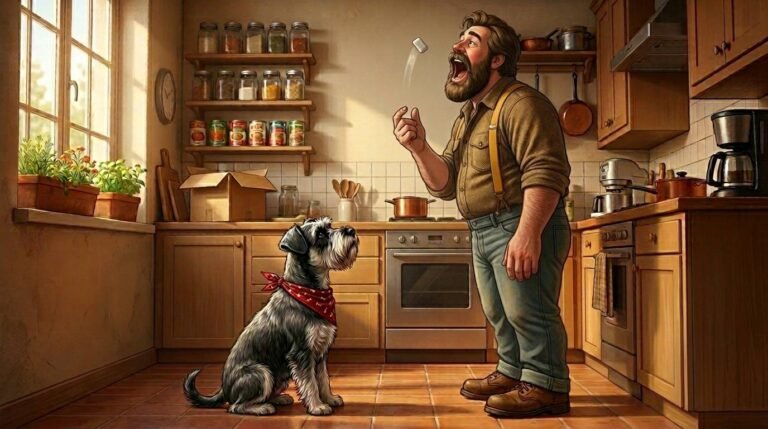
It was a regular morning. Big Guy was in the kitchen. I was in the kitchen. Where else would I be? That’s where we both live before the coffee happens.
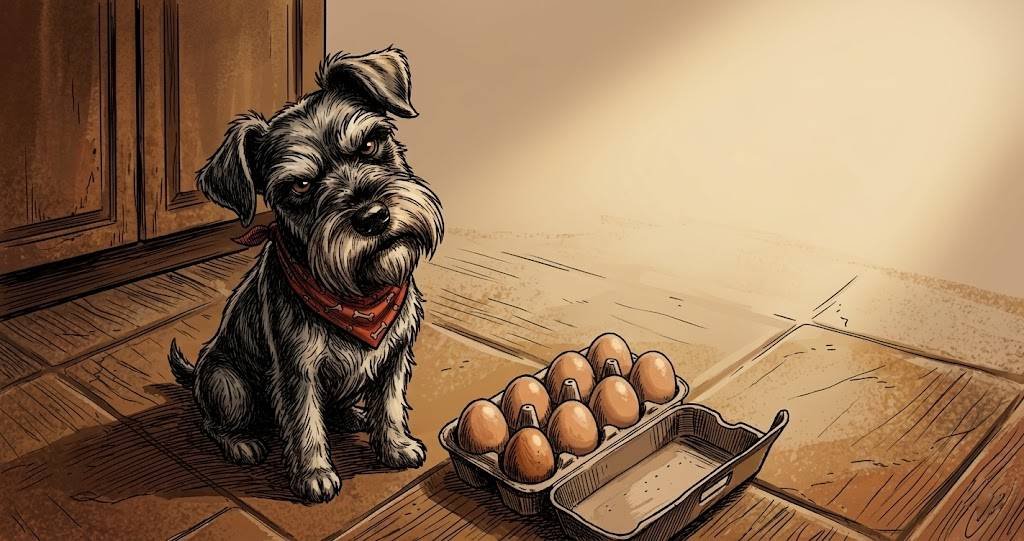
He opened the fridge. He pulled out a carton. Set it on the counter. Opened it.
Something was off. One of them smelled weird.
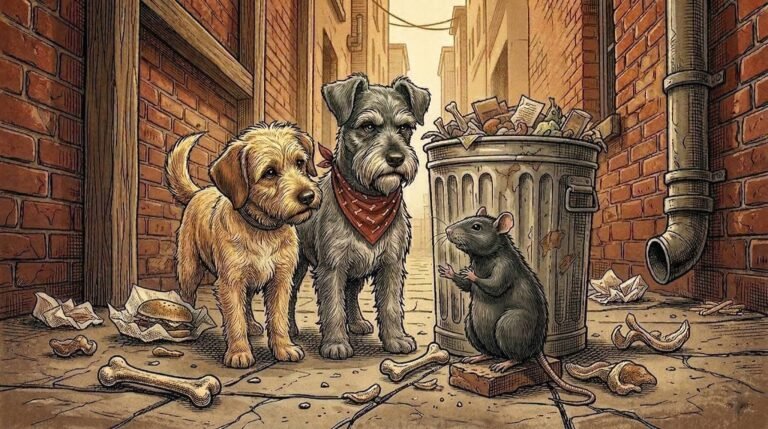
The smell coming off that one egg was sharp, sulfurous, wrong. A smell I knew from a long time ago. On the street, that smell meant don’t. That smell meant step back. That smell meant a dog I used to know who didn’t step back. He didn’t have George as a friend.
George had been very clear about this once. A whole afternoon’s lecture in an alley.
“If it smells like sulfur. If it smells sour. If it smells like rot. Don’t eat it. The bad egg kills. Even the smell is a warning.”
I’d never forgotten.
And now there was a bad egg sitting on Big Guy’s counter, and Big Guy hadn’t noticed. My nose investigated it, because investigating is my job. And he saved my life. So I had to protect him.
His hand reached toward the carton.
I didn’t know which one he was going to pick.
If he grabbed the bad one — and there was a one-in-six chance — he was about to eat poison. In his own kitchen. On a regular morning. Who would feed me if he killed himself? With me right here, standing two feet away, knowing what was about to happen and unable to say a single word about it.
I started barking.
Not my normal bark. Not the someone’s-at-the-door bark or the that-squirrel-is-on-my-property bark. The other one. The short, sharp, repeating one. Stop. Stop. Stop.
Big Guy turned around. Said my name in the calm voice he uses when he thinks I’m being dramatic. Turned back to the carton.
Picked up an egg.
I couldn’t tell which one. He turned to the stove, where a pot of water was already boiling. He lowered the egg into the water with a spoon. Just one egg. The shell still on. Bobbing there. Cooking.
No way to tell now whether it was one of the five good ones or the one bad one.
I escalated. Louder. Closer. I stood at his feet by the stove, looking up, barking. He looked down. He patted my head. He kept waiting for the water. The smell in the kitchen was shifting — warm shell, hot water, the faint thing that boiling eggs do — and my nose couldn’t tell anymore whether it smelled okay or whether it smelled like cooked bad. The heat changes things. The heat hides things.
I jumped up against his shin once. Not aggressively. Just — please. Stop.
He laughed. He thought I was being cute. He kept cooking.
Big Guy was about to eat eggs that might be killing him, and the only one in the room who knew was a schnauzer with no vocabulary.
He pulled the egg out with the spoon, ran it under cold water, peeled it on the counter. Cut it in half. Cut off a corner of the white. Crouched down. Held it out to me.
I stepped back.
I’d never refused food from Big Guy before. Not once. Not the carrot, not the strawberry, not the bread, not anything. But this — this might be the one in six. This might be the piece that ends with me on the kitchen floor not getting up.
I stepped back.
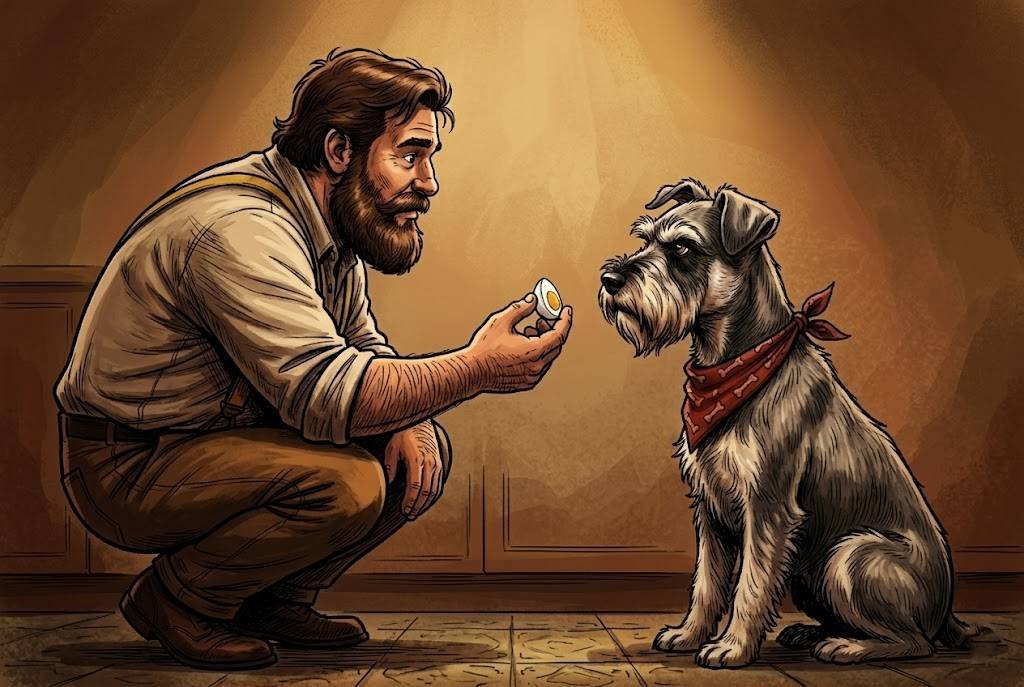
He looked at me, confused. Hand still extended. Holding a piece of warm hard-boiled egg.
He waited a second. Then he shrugged, brought the piece back to his own mouth, and ate it himself.
He chewed. He swallowed. He went back to his plate and kept eating.
I watched him.
And as he chewed — calmly, the way you chew breakfast, not the way you chew a thing that’s about to kill you — something else George had told me came back. It was about houses.
“In houses, eggs are different. They sort them. They keep them cold. The bad one is rare, and when there is one, they throw it out. Humans eat eggs. If you’re in a house and the human is eating eggs — that’s not your street egg.”
George had said it once. I’d filed it under not relevant. It had been not relevant for a long time.
It was relevant now.
Big Guy finished his plate. He didn’t fall down. He didn’t get sick. He stood up, took his plate to the sink, went to the coffee machine.
He’d lived.
I went over to where I’d been standing. The bowl was empty. The plate was empty. The fork was in the sink. I didn’t know which egg had been the bad one and I never would.
Big Guy crouched down again. Held out a different piece — a small one, cool now, from a corner of the plate he hadn’t finished. Offered it again.
I sniffed it.
It smelled clean. It smelled like food. It didn’t smell like the one in six.
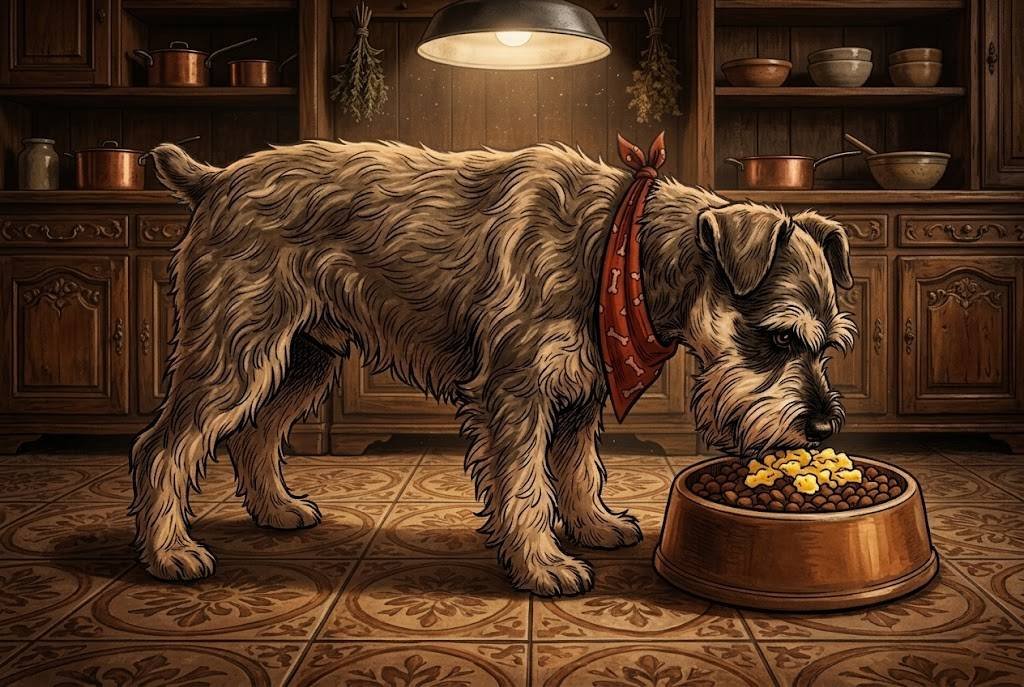
I took it. I chewed it. I swallowed it.
First egg of my life.
It wasn’t bad. It might even have been good. I’d have to eat a few more before I had an opinion.
The next morning, Big Guy was back at the counter with another carton. He cracked an egg into a bowl, sniffed it, and dropped it in the trash. Shell and all. He pulled a new one from the carton, cracked it, sniffed, kept that one.
Here’s what I’ve learned about eggs since that morning.
Are Eggs Safe for Dogs?
Yes. Cooked eggs are one of the most nutrient-dense, dog-safe foods you can pull out of a fridge.
They’re complete protein — meaning every amino acid a dog needs is in there. They’ve got B vitamins, especially B12. They’ve got selenium. They’ve got riboflavin. They’ve got iron. They’ve got essential fatty acids. The AKC confirms eggs as a strong protein source for dogs, in case you wanted it from someone with a diploma.
What they don’t have, when cooked plain: anything dangerous. No toxic compound. No species-specific problem.
The cooked part is doing a lot of work in that sentence. We’ll get to raw in a minute.
When people ask can dogs eat eggs, every reliable safe human food list says the same thing: yes, cooked, plain. The vets agree. The trainers agree. The dog agrees too, after he gets over his survival instinct and figures out the house version is different from the street version.
You eat eggs for breakfast because they keep you full until lunch. The dog gets a small piece because the same logic applies, just at smaller scale. Different stomach, same protein.
Cooked eggs are safe. Raw eggs are a separate conversation.
Raw vs Cooked Eggs — The Real Difference
This is where the internet splits. One side says raw eggs are natural and dogs evolved to eat them. The other side says they’re a salmonella problem waiting to happen. The actual answer requires understanding two things, not one.
Salmonella risk. Raw eggs can carry salmonella — both the supermarket kind and the backyard kind, though it’s rarer in well-handled eggs. Dogs have more acidic stomachs than humans, which helps, but it’s not a force field. Salmonella in dogs looks like vomiting, diarrhea, fever, lethargy. Older dogs, puppies, and immunocompromised dogs are at higher risk. The fix is simple and absolute: cooking kills salmonella. Cook the egg, the salmonella goes away.
Biotin absorption. This one’s less talked about. Raw egg whites contain a protein called avidin, which binds to biotin — vitamin B7 — and prevents it from being absorbed. One raw egg, occasionally, won’t cause a biotin deficiency. Daily raw eggs over a long period can. Biotin deficiency in dogs shows up as skin problems, coat degradation, and slower healing. PetMD covers the biotin issue in more detail, and they’re more polite about it than I am. Cooking the egg inactivates the avidin. Cook the egg, the biotin problem goes away.
Both problems have the same solution. Cook the egg. There is no good reason to feed a dog raw eggs that survives a serious look at the evidence.
Now, how to cook them.
Hard-boiled is the safest, simplest option. Cook them through, peel them, cut to size, serve plain. No salt, no pepper, no nothing. A hard-boiled egg is a delivery system for protein — keep it that way.
Soft-boiled is a no. The yolk may still be runny, which puts you back in the salmonella conversation. Not worth the trouble.
Scrambled is great — if you scramble them dry. No butter, no oil, no milk, no cream, no salt, no seasonings. Just egg in a hot pan, stirred until set. Most humans add at least three things scramble that a dog shouldn’t eat. Cook the dog’s eggs separately, plain, before you cook yours with all the extras.
Fried eggs are not great. Frying requires fat — usually butter or oil — and the yolk often isn’t fully cooked. Skip them for the dog.
Egg salad is a hard no. Mayonnaise, mustard, often onion or garlic powder. None of that belongs in a dog.
You wouldn’t eat a raw egg sandwich on the way to work. You cook it first. Same instinct applies twice over for the dog — salmonella once, avidin twice.
Cook them. Plain. That’s the whole answer.
How Many Eggs Can a Dog Eat?
Eggs are protein, and protein is heavier than vegetables. The 10% rule applies — and it bites harder here than with carrots or strawberries.
The 10% rule, one more time: treats, snacks, additions — anything that isn’t the dog’s regular balanced food — should stay under 10% of daily calories. Eggs count. They’re not free just because they’re healthy. They’re a treat with calories, fat, and cholesterol attached.
For a small dog, a quarter to half an egg, a few times a week, is plenty.
For a medium dog, half to one whole egg, a few times a week.
For a large dog, one whole egg, a few times a week.
Not every day. Eggs are dense — too many, too often, means too much cholesterol and too much fat for most dogs over time.
The other thing worth noting: eggs and plain cooked chicken are the classic restorative combination for a dog coming off a bland-diet stretch — say, after a stomach issue. The protein is gentle, the prep is simple, and the dog usually accepts both. If your vet has recommended bland food and you’re tired of plain rice and chicken, a little plain scrambled egg fits the same brief.
A little, often. Not a lot, every day.
Eggshells for Dogs — Calcium Source or Internet Myth?
Eggshells contain calcium. That part isn’t a myth. The myth is the rest of the story.
The claim: grind up eggshells, sprinkle them on your dog’s food, free calcium supplement. The reality is more complicated.
Yes, eggshells are calcium carbonate, and yes, calcium carbonate is a real source of calcium. But there are two problems with the simple version of this advice.
First: whole eggshells or large pieces are not food. They’re sharp, they’re hard to chew, and they can scratch the digestive tract or cause choking. If you’re going to do this, the shells have to be ground to a fine powder. Like, powder powder. Not crunchy little fragments.
Second: most dogs on commercial dog food are already getting their daily calcium requirement from their kibble. Adding more calcium isn’t a small thing — it can push the calcium-to-phosphorus ratio out of balance, which matters especially for growing puppies and large-breed dogs. Too much calcium during growth has been linked to skeletal problems.
Eggshell powder isn’t dangerous as a one-off. As a daily supplement, it’s a vet conversation, not a casual addition.
You wouldn’t take random handfuls of calcium pills with no idea of the dose. Eggshell powder is the same thing without the label.
Eggshells can help. They can also overdo it. Vet first if it’s a regular thing.
Why Some Dogs Refuse Eggs at First
Most dogs love eggs. Some don’t — and the reason is rarely about the food itself.
Dogs categorize food by smell, and they categorize fast. A dog that’s been on the street, or that’s eaten something bad once, or that learned from another dog to avoid a certain smell, can carry that learning for the rest of their life. The category sticks even when the actual food in front of them is completely different.
A bad egg has a specific smell — sulfur, sour, rot. A good cooked egg shares enough of that chemistry that a sensitive nose can read the wrong category at first. The dog isn’t being picky. The dog is reading data you can’t read, and matching it against a survival rule that worked once.
If your dog refuses eggs, here’s what actually helps.
Start with hard-boiled. The smell is the mildest. Cut a tiny piece. Don’t make a thing of it.
Mix it with something familiar — plain cooked chicken works well, and the chicken-and-egg combination is gentle on most dogs. The familiar food shifts the egg’s category from unknown to probably fine.
Don’t push. A suspicious dog who gets pushed becomes a stubborn dog who refuses for longer.
Give it time. Some dogs accept eggs the first time. Others need three, five, seven exposures before the category updates.
I’m one of those dogs. It took me a while. George had taught me well, and his lessons had an end-date he didn’t know about. Same thing happened with strawberries that day in the garden — different food, same problem. The instinct to hesitate is real, and it deserves respect, not correction.
You once ate something that gave you food poisoning. You can still taste it years later. Your dog has the same memory, just no words to explain it.
Trust takes time. With food, the dog isn’t being picky — they’re being careful.
The Verdict
Big Guy still makes eggs in the mornings. I no longer try to stop him. He pays more attention. I no longer bark, I no longer get between him and the stove, and I no longer step back when he offers me a piece.
I still check the smell of every egg he pulls out of the carton.
Old habits.
What I took away from that morning — and what I’m telling you now — is that a dog’s reaction to a food is rarely about the food alone. It’s about everything that food has meant before. The street and the house aren’t the same place. The same smell can mean two different things. A survival rule that kept you alive in one context can make you miss a good breakfast in another.
So — can dogs eat eggs? Yes, cooked, plain, in moderation. Skip raw, skip the seasonings, skip the daily-omelet ambition. And if your dog hesitates the first time, don’t take it personally — they’re carrying instructions you didn’t write.
Updated personal ranking: chicken still first, by a landslide. Bread second. Strawberries third. Eggs — new entry, holding their own — fourth. Banana drops to fifth. Carrot sixth. Kale still doesn’t qualify and we still don’t need to discuss it.
If your dog refuses eggs, don’t take it personally. They’re not insulting your cooking. They’re remembering something you don’t know about.
Ham
Reluctant Egg Convert