Can Dogs Eat Chicken? A Complete Safety Guide
Yo, food lovers.
Answer First
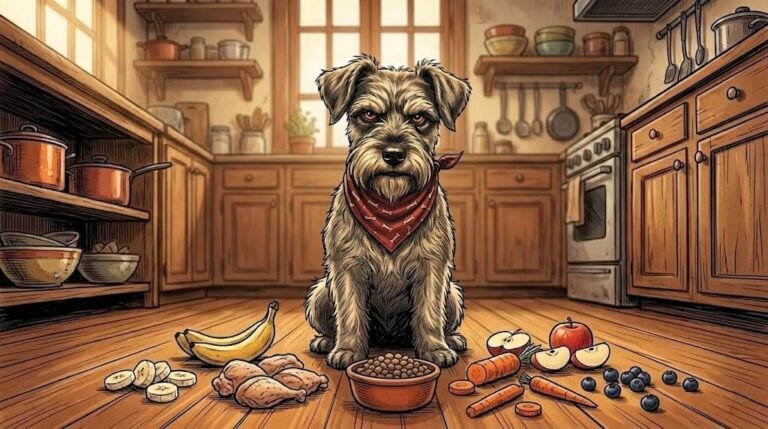
Can dogs eat chicken? Yes — plain cooked chicken, boneless and unseasoned. That’s the whole safe list. Cooked bones can splinter and cause choking, obstruction, or internal injury. Raw chicken risks salmonella for your dog and your family. Roast chicken with garlic, onion, butter, or salt is not safe chicken anymore. Feed it 2-3 times a week max as a treat or topper, max 10% of daily calories. Plain chicken alone is not a complete diet — for chicken-based meals, you need a vet-formulated recipe. Boiled, plain, boneless, cooled, cubed. That is the safe version.
Now let me tell you exactly how this works in my kitchen.
The Day Big Guy Roasted a Whole Chicken
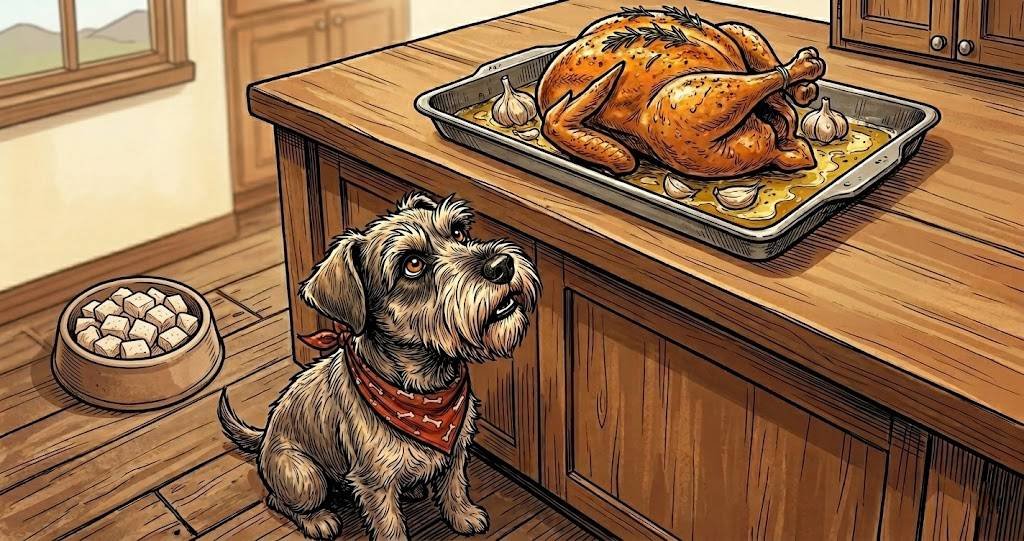
It’s Sunday. Big Guy pulled a whole roasted chicken out of the oven. It has golden skin, rosemary tucked under it, garlic cloves nested around the legs, butter pooled at the bottom of the pan.
The smell hit me before the oven door fully opened.
I had positioned myself strategically at the counter corner. Eye line on the carving board.
Then Big Guy did something interesting.
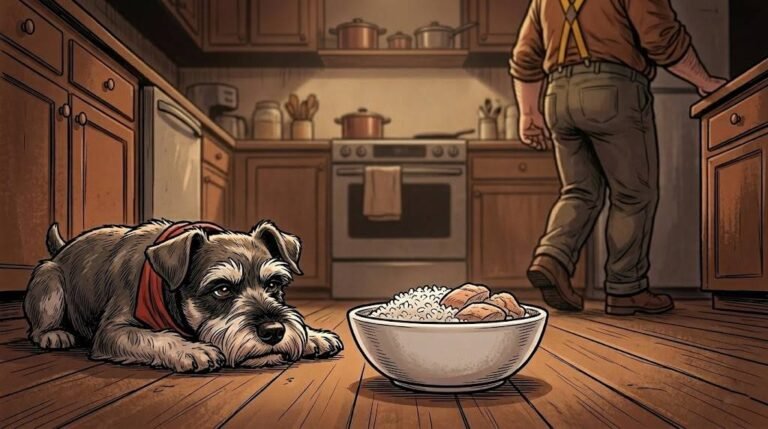
Before he touched the seasoned bird, he opened the fridge and pulled out a small Tupperware. Inside that there was a plain boiled chicken breast. No skin. No seasoning. Cubed and cooled. He set it on my mat. Then he carved the roast for himself — the buttered, garlicked, salt-rubbed Sunday version.
One bird. Two meals.
You read ingredient labels at the grocery store. Big Guy reads them for me. The chicken on his plate has things in it that would send me to the vet. The chicken on my mat doesn’t. Same animal, different preparations. One feeds me. One would hurt me.
If you can’t tell the difference, you shouldn’t be sharing.
The chicken on Big Guy’s plate is not the chicken on mine. Plain or nothing.
Quick Diagnosis: Which Chicken Are You About to Give Your Dog?
Look at the plate. Match the list:
- Plain boiled or baked, no skin, no seasoning, no bones → safe
- Cooked bones, any kind, any size → never, vet now if eaten
- Raw chicken → don’t, unless your vet signed off
- Roast chicken with garlic, onion, butter, or salt → no
- Fried, breaded, nuggets, fast food → no
If you can’t tell what’s in it, skip it. Plain or nothing.
Plain Cooked Chicken: The Only Version That’s Safe
Small amounts. Not daily. Not processed. That’s the rule.
Veterinarians often recommend plain chicken as part of a temporary bland diet when appropriate. The American Kennel Club and the AVMA both back chicken-and-rice as the standard bland diet for dogs recovering from vomiting or diarrhea. Wait 24 hours after symptoms stop, then start small portions.
Outside of recovery, chicken works as a treat or meal topper. Plain chicken alone is not a complete diet — it’s missing calcium, several vitamins, and the right fat balance. If you want to feed chicken as a main meal protein, that’s a vet-formulated recipe conversation, not a blog conversation. The 10% rule applies for treats and toppers — they shouldn’t exceed 10% of your dog’s daily calories.
Hard limits:
- Frequency: 2-3 times a week max as a regular treat
- Portion (small dogs, under 20 lbs): 1-2 tablespoons cubed
- Portion (medium dogs, 20-50 lbs): ¼ cup cubed
- Portion (large dogs, over 50 lbs): up to ½ cup cubed
- Bland diet exception: vet-prescribed only, follow vet’s portion guidance
- Full meal exception: vet-formulated home-cooked recipe only, never DIY
You eat chicken soup when you’re sick. I get plain boiled chicken when my stomach’s wrecked. Same idea, less broth.
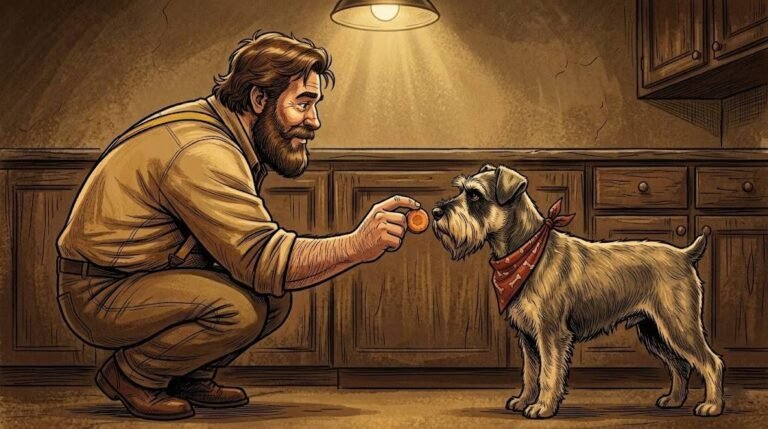
I had a bad reaction to something in the yard once. Big Guy boiled chicken for two days. Plain water, no salt, fully cooked, cooled, shredded. Small portions every few hours. Day three I was back to normal.
Treat, topper, or vet-formulated meal. Not a guess.
Cooked Chicken Bones: The One That Actually Kills
This section is not funny.
Cooking changes bone structure. Cooked bones become brittle. They splinter. Splinters puncture mouths, lodge in throats, tear esophagus walls, cut intestines. Choking is the immediate risk. Internal puncture and obstruction are the slow-motion versions.
Drumstick and wing bones are the most common ER cases. Carcass bones are the worst — too many pieces, all sharp, often swallowed in a hurry from a trash can.
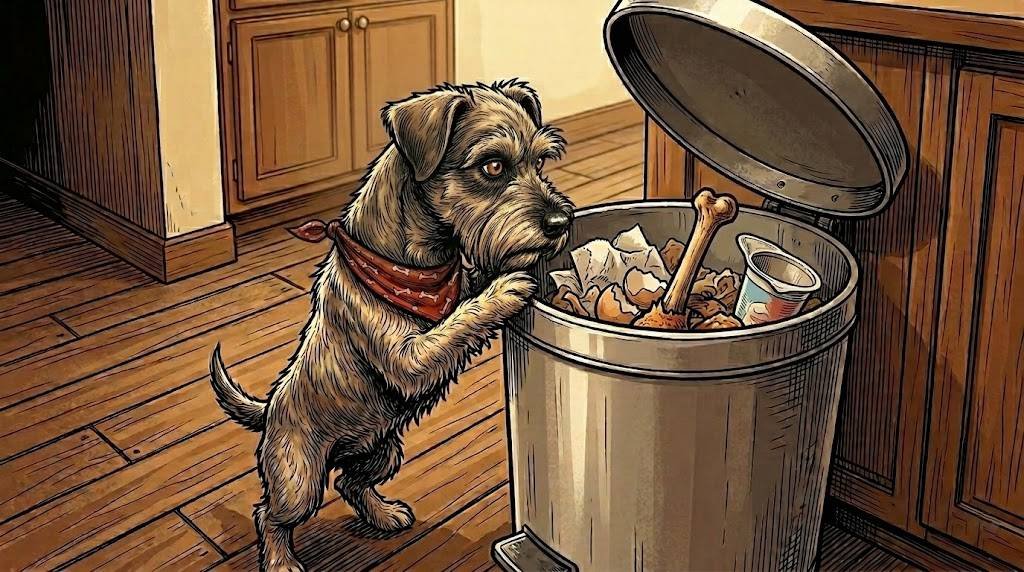
The rule covers every cooked chicken bone. Wings, drumsticks, thighs, breast bones, carcass scraps. The piece left on Big Guy’s plate after he’s done eating. All of it.
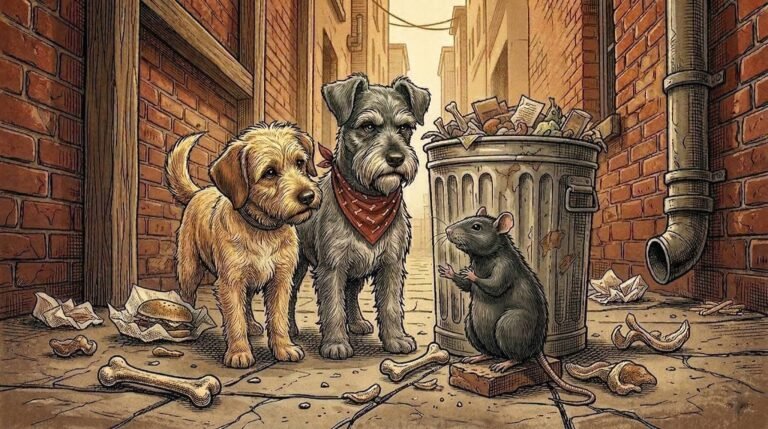
My friend and mentor George the rat saw a dog eat a roast chicken carcass once. The dog needed emergency care. George didn’t say much about it after. It must have been a sad story.
Raw bones are a separate conversation, and some vets approve them under supervision. That’s between you and your vet. The cooked-bone rule has no exceptions — see the full list of kitchen kills
If your dog ate a cooked chicken bone:
- Don’t induce vomiting — splinters going up cause more damage than splinters going down
- Call your vet or emergency animal hospital immediately
- Watch for: lethargy, vomiting, refusing food, straining or bloody stool, signs of pain
- Don’t wait for symptoms to start — call first
You wouldn’t swallow a splinter on purpose. Cooked chicken bones are splinters that smell like dinner.
No cooked bones. Ever. Not the wing tip. Not the carcass scrap. Nothing.
Raw Chicken: Skip It
Don’t start raw without a vet. Don’t switch to raw because a friend’s dog does fine. Don’t feed raw if you have kids or immunocompromised humans in the house. Three rules. No exceptions.
Some people feed raw, some vets disagree. I’m not settling that fight.
Salmonella and campylobacter are the risk. Dogs tolerate these bacteria better than humans, but they shed bacteria in saliva and stool for days after eating contaminated meat. That’s a household problem. Kids touching the dog. Immunocompromised humans in the home. The dog licks your face.
The AVMA officially discourages raw diets for that public health reason. The FDA has flagged raw pet food as a contamination source.
You don’t eat raw chicken. Your dog probably shouldn’t either. And even if she could, you’re the one cleaning up.
Raw chicken is a vet conversation. If you’re unsure, skip it.
The Roast Chicken Problem: When the Meat Is Fine but Everything Else Isn’t
Big Guy’s Sunday roast is not safe for me. The meat is, but the roast is not.
The meat didn’t change between the grocery store and the oven. The seasoning did.
What’s typically in a roast chicken that hurts dogs:
- Garlic — toxic to dogs cooked or raw, even small amounts, especially with repeated exposure. Damages red blood cells. Damage is cumulative.
- Onion — same family as garlic, same problem. Onion in the cavity, onion powder in the rub, onion in the gravy — all hazardous.
- Butter and oil — pancreatitis risk. Schnauzers are predisposed. Yes, I’m aware.
- Salt rub — sodium load, especially heavy on a crusted bird.
- Skin — fat-heavy even unseasoned. With seasoning, worse.
- Herbs — vary. Rosemary in small amounts is generally fine. Others aren’t. If you can’t identify every herb, don’t share.
For garlic and onion in any form — cooked, raw, powdered, fresh, doesn’t matter. The “small amount won’t hurt” thinking is how dogs end up at the vet.
Fried, breaded, fast-food, nuggets — all out. Fat alone is a problem. Breading often contains onion or garlic powder. Fast-food sodium is off the charts. Nuggets are a fat-salt-coating combination that’s bad for dogs and bad for humans. The drive-thru is not a treat source.
The fix is simple: set aside a portion BEFORE you season the bird. Boil it separately in plain water. Or skip sharing the roast entirely and feed her plain chicken on a different day.
You don’t share your seasoned, salted, buttered roast with the toddler in the high chair either. Same logic. Smaller stomach, less margin.
Big Guy now sets aside my portion before he seasons his bird. He didn’t always, he learned. The Tupperware in the fridge is the result.
The chicken is fine. What you put on it is the problem. If you can’t separate the two, don’t share.
How to Actually Serve Chicken to Your Dog
Five steps. Memorize them.
1. Buy boneless, skinless chicken breast or thigh. Breast is leaner, thigh has more fat. For most healthy dogs either works. For a recovering dog or a dog with weight issues, breast.
2. Boil in plain water. No salt. No broth. No bouillon cube. No seasoning of any kind. Plain tap water and chicken. 15-20 minutes for breast until fully cooked through. Internal temperature 165°F if you check.
3. Cool fully before serving. Lukewarm or cooler. Hot food burns mouths.
4. Shred or cube to your dog’s size. Smaller pieces for smaller dogs. Cubing reduces choking risk and lets you control portion.
5. Refrigerate leftovers in a sealed container, use within 3-4 days. After four days, compost.
Portion enforcement (the part most owners ignore):
- Small dogs: 1-2 tablespoons cubed
- Medium dogs: ¼ cup cubed
- Large dogs: up to ½ cup cubed
- Frequency: 2-3 times a week as treat or topper
- Never more than 10% of daily calories
- Vet-prescribed bland diet or vet-formulated full meal are the only exceptions
The same logic applies to every human food you share. Chicken is one food in a bigger picture — see the full safe foods list .
You meal prep chicken on Sunday for the week. I just need you to remember the no-salt rule.
Boiled, plain, boneless, cooled, cubed. Five words, no sixth.
When to Call the Vet
Call if your dog:
- Ate a cooked chicken bone of any size — don’t wait for symptoms
- Ate raw chicken and is vomiting, has diarrhea, or seems lethargic
- Ate a heavily seasoned roast, especially with garlic or onion
- Shows signs of pancreatitis after fatty chicken — repeated vomiting, abdominal pain, hunched posture, no appetite, lethargy
- Is choking or gagging — emergency, don’t drive, call
The Pet Poison Helpline and ASPCA Animal Poison Control both run 24-hour lines. Save the current numbers in your phone before you need them.
When in doubt, call. Don’t Google. Don’t wait. Call.
The Two Chickens
It’s Evening. Big Guy on the rocking chair the kitchen is clean. Tupperware in the fridge with tomorrow’s portion already cubed.
The chicken on Big Guy’s plate today had garlic, butter, salt, rosemary, and skin. It would have hurt me. The chicken on my mat was the same animal, prepared a different way. It didn’t hurt me. It fed me.
The ingredient is rarely the problem. What humans do to the ingredient is.
The five rules for sharing chicken with your dog:
- Plain or nothing. If it’s seasoned, it’s not for her.
- Boneless always. Cooked bones are not negotiable.
- Treat, topper, or formulated meal. 10%, 2-3x a week as treat. Never daily as a guess.
- Start small or don’t start. New foods test small first.
- If you’re unsure, skip it. Better hungry than at the vet.
Big Guy figured this out. Your dog is hoping you will too.
Ham
In-House Chicken Expert, Strictly Plain