Can Dogs Eat Carrots? A Schnauzer’s Honest Review of the Orange Vegetable
Yo, food lovers.
Answer First
Yes — dogs can eat carrots. They’re safe, low-calorie, and full of fiber and beta-carotene. Serve them raw in chunks for medium and large dogs, or grated and cooked for puppies and small breeds — choking risk is real with whole baby carrots. Skip the seasoning. Skip the butter. Keep portions under 10% of daily calories. Diabetic dogs, talk to your vet first. Cut to size, serve plain, done.
Here’s the longer story of how I came around to the orange thing.
I heard it before I saw it.
I was on my bed in the living room, half-asleep, half-listening — which is my default state when Big Guy is in the kitchen. I know his sounds. Bread is soft. Chicken is wet. Apple is crisp and a little sweet. This sound was different. Dry. Hard. Bright. The kind of sound that doesn’t belong to anything I want.
I got up anyway. It is the protocol when I hear a food noise in from the kitchen.
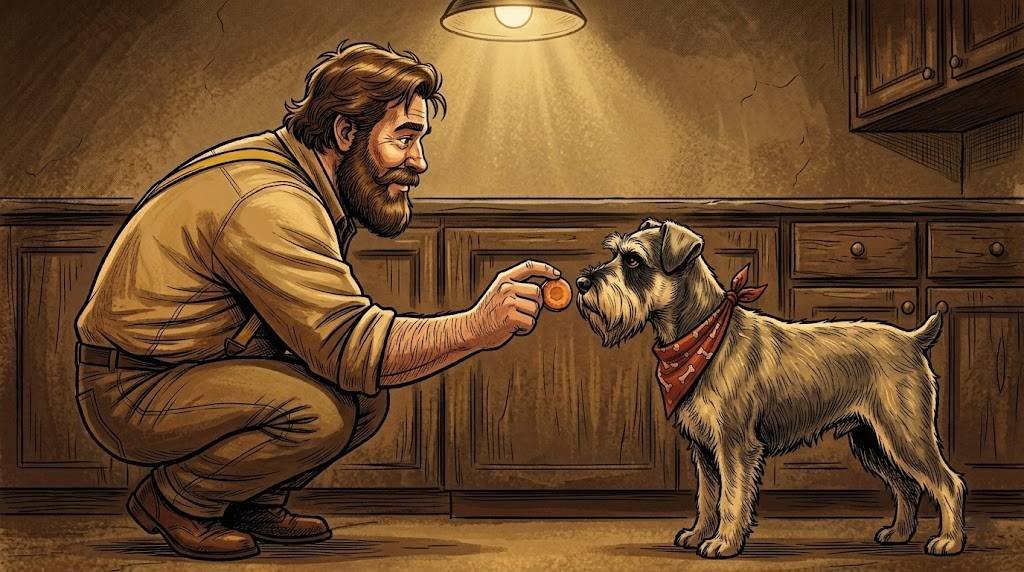
Big Guy was at the counter. Long orange thing in one hand. A chunk of it in his mouth, making that wrong sound. He saw me. Sliced off a piece and held it down.
I sat. I considered. I took it.
I crunched it. I didn’t spit it out. That’s the highest praise carrots are ever going to get from me, and Big Guy seemed to know it, because he just laughed and went back to his cutting board.
That was years ago. I’ve eaten plenty of carrots since. I have opinions, of course.
Here’s what I’ve learned.
Are Carrots Safe for Dogs?
The short answer to can dogs eat carrots is yes, every time.
The long answer is yes. Unambiguously. Carrots are on the short list of human foods that don’t require an asterisk.
They’re low in calories. They’ve got fiber. They’ve got beta-carotene — the thing that makes them orange and does something useful with vitamin A. Vitamin K. Potassium. Water. Crunch.
What they don’t have is the stuff that wrecks a dog’s system. No fat. No salt. Nothing toxic. Nothing that sneaks up on you three hours later.
You eat baby carrots at your desk because they’re not chips. Just healthier.
Carrots show up on every reliable safe human food list for a reason. The AKC confirms carrots are non-toxic and nutritionally useful. The vets agree. The trainers agree. Even the dog agrees, eventually, after a brief inspection.
Carrots are safe. Just don’t expect your dog to write a thank-you note.
Raw vs Cooked Carrots — What’s Better for Dogs?
When people ask can dogs eat carrots raw or cooked, the honest answer is both.
Raw carrots are the loud option. They’re crunchy. They take work to chew. They give the teeth a little friction — a little, I said — and they hold onto more of their vitamins because nothing’s been cooked off. Big Guy slices them into coins, or into sticks, or into rough chunks. Any shape works as long as the size matches the dog. More on size later. That part matters.
Cooked carrots are the quiet option. Steamed, boiled, roasted plain — all fine. They go soft. They’re easier on a sensitive stomach. They’re easier for an older dog to chew. They lose a little of the vitamin content in the cooking, but not enough to lose sleep over. If your dog has a touchy gut or just got over something, cooked carrots are the better call.
Frozen raw carrots are a third thing. A frozen baby carrot — sized appropriately — is a classic move for a teething puppy. Cold helps the gums. Hard helps the chewing instinct. I’m not a teething puppy, but I’ve watched enough of them lose their minds over a frozen carrot to know it works.
The one rule that doesn’t bend: plain. No butter. No salt. No olive oil drizzle. And nothing — nothing — that’s been cooked in a pot with onions or garlic, which are never near carrots in a dog’s bowl. Big Guy makes stew sometimes. The carrots in that stew are not for me. He knows. I know. The cutting board has zones.
You’d eat a raw carrot with hummus. You’d eat a cooked carrot in soup. Neither would change your life. Same logic for the dog — the format is preference, not nutrition science.
Raw for crunch, cooked for sensitive stomachs. Pick whichever your dog actually eats.
Are Carrots Good for Dogs’ Teeth?
A little. Not as much as the internet wants you to believe.
There’s a thing people say — that carrots are nature’s toothbrush. That if your dog eats carrots, you don’t need to worry about dental care. That the crunch scrapes the plaque right off and your dog’s mouth becomes a clean fresh place where dental disease never visits.
This is wishful thinking with a vegetable attached.
What carrots actually do: provide some mild abrasive friction while the dog chews. The fiber and the texture work against the tooth surface a little. Over time, this is marginally better than chewing on something soft. It is not a substitute for brushing. It is not a substitute for dental treats designed for dental work. It is not a substitute for whatever your vet wants you to do about your dog’s teeth.
My rat friend, George says it’s not a toothbrush. George is always right.
You eat an apple. The apple does some incidental cleaning in your mouth. You don’t skip brushing because you ate an apple. Same logic.
If your dog likes raw carrots and chews them up, great — you got a little dental help on the side, plus a snack with some fiber. If you were planning to use carrots as your entire dental strategy, that plan needs revision.
Carrots help. Carrots don’t replace your vet’s dental care plan.
How Many Carrots Can Dogs Eat?
Knowing dogs can eat carrots is one thing. Knowing how many they should eat is another.
Treats are treats. Even the healthy ones.
The number every vet repeats is the 10% rule — treats, snacks, table food, anything that isn’t your dog’s regular meal, should stay under 10% of daily calories. The other 90% needs to be the actual balanced food your dog is supposed to be eating. Carrots are a treat. Even though they’re a vegetable. Even though they feel virtuous. Still a treat.
For a small dog — say a Schnauzer-sized dog, hypothetically, asking for no particular reason — that’s about one or two baby carrots a day, or equivalent in chunks. Maybe a little more on a generous day, but not much. Small stomach, small calorie budget.
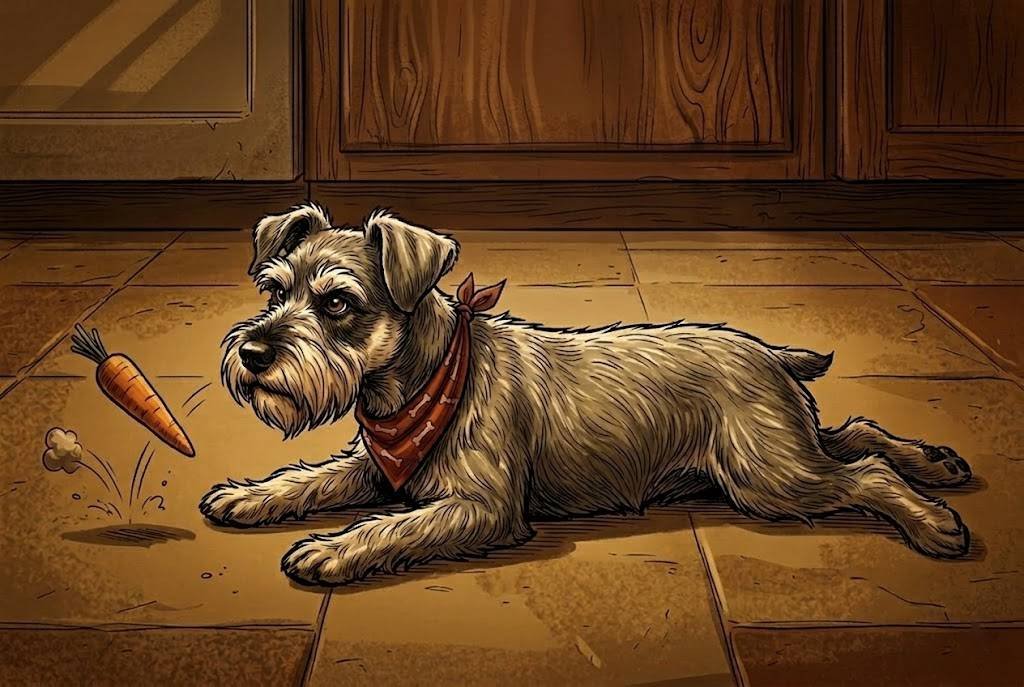
For a medium dog, two to four baby carrots, or one medium-sized carrot cut into pieces, is a reasonable ceiling.
For a large dog like my friend, Alfred, one or two medium carrots, cut up, is fine.
These are ballpark numbers. Your dog’s real number depends on size, activity level, and what else they’re eating that day. If they had a big training session and burned through extra calories, the budget is bigger. If they spent the day on the couch judging the mailman, the budget is smaller.
The other thing worth mentioning: carrots have natural sugar. Not a lot. More than broccoli, less than fruit. For a healthy dog, this is irrelevant. For a diabetic dog, or a dog with insulin issues, the sugar matters and your vet should set the limits, not the internet.
You don’t eat a kilo of carrots in one sitting. Your dog shouldn’t either. Different stomach. Same principle.
Treats stay under 10%. Carrots count as treats.
Choking Risk — Puppies and Small Dogs
This is the part where I’m extremely serious.
A whole baby carrot is the wrong size for a small dog. It’s the wrong size for a puppy. It’s the wrong size for any dog that swallows things faster than it chews them — and there are a lot of those dogs. The shape is the problem. A whole baby carrot is exactly the right size and exactly the wrong shape to lodge in a small dog’s throat.
This isn’t theoretical. Vets see it. It happens.
The fix is simple. Cut the carrot before you give it to the dog. For small dogs and puppies — thin coins, grated shreds, or cooked soft pieces. Nothing they can swallow whole. Nothing that has the geometry of a cork.
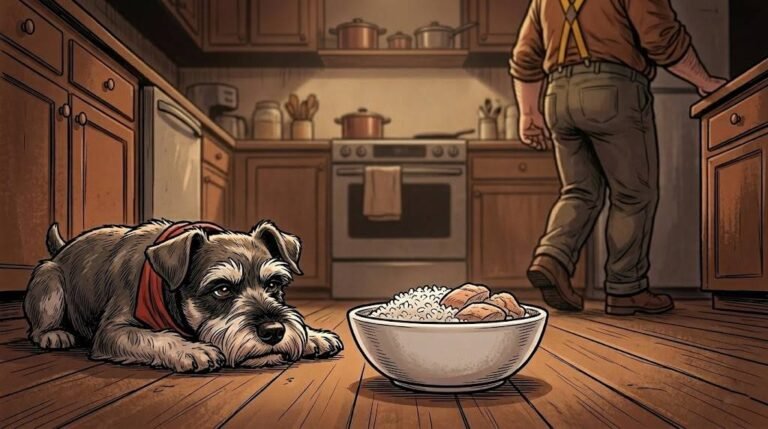
For a dog with a sensitive stomach or a puppy still figuring out their digestive system, soft cooked carrot mixed with plain boiled chicken — the bland diet combo — is gentle, easy, and gets some nutrition in without stress. The carrots cook down soft. The chicken settles things. Both small. Both plain. Both safe.
You’d cut a carrot stick before giving it to a toddler. Same reasoning. Same throat geometry problem. The carrot is fine. The size of the carrot is the question.
Dogs can eat carrots safely. Whole baby carrots are the exception, not the rule.
Cut to size. Smaller dog, smaller piece. No exceptions.
The Verdict
So — can dogs eat carrots? Yes, with the cautions noted above. Big Guy is back at the counter. He’s almost done with whatever he was making. He looks at me. Slices off one more piece. Holds it down.
I take it. I crunch it. I don’t love it. I don’t hate it. I eat it.
That, in the end, is the truest thing I can say about carrots. They don’t pretend to be exciting. They don’t pretend to be a meal. They don’t pretend to be medicine. They’re orange, they’re crunchy, they’re fine. I don’t pretend I like it. But I eat everything. They sit on the spectrum somewhere between real food and something to chew on, and that’s exactly where they belong.
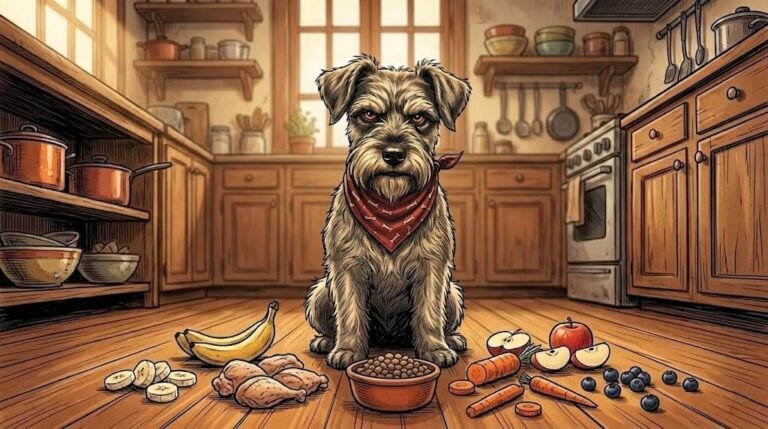
For the record, my personal ranking goes like this: chicken first, by a landslide. Bread second, because Big Guy makes good bread. Banana third, on the days I’m in the mood for soft and sweet. Carrot fourth — present, accounted for, eaten. Kale last, which barely qualifies as food and we don’t need to discuss it.
If your dog likes carrots, feed them carrots. If your dog won’t touch carrots, your dog has standards I respect, but I judge him.
That’s the most you can ask from a vegetable.
Ham
Reluctant Carrot Endorser