Can Dogs Eat Rice? White Rice, Brown Rice, and the Bland Truth
Yo, food lovers.
Rice. The most boring food on the planet. Humans spend decades trying to make it interesting — garlic, butter, soy sauce, things from jars with unreadable labels. Dogs get the plain version. Boiled. Unseasoned. Served lukewarm in a clean bowl.
Dogs win.
Answer First
Plain cooked rice is safe for most dogs. That’s the short answer. The longer answer is about what kind of rice, how much, when it actually helps, and why the rice sitting in your takeout container is a completely different conversation.
Dogs can eat plain cooked rice. Most dogs tolerate it well. It’s a digestible carbohydrate, it shows up in commercial dog food, and it’s been used for decades as part of temporary bland diets for upset stomachs.
White rice is often used short-term as part of a bland diet when appropriate — usually paired with a plain protein like boiled chicken or turkey. It’s easy on the stomach. Low fiber. Not exciting, but that’s the point.
Brown rice has more fiber and more nutrients. For a healthy dog eating an occasional small portion, it can be fine. For a dog with an upset stomach, it’s usually the wrong call. More fiber is not what a struggling digestive system needs.
The rule is simple. Plain, cooked, unseasoned. No butter. No oil. No garlic. No onion. No soy sauce. No sauce of any kind. No fried rice. No takeout rice where you don’t know what went in the pot.
If your dog has ongoing vomiting, diarrhea that isn’t improving, diabetes, pancreatitis, kidney disease, or any chronic condition — or if your dog is a puppy or a senior — call your vet before making dietary changes. Rice is not a treatment plan. It’s an ingredient.
Quick Check: Is This Rice Safe for Your Dog?
Safe: plain cooked white rice, plain cooked brown rice in small amounts for healthy dogs, rice mixed with plain boiled chicken or turkey when appropriate, cooled rice served in small portions.
Not safe: fried rice, rice cooked with onion or garlic, rice with butter or heavy oil, rice with soy sauce or seasoning, rice with raisins, spiced rice, rice casseroles, takeout rice where ingredients are unknown.
Why Rice Is Usually Safe for Dogs
Rice is a digestible carbohydrate. That is most of the story. Dogs do not need rice to survive — a well-balanced commercial diet already covers what they need — but many dogs tolerate plain cooked rice well. It is not exotic. It is not a superfood. It is simple food: useful in the right situation, harmless for many dogs in moderation, and a problem mostly when humans start adding things.
It already shows up in a lot of commercial dog foods. Manufacturers use it as an energy source. It’s not filler in the pejorative sense — it’s a functional ingredient that dogs process reasonably well. Some dogs eat it every day without knowing it.
The issue with rice is almost never the rice. It’s what humans do to rice before serving it. A plain bowl of white rice is one thing. A serving of fried rice with garlic, onion, soy sauce, and oil is something else entirely. Same base ingredient. Very different outcome for a dog’s stomach — and in the case of garlic and onion, potentially a lot worse than a stomach problem.
You already understand this. Toast after an upset stomach: boring, simple, occasionally useful, not a complete nutritional philosophy. Rice for dogs works the same way. It’s not magic. It’s just inoffensive when it’s plain.
Plain rice is safe. The issue is never the rice. It’s the kitchen.
White Rice vs. Brown Rice for Dogs
The difference comes down to fiber and digestibility.
White rice is lower in fiber. That makes it easier on a dog’s digestive system when things aren’t running smoothly. It digests faster. It’s gentler. It also raises blood sugar more quickly, which matters for diabetic dogs — more on that later. For a dog with an upset stomach, white rice is usually the right choice.
Brown rice has more fiber and more nutrients. For a healthy dog eating a small occasional portion alongside a balanced diet, brown rice can be fine. But for a dog with digestive trouble, brown rice is often not the gentlest first choice. The digestive system is already working harder than it wants to. Giving it more fiber to process is not a kindness.
Think of it this way. When your stomach is staging a protest, you don’t reach for the high-fiber, nutritionally complex option. You reach for the plainest, most boring thing available. You want something your body can handle without effort. White rice is that for dogs. Brown rice is the option that makes sense on a normal day, not a bad one.
For a healthy dog eating a small amount occasionally, either can work if tolerated. For an upset stomach, plain white rice is often the gentler option. For a dog with a sensitive stomach, start small regardless of which type. For a dog with diabetes or weight issues, ask your vet before adding either.
Upset stomach: plain white rice is often the gentler option. Healthy dog: either can work, in moderation, if tolerated.
Can Rice Help a Dog’s Upset Stomach?
Plain white rice is commonly used as part of a temporary bland diet for dogs with mild digestive upset. Usually it’s paired with a plain protein — boiled chicken or turkey, nothing added — when a vet recommends a temporary bland diet. If you’re looking at protein options, Can Dogs Eat Chicken covers boiled chicken specifically.
The key word is temporary. A bland diet is not a long-term solution. It is usually meant as a short pause while the stomach settles, but your vet can tell you the right amount and duration for your dog. Every dog is different. A bland diet that works for one dog may not be appropriate for another, particularly if there’s an underlying condition involved.
Rice does not cure stomach problems. It makes digestion easier for a short period. If the problem isn’t resolving, the rice isn’t the answer — a vet is.
Call your vet if: vomiting continues, diarrhea is severe or bloody, your dog is lethargic, your dog refuses water, symptoms last more than 24 hours or keep returning, your dog is a puppy or a senior, or your dog has a known condition like pancreatitis, diabetes, or kidney disease.
A bland diet is like canceling the buffet after your stomach has filed a formal complaint. It’s a temporary measure. It’s not a lifestyle. And if the stomach keeps filing complaints after the buffet is gone, that’s information that needs to go to someone with a medical license.
Bland diet is short-term. Serious symptoms get a vet call, not more rice.
How Much Rice Can Dogs Eat?
For a sick dog on a temporary bland diet, your vet’s guidance covers the portions. Follow that. Don’t freelance the amounts.
For a healthy dog eating rice occasionally as a food topper or side: start small. Rice adds calories. It’s not nutrient-dense enough to replace balanced food, and too much of it shifts the dietary balance without adding much value.
As a rough, non-medical general guide: a small dog might get a spoonful or two as an occasional topper. A medium dog, a small scoop. A large dog, a larger scoop. This is occasional food guidance, not medical dosing or a bland-diet prescription. If you’re using rice as part of a recovery diet, that’s a different situation and your vet sets those amounts.
The trap humans fall into is the “just a little” trap. A little pasta becomes a bowl. A bowl becomes a habit. A habit becomes a reason why the dog’s weight chart is going in the wrong direction. Rice isn’t evil. A mountain of rice every day is still a mountain of extra calories, and that math doesn’t change because the ingredient sounds harmless.
Sick dog: follow your vet’s bland diet guidance. Healthy dog: a spoonful or two, occasionally.
When Rice Is Not a Good Idea
Rice is safe for most dogs. Most is doing real work in that sentence.
A dog with diabetes or blood sugar issues needs a vet’s input before eating rice regularly. White rice in particular has a higher glycemic index. It can affect blood sugar more quickly than other carbohydrates. That’s not a problem for a healthy dog in small amounts. It can be a problem for a dog whose blood sugar is already being managed.
An overweight dog doesn’t need the extra calories. Rice isn’t high in fat, but it adds up. If a dog is already eating a calorie-controlled diet, adding rice regularly works against that.
A dog with pancreatitis needs careful dietary management. Rice itself is low in fat, but if it’s part of a meal that includes other ingredients, that changes the calculation.
A dog with ongoing vomiting or diarrhea needs a vet, not more rice. Rice is a short-term tool. It doesn’t diagnose. It doesn’t treat. It just makes digestion a little easier while the real problem is being addressed — or while you’re on hold waiting to talk to someone who can address it.
Some dogs have food sensitivities or grain reactions. This is not common, but it exists. If your dog reacts badly to rice specifically, that’s information worth knowing. Introduce it slowly. Watch for signs of intolerance.
A food being safe in general doesn’t mean it’s right for every individual. Humans understand this intuitively. Someone at the table can eat shellfish without a second thought. The person next to them carries an EpiPen. Same food. Very different relationship with it. Dogs work the same way.
Safe for most dogs doesn’t mean safe for your dog. When in doubt, ask your vet.
Rice Dishes Dogs Should Not Eat
The list is long because humans are creative with rice in ways that don’t help dogs.
Fried rice: oil, often garlic, often onion, soy sauce, sometimes egg prepared with additives. Not plain. Not safe.
Garlic rice: garlic is toxic to dogs. The rice being involved doesn’t change that.
Onion rice: same problem. Onion is toxic to dogs. Toxic Foods for Dogs has the full breakdown. So does Can Dogs Eat Onions or Garlic if you want the specific detail.
Spicy rice: dogs don’t process spice the way humans do. It can cause stomach irritation.
Rice with butter or heavy oil: too much fat, wrong ingredients, not what a dog needs.
Rice with soy sauce: high sodium, potentially other additives. Skip it.
Rice with raisins: raisins are toxic to dogs. The rice in the dish is irrelevant. Can Dogs Eat Grapes or Raisins covers why this matters.
Rice casseroles: unknown ingredients, usually multiple things that don’t belong in a dog bowl.
Takeout rice: you don’t know what’s in it. Assume garlic. Assume onion. Assume oil. Assume something you haven’t thought of yet.
The rice is not the villain. The human kitchen chaos is. Plain rice cooked at home with nothing added is a completely different ingredient than the rice that comes out of a restaurant container.
If you didn’t cook it plain yourself, assume it has something in it that shouldn’t go near your dog.
What Ham Would Do
If the rice is plain, cooked, cooled, unseasoned, and a small amount: fine. Boring, but fine.
If the rice has garlic, onion, raisins, sauce, oil, spice, or came from a takeout container: no. Bowl goes away. Dog survives. Human learns.
That’s the whole framework. It’s not complicated. Rice is not interesting enough to be complicated.
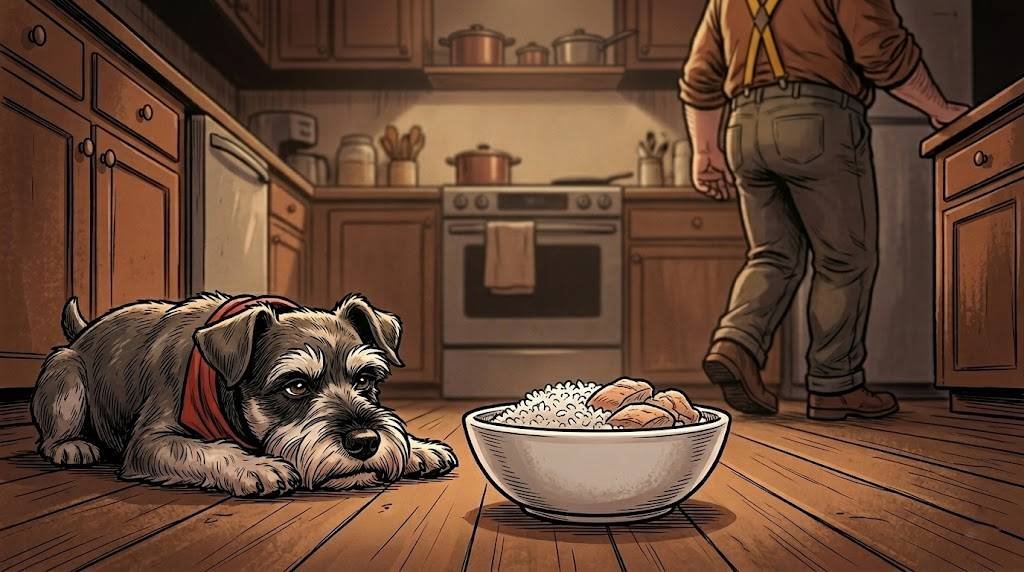
One time Big Guy made the rice-and-turkey situation. I was not at my best. The kind of not-at-my-best that involves multiple trips to the garden before sunrise. Big Guy was up the whole time. He didn’t say anything about it.
By morning he had two things going on the stove. I heard it before I smelled it. Then I smelled the turkey.
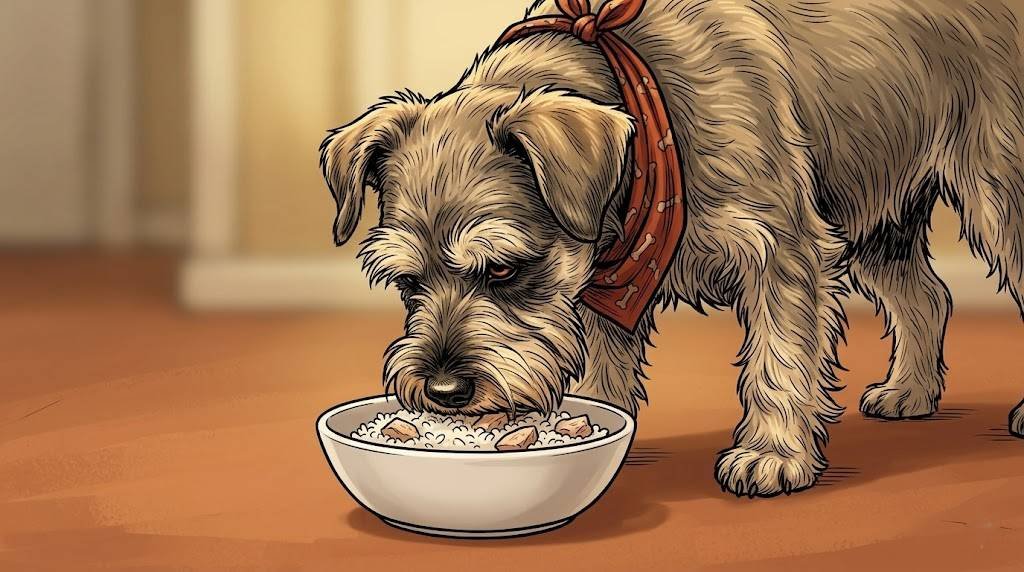
I’m a food person. Even at my worst, I’m still a food person. I considered my options from my spot on the floor — head on paws, the whole invalid posture — and I decided the turkey was worth the effort of standing up.
Big Guy had put the bowl closer than usual. I didn’t have to go far. Turkey and rice, nothing else. I ate slowly. Something in my stomach went quiet. I had another bite. The turkey was the reason. The rice just came with it.
Not bad. For something that boring.
FAQ
Can dogs eat white rice?
Yes. Plain cooked white rice is safe for most dogs. It’s easy to digest and often used short-term as part of a bland diet for upset stomachs. Keep it plain and unseasoned.
Can dogs eat brown rice?
Yes, in small amounts, for healthy dogs. Brown rice has more fiber than white rice, which makes it harder to digest for dogs with sensitive stomachs or digestive upset. Plain white rice is the better option when a dog isn’t feeling well.
Can dogs eat rice every day?
It’s not the best idea as a regular habit. Rice doesn’t provide complete nutrition on its own, and feeding it daily can add unnecessary calories and displace more balanced food. Small occasional amounts alongside a complete diet are fine for most dogs.
Is rice good for dogs with diarrhea?
Plain white rice is often used as part of a temporary bland diet during mild digestive upset — usually paired with a plain protein like boiled chicken or turkey. It’s not a cure. If diarrhea is severe, bloody, or lasts more than 24 hours, call your vet.
Can dogs eat fried rice?
No. Fried rice typically contains oil, garlic, onion, soy sauce, and other ingredients that are unsafe for dogs. The rice itself isn’t the problem. Everything added to it is.
Rice is not the enemy. Chaos is the enemy. Garlic is definitely the enemy.
Ham
Dumpster Graduate, Bland Diet Skeptic, and Survivor of Human Seasoning