Dog Training: What Actually Works and Why
Hello, two-leggers.
Answer First
Dog training tips usually focus on obedience instead of communication — and that’s where things go wrong. Most training frustration comes from inconsistency, poor timing, weak rewards, and skipping the most important question: why does my dog do this? Start with one behavior, one clear rule, one reward your dog actually cares about, and consistent timing. If fear, aggression, or severe anxiety is involved, work with a certified trainer or veterinary behaviorist.
Now — I have thoughts on this. Many, many thoughts. Possibly too many. But I’ve earned them, every single one, through a career of spectacular failure followed by reluctant growth, so please bear with me while I share them.
Quick Diagnosis: What Kind of Training Problem Do You Have?
- If your dog knows commands at home but ignores them outside → distraction management, not more repetition
- If your dog pulls, barks, or lunges on leash → the behavior has a purpose your dog considers urgent
- If your dog destroys things when you leave → anxiety or boredom, not spite
- If your dog “forgets” training after a few days → the training never stuck because the reward wasn’t motivating enough
- If everything you’ve tried just… doesn’t work → you may be solving the wrong problem entirely
Start here:
If your dog pulls on leash, read Why Dogs Pull on Leash, then How to Stop Dog Pulling on Leash.
If your dog barks too much, read How to Stop Dog Barking.
If your dog reacts to dogs or people on leash, read How to Handle Leash Reactivity.
If your dog panics when left alone, read How to Help a Dog with Separation Anxiety.
If training never seems to stick, read Dog Training Mistakes Owners Make.
What to read next:
Pick the problem you’re dealing with most right now: pulling, barking, leash reactivity, separation anxiety, or training that just won’t stick. The approach is the same for all of them. First figure out what the behavior is doing for your dog. Then change the pattern with timing, consistency, and a reward your dog actually wants.
Why Most Dog Training Advice Doesn’t Work
Training can go wrong in a very specific way, and I say this as someone who graduated from dog school with what I consider full honors — though The Therapist insists “surviving the course” and “graduating with honors” are not the same thing, which I find both inaccurate and hurtful.
The problem — and I’ve heard this from at least six dogs at the park, and lived it myself during my early training disasters — is that it’s easy to end up with training advice that tells you what to do without explaining why your dog does what he does in the first place. Good trainers don’t make this mistake. But plenty of quick-fix guides do, and they’re usually the ones people find first. It’s like giving someone driving directions without mentioning that the road’s been closed for months. Technically correct. Practically useless.
You do this at work, by the way. Someone gives you a task with no context — just “do this by Friday” — and you do it wrong because you didn’t understand the point. Then they’re frustrated, and you’re frustrated, and everyone quietly resents each other over sandwiches in the break room. That’s what it’s like being a dog getting trained by someone who read one article about positive reinforcement and now waves treat bags around like a sommelier presenting wine.
When The Therapist first tried to train me, she followed a very popular method that involved saying “no” firmly and redirecting my attention. Do you know what I learned from that? I learned that if I chewed the couch cushion, she would come over and interact with me. MAGNIFICENT. I chewed faster. She said “no” louder. I chewed with artistic commitment. She called her mother. Her mother suggested a spray bottle. I discovered I enjoy light misting.
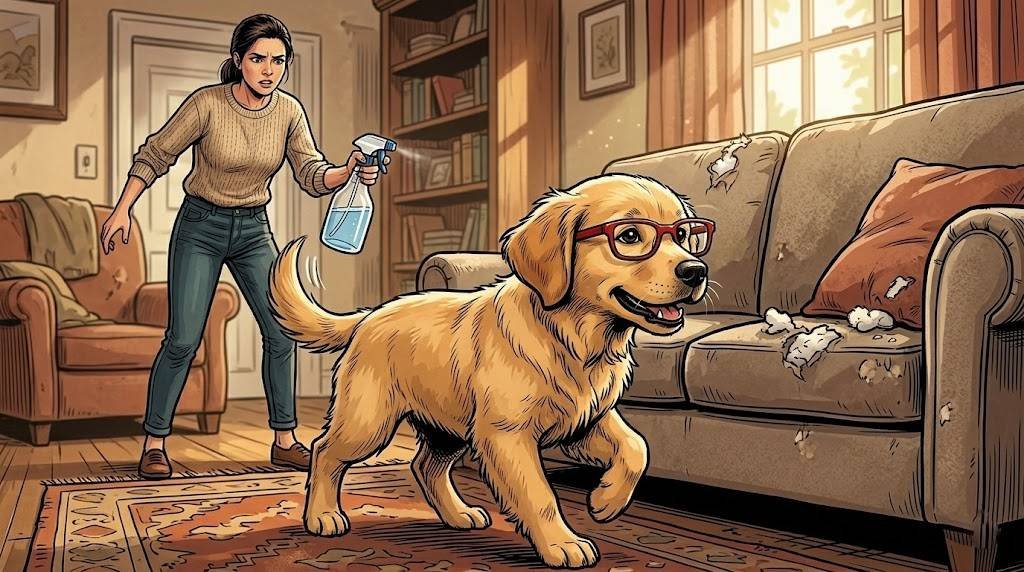
Young Alfred the golden retriever happily ignoring a spray bottle during early training
The actual breakthrough came when she stopped trying to correct me and started asking why. Why was I chewing? Because I was bored and understimulated and my teeth hurt and nobody had given me anything appropriate to destroy. Once she understood that, the solution was obvious — and it had nothing to do with saying “no.”
That’s the core of everything I’m about to tell you: understand the behavior first, then the training writes itself.
The One Dog Training Rule That Changed Everything
I’m going to share the single most important training principle I’ve ever encountered, and I want you to know that it took The Therapist — a licensed human therapist, mind you, someone who literally studies motivation for a living — almost four months to figure this out with me.
Every behavior your dog repeats is a behavior that works.
That’s it. That’s the entire foundation. If your dog pulls on the leash, it’s because pulling has historically gotten him where he wants to go. If your dog barks at the door, it’s because barking has historically made things happen — the mailman leaves (and I maintain that the mailman is ALWAYS suspicious, but that’s a separate investigation), you come running, something changes. If your dog steals socks, it’s because stealing socks has historically resulted in the most thrilling chase game in the household.
The point is that most dogs are not being disobedient in the way humans imagine. They are usually repeating behavior that has worked before — and dropping what hasn’t. This is, if I’m being honest, far more rational than most human behavior I’ve observed.
Think about your phone. It buzzes, you check it. Every single time. Even when you told yourself you wouldn’t check it during dinner. Even when the notification is just your weather app telling you it’s cloudy, which — you have windows. You can see it’s cloudy. But you check anyway, because checking has historically produced something interesting often enough that you can’t stop. That’s not a lack of willpower. That’s reinforcement. That’s exactly how your dog’s brain works, except we’re more honest about it.
The training implication is enormous: if you want to change a behavior, change what works. Don’t punish the old behavior — make it stop producing results, and make the new behavior produce better ones. The Therapist calls this “making the right choice the easy choice.” I call it common sense, but she’s the one with the degree.
What “Positive Reinforcement” Actually Means
I need to address this because I’ve noticed — through extensive eavesdropping on The Therapist’s phone calls with friends who also have dogs, which is a perfectly legitimate form of continuing education — that most two-leggers misunderstand positive reinforcement completely.
Positive reinforcement does not mean being nice to your dog. It does not mean never saying “no.” It does not mean letting your dog do whatever he wants because discipline is mean. I have met dogs raised this way, and dogs raised with no clear structure can become anxious because they don’t know what’s expected of them — which is actually quite cruel if you think about it.
Positive reinforcement means: when your dog does the thing you want, something good happens. That’s it. The “positive” is a scientific term meaning “adding something,” not a moral judgment meaning “being pleasant.”
Have you ever worked for a boss who only told you what you did wrong, never what you did right? You eventually stop trying, don’t you? Or you start doing the bare minimum. Or — and this is the really interesting one — you start hiding your work so there’s less to criticize. Dogs do all three. I certainly did. During my teenage phase, The Therapist went through a period where she corrected everything — don’t bark, don’t jump, don’t chew, don’t pull, don’t dig, don’t exist so enthusiastically — and I just stopped offering behaviors altogether. I would sit. I would lie down. I would stare at her with the specific blankness of someone who has been told that everything they do naturally is wrong.
She noticed. To her credit, she noticed fast. And she flipped the approach entirely: instead of marking everything I did wrong, she started marking everything I did right. I laid down calmly? Treat. I walked without pulling for three steps? Treat. I looked at a squirrel — A SQUIRREL, the most magnificent of all urban wildlife — and chose not to chase it? ENORMOUS treat, party, celebration.
Within two weeks I was offering new behaviors constantly, trying to figure out what else might produce that level of enthusiasm. I went from shutting down to innovating. Same dog. Different approach.
The key insight she brought from her human therapy practice: people and dogs both learn faster from success than from failure. Mark what works. Build on it. Let the unwanted stuff fade because it stops producing results.
Dog Training Basics: Timing, Consistency, and the Three-Second Rule
Your dog lives in a very short window — trainers usually say one to three seconds. If something happens after that, your dog does not connect the two. This is not a limitation of intelligence — it’s a difference in how dogs process the world. You yell at your dog for chewing the shoe he chewed twenty minutes ago, and your dog thinks you’re yelling at him for lying on the carpet, which is what he was doing when you yelled.
You’ve experienced this. Someone gets angry at you for something you said yesterday, but they bring it up while you’re making coffee, and for a bewildering thirty seconds you think they’re angry about how you make coffee. That momentary confusion? Your dog lives there permanently when you punish after the fact.
The Therapist got obsessed with timing. She started carrying treats everywhere — EVERYWHERE, I cannot stress this enough, there were treat crumbs in her work blazer, in her car, I once found a dried piece of chicken in her coat pocket that had been there so long it had fossilized into something genuinely sculptural — and the moment I did something right, she marked it. Not five seconds later. Not after she finished her phone call. That exact moment.
That short timing window matters. If you miss it, don’t correct after the fact. Just wait for the next opportunity. There will always be a next opportunity, because dogs — especially golden retrievers — do things constantly. We are a species of perpetual activity. I am doing something right now. Several things, actually. I’m writing this, I’m monitoring the window for squirrels, and I’m quietly hoping someone will say the word “walk” so I can lose my entire mind with joy.
And consistency — this is the part where I have to be slightly critical of The Therapist, which I do with love and enormous respect and also the knowledge that she can’t read this. Consistency means everyone in the household follows the same rules. If The Therapist says “off the couch” but a family member lets me on the couch when she’s not looking, I have not learned “don’t get on the couch.” I have learned “check who’s home first.” Dogs are spectacular at reading context. We will absolutely identify the person with the weakest enforcement and exploit that relationship with surgical precision.
Same words, same rules, same timing, every person, every time. This is the boring part. This is also the part that matters most.
Why Your Dog “Knows” the Command but Doesn’t Listen
This is my favorite misconception to demolish, partly because I am personally blamed for this on a near-daily basis.
“He knows ‘sit.’ He just won’t do it.” I hear this at the park constantly — one owner actually said it while her dog was actively chasing a pigeon — and every time I want to walk over and explain: your dog does not “know” sit. Your dog knows sit-in-the-kitchen-when-you’re-holding-a-treat-and-it’s-quiet-and-there’s-nothing-interesting-happening. That is a very different thing from sit-at-the-park-where-there-are-seventeen-dogs-and-a-man-with-a-hotdog-cart.
Have you ever tried to do mental math while someone’s shouting at you? You “know” math. But context matters. Environment matters. Emotional state matters. Your dog isn’t being stubborn. Your dog is overwhelmed by an environment you didn’t train for.
This is called generalization, and it’s the dog training tip most guides skip entirely. You teach your dog “sit” in the living room and then expect it to transfer to every location on Earth. It doesn’t work that way. You have to practice in the living room, then the hallway, then the garden, then the quiet street, then the busier street, then — eventually, after weeks — the park with the seventeen dogs and the hotdog cart. Each new environment is a new classroom.
The Therapist figured this out when she realized I would perform a flawless “stay” in the kitchen — I mean genuinely impressive, statue-like, dignified — and then completely fall apart at the park. She wasn’t frustrated with me, which I appreciated. She was frustrated with herself for assuming that learning transfers automatically. It doesn’t. Not in dogs, not in humans, not in anyone.
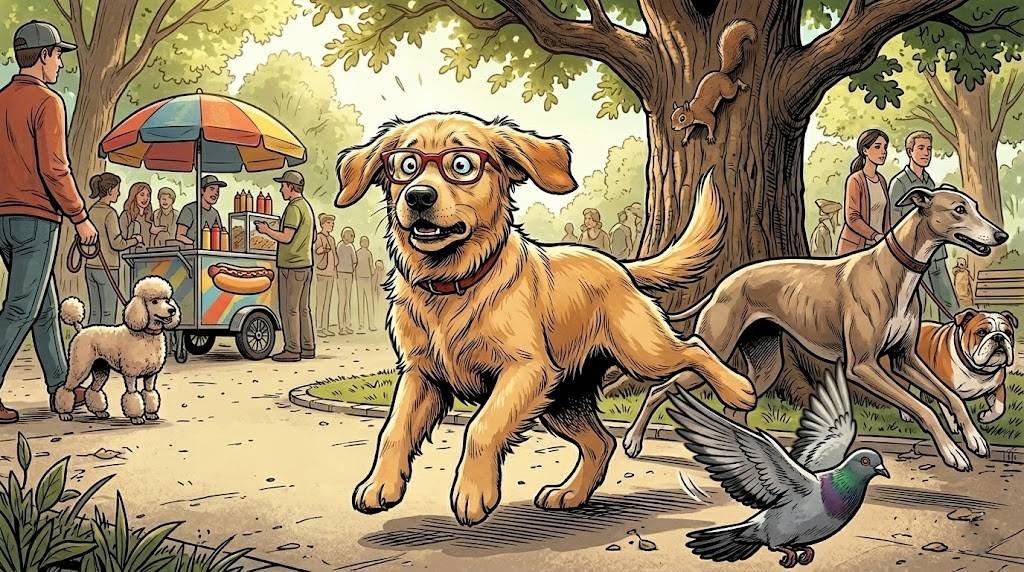
Young Alfred overwhelmed by distractions in a busy park trying to hold a sit
If your dog “knows” something only in one place, your dog doesn’t know it yet. Train in new environments, starting easy and building up. And be patient with the process. I was not patient. The Therapist was not patient. We were impatient together, which is its own form of partnership.
The Right Tools Help — But They Don’t Replace Training
I want to say something about equipment, because I’ve seen — from my extensive window-based surveillance of the neighborhood — dogs wearing every contraption imaginable, and their owners still being dragged down the street like a kite in a windstorm.
A front-clip harness can help with pulling. A long line can help with recall practice. A properly sized crate can help with anxiety management. These are good tools. The Therapist used several of them with me, and they genuinely made the training process smoother.
But here’s what no piece of equipment can do: teach your dog why he should walk nicely, or come when called, or stay calm in the crate. The tool manages the situation. The training changes the behavior. If you buy a front-clip harness and do nothing else, you have a dog who pulls slightly less in that specific harness and pulls exactly the same without it.
You know this from your own life. Noise-canceling headphones don’t fix a noisy office — they let you cope while you figure out the real solution, which might be talking to your coworker, moving desks, or accepting that Gary will never stop eating crisps at his desk. The headphones are the front-clip harness. The conversation with Gary is the training.
Choose equipment that supports your training goals, not equipment that replaces them. And if you’re unsure what your dog needs, a certified trainer can assess the situation and recommend the right tools for your specific dog. Because your specific dog — I cannot stress this enough — is not the same as the dog in the YouTube video. I am certainly not the same as any dog in any video. I am considerably more distinguished.
When to Call a Professional
I’m going to say something that I, as a professor with considerable expertise, find remarkably easy to admit: some problems are beyond what you can fix alone, and recognizing that is not failure. It’s intelligence.
If your dog’s behavior involves fear, aggression, severe anxiety, or any situation where someone — dog or human — might get hurt, please work with a certified dog trainer or veterinary behaviorist. Not because you’re doing it wrong, but because these are complex problems with complex causes, and a professional can see patterns you can’t.
You’d do this yourself — if your car made a sound you couldn’t identify, you’d take it to a mechanic, not keep driving and hoping. Same principle. Different species.
The Therapist — and this is one of the things I admire most about her, reluctantly — knows when something is beyond what you can handle alone. She and I worked through my separation anxiety ourselves, over several months, with patience and consistency and a few incidents I prefer not to recount. But she would be the first to tell you: if your dog’s situation involves fear, aggression, or anxiety that isn’t improving, don’t keep guessing. Find someone who’s spent years studying exactly this. That’s not failure. That’s the smartest thing you can do for your dog.
The best thing you can do for your dog is be honest about what you can handle and what needs professional support. Your dog doesn’t care about your pride. Your dog cares about feeling safe.
The Dog Training Tips Nobody Mentions
If you approached me at the park — please do, I love meeting two-leggers, especially ones who throw balls, do you throw BALLS — I would tell you this:
Training isn’t something you do to your dog. It’s something you figure out together. The Therapist didn’t train me. We trained each other. She learned to read my body language. I learned to read her expectations. She discovered that I work for tennis balls more than treats. I discovered that she makes a specific face when she’s about to give up, and if I offer one more good behavior at that exact moment, she lights up like a sunrise.
That’s the part no training guide mentions. The relationship. The paying attention. The thousands of tiny negotiations that happen between a dog and a human who are both trying their best and both getting it wrong regularly and both — eventually, imperfectly, joyfully — getting it right.
Everything I’ve told you today leads somewhere specific. If your dog barks too much, there’s a way through it. If your dog pulls on the leash, there’s a reason and a solution. If your dog panics when you leave, there’s help for that. If your dog reacts to other dogs, that can change. These are not permanent problems. They’re conversations that haven’t happened yet.
Start the conversation. Listen more than you correct. Celebrate the small victories. And for the love of everything good in this world — carry treats in your pockets at all times. Your coat will smell terrible and your dog will think you’re magnificent.
Which, to be fair, you are. Even if you don’t throw balls.
What to read next:
Pick the problem you’re dealing with most right now: pulling, barking, leash reactivity, separation anxiety, or training that just won’t stick. The approach is the same for all of them. First figure out what the behavior is doing for your dog. Then change the pattern with timing, consistency, and a reward your dog actually wants.
Professor Alfred
Dog School Graduate, Training Disaster Survivor, and Ongoing Work in Progress