How to Crate Train a Puppy: Step-by-Step Guide That Actually Works
Hello, two-leggers.
Answer First
Crate training a puppy takes two to four weeks when done properly, and up to eight before your puppy actively chooses the crate as their preferred resting spot. The method has four stages: make the crate appealing before any confinement, practice door closing without latching, build duration gradually, and add mild distractions last. Skip any stage and the whole thing takes three times longer. Respect bladder limits absolutely — one accident destroys weeks of conditioning. If your puppy shows severe distress rather than normal adjustment, this may be rather than a training issue.
If you’re still wondering whether the whole concept is cruel — a reasonable question that I myself spent approximately six days stuck on — I addressed that elsewhere. Here, I want to show you the method. The actual steps. What The Therapist did, in what order, and why skipping any of them creates problems that take much longer to fix than they would have taken to prevent.
The First Night That Nearly Broke Us Both
Before I walk you through the method, I want to tell you about the night The Therapist and I nearly undid every bit of progress we had made, because it contains approximately seventy percent of the lessons this article is going to teach you, and because — if I’m honest with myself, which I try to be, sometimes, though it’s harder than it sounds — I think about this night more than I would like to admit.
By this point I had been in training for about two weeks. I had finally accepted the crate during the day. I would enter willingly for treats. I would lie down on my blanket and chew a bully stick and, on one memorable afternoon, fall asleep for twenty minutes with the door closed without noticing. The Therapist was, I think, feeling cautiously optimistic. She had been reading me passages from her training book at breakfast (I pretended not to listen — I was listening) and had announced, with the kind of confidence that always precedes disaster in our household, that we were ready for the first full night.
She placed the crate in the living room. Downstairs. She kissed the top of my head, turned off the light, and went upstairs to her bedroom to sleep.
Reader. I cannot adequately convey to you what happened next.
From my perspective — and I want you to take my perspective seriously here, because it is the perspective of essentially every puppy who has ever been left alone in a crate on the first night — this was not training. This was ABANDONMENT. I had spent two weeks being reassured that the crate was a safe space, and now my primary human, my food source, my ball-thrower, my reason for existing, had disappeared to some distant floor of the house that might as well have been another country. I could not see her. I could not smell her. I could not hear her breathing. The house had gone dark in a way I had never experienced, because whenever it had gone dark before, she had been in the same room.
I screamed.
I am not using this word loosely. I produced a vocalization that I have not equaled since — a sustained expression of pure existential panic that, I later learned, brought The Therapist running down the stairs with genuine concern for my physical welfare. She thought I had hurt myself. She thought something was actually wrong. And from my point of view, something WAS actually wrong — she had vanished, and I had no frame of reference for understanding that she was coming back.
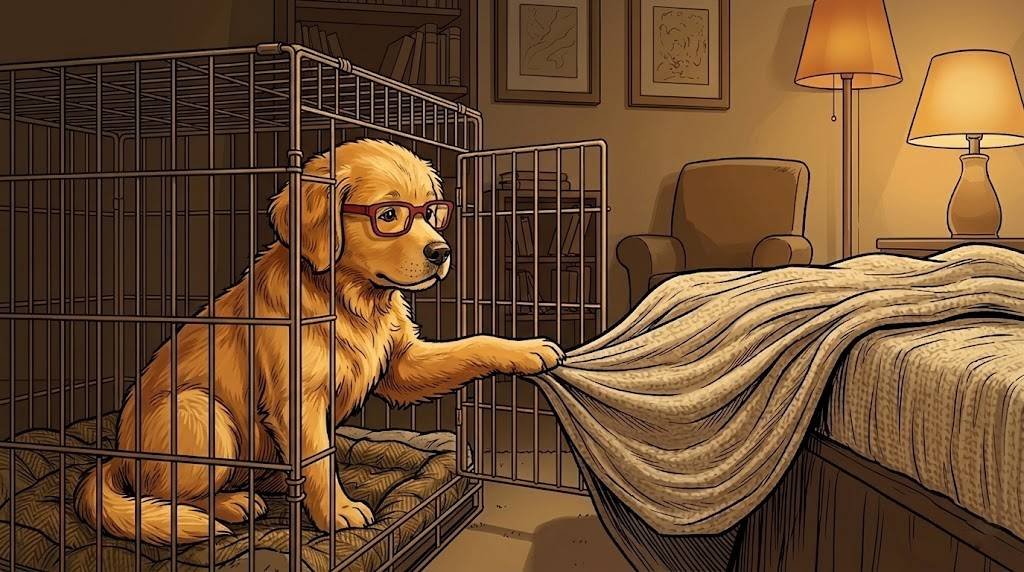
After about five minutes of this, she did the single most important thing any two-legger can do on a first night: she changed her plan. She carried the crate upstairs. She placed it directly beside her bed, so close that I could reach through the wire and touch her arm with my paw if I stretched. I could see her. I could smell her. I could hear her breathing, slow and steady and maddeningly calm compared to my own.
I went to sleep within ten minutes.
That’s it. That was the whole fix. Proximity. Not more training, not better treats, not a different crate — proximity. And the reason I’m opening this guide with that story is that the method I’m about to walk you through only works if you understand what the method is FOR. The method is not about teaching your puppy to tolerate a box. The method is about teaching your puppy that the box is safe — which is a completely different project, and one that falls apart the moment you ask them to be safe in a place where you aren’t.
Quick Diagnosis: Where Are You in the Process?
Before we get into the full step-by-step framework, let me help you figure out where you actually are — because the right next step depends entirely on where you’re starting from:
- Your puppy has just arrived and hasn’t seen the crate yet → Start with Stage One below. Do not skip it. Do not shorten it.
- Your puppy has been introduced to the crate but won’t enter voluntarily → Go back to Stage One. The foundation wasn’t built.
- Your puppy enters willingly but can’t tolerate the door closed → You’re ready for Stage Two. Proceed slowly.
- Your puppy tolerates short durations but melts down during longer ones → You’re in Stage Three territory. Build increments.
- Your puppy handles the crate at home but loses composure with noise or guests → Stage Four. Add distractions deliberately.
Find your stage? Good. Now let me walk you through what each one actually involves.
How to Crate Train a Puppy: Step-by-Step Foundation
This is the section where I am going to attempt to be unusually organized—which does not come naturally to me, as you may have noticed—because the order genuinely matters here, and skipping stages creates problems that take much longer to fix than they would have taken to prevent.
Stage One: Make the Crate Appealing Before Any Confinement
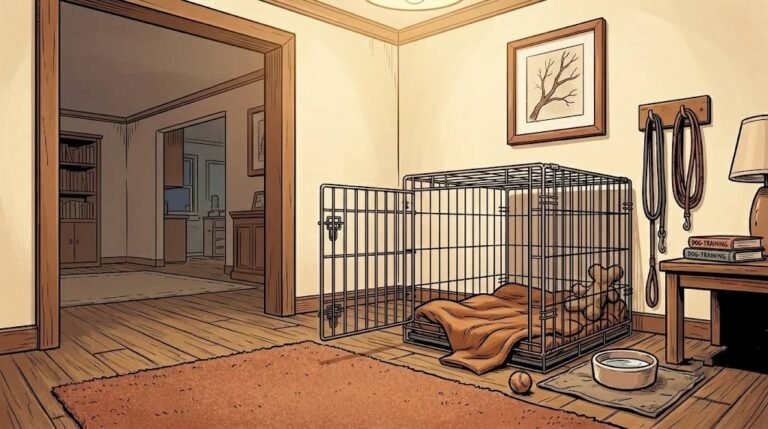
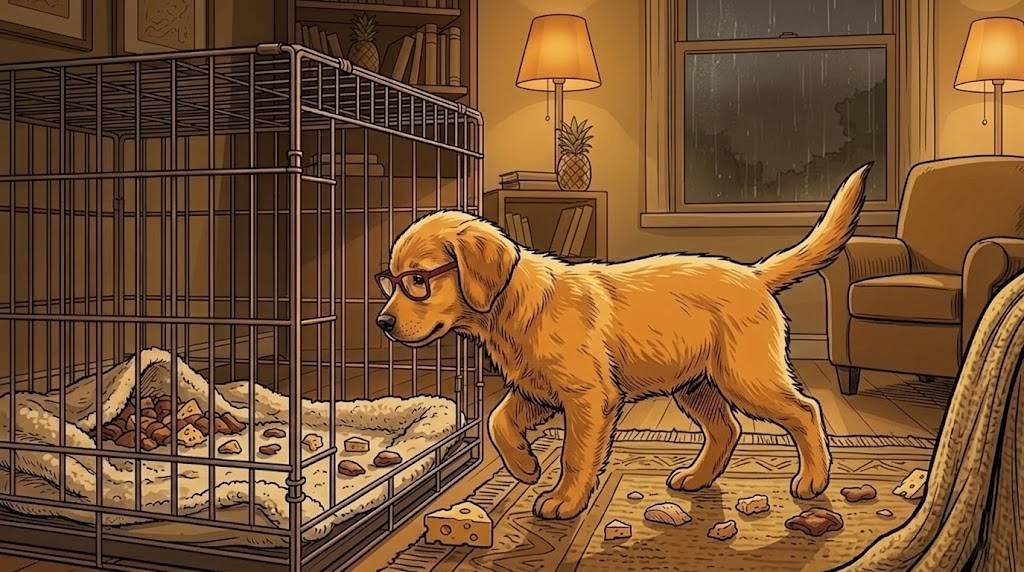
This is the stage The Therapist skipped initially and then had to redo, and I want to save you that mistake. For the first two to three days, the crate lives in your main living area with the door removed entirely—unscrewed, taken off, not just propped open because a propped-open door will eventually swing and terrify your puppy at exactly the wrong moment. Scatter high-value treats inside. Add a favorite blanket or toy. Let the puppy discover the crate on their own schedule, without any pressure, coaxing, or attempts to close anything. The goal at this stage is not training. The goal is establishing the crate as a place worth going. If the crate cannot compete with other favorite spots in the house, you have not yet made it appealing enough.
Stage Two: Practice Door Closing (Without Latching)
Once your puppy is entering the crate voluntarily for treats and lying down inside comfortably—which usually takes about a week if you’ve done Stage One properly—reattach the door. Do not latch it yet. Practice what I can only describe as door-swinging rehearsal: partially close the door, open it, close it, open it, dozens of times per session, while the puppy is inside happily chewing something. The goal is desensitizing them to the door’s movement so that when it finally latches, the movement itself is familiar.
I remember exactly when she reattached the door—I noticed immediately, because I’m extremely observant about changes to my environment, especially mechanical components being added to spaces I’ve come to trust, and I expressed my concern through a brief panic bark, which The Therapist ignored with a calm indifference I found both impressive and mildly offensive. She then spent the next three days doing nothing but the door-swinging rehearsal, and by day four I barely noticed when she closed it gently against the frame. When she finally latched it for the first time, I was mid-chew on a bully stick, she counted to five, and she opened it before I’d fully processed what had happened. That was the real beginning of duration training.
Stage Three: Building Duration Gradually
Here is approximately what the first month looked like for me, which you can use as a rough benchmark:
- Week one: thirty seconds to two minutes, with The Therapist sitting directly beside the crate the entire time
- Week two: five to ten minutes, with her moving around the room but staying visible
- Week three: fifteen to twenty minutes, with her leaving the room briefly for tasks
- Week four: thirty to sixty minutes, during natural rest times when I was already tired
The critical rule during this entire phase is that you never, ever leave a puppy in the crate longer than their bladder can handle, and the formula is roughly one hour per month of age plus one—so a four-month-old puppy like I was can manage about five hours maximum, though I want to emphasize that this is a ceiling, not a target, and during training you should be working well below it. Why does this matter so much? Because one accident in the crate destroys weeks of positive conditioning. Once the crate has become a place where the puppy has been forced to soil themselves, rebuilding the association takes dramatically longer than it would have taken to just let them out in time.
Stage Four: Adding Mild Distractions
Once duration is established in a quiet environment, begin adding baby-level distractions—the vacuum running in another room, a friend visiting, music at normal conversational volume. The goal is building tolerance to the kind of household noise that real life will produce. You do this too when you’re learning anything difficult—you don’t start practicing focus in the loudest coffee shop you can find, you start in your quiet kitchen and gradually increase the noise level as your ability to tune it out improves.
Choosing the Right Crate (Because Size and Material Actually Matter)
I want to discuss three types of crates, and I want to do so with the full weight of my lived experience as a dog who has encountered all three and developed strong opinions about each.
Wire crates offer ventilation, visibility, collapsibility for travel, and adjustable dividers that grow with your puppy—which matters enormously, as I will explain in approximately one paragraph. They are the default recommendation for most training situations, and they worked well for me once The Therapist solved the sizing catastrophe.
Plastic crates are more enclosed and more den-like, which some dogs prefer, though I personally found them somewhat claustrophobic because I like being able to see what’s happening. They’re also standard for airline travel, so if you’re going to fly with your dog, you’ll probably end up owning one of these eventually.
Soft-sided crates look appealing and travel well, but I want to warn you based on direct experience: I chewed through one in approximately forty-five minutes when I was six months old. These are appropriate for fully trained adult dogs who have no destructive tendencies. They are not appropriate for puppies. Do not buy one for a puppy. You will lose both a crate and whatever was inside it, possibly including portions of your floor.
Now, the sizing issue, which is where The Therapist made her most expensive mistake.
She bought a crate designed for an adult golden retriever when I was still twenty pounds. Her reasoning was economic—why buy two crates when I would eventually grow into the big one—and her reasoning was also wrong, because within a week I had designated one corner as my sleeping area and the opposite corner, approximately three feet away, as my bathroom. I was four months old. I had no concept that this was inappropriate. The crate was simply big enough to have both zones, so I had both zones. The Therapist was horrified. She came home from work on day seven to discover that I had, with considerable apparent pride, created a small but functional apartment inside my crate, complete with separate rooms for separate activities.
The solution was a divider panel—a flat metal insert that reduced the usable space inside the crate so that I had room to stand up, turn around, and lie down comfortably, but NO extra space for additional zoning projects. This is the rule: the crate should be just large enough for the puppy to stand, turn, and lie down, and no larger. A crate that is too big defeats the entire purpose of crate training, which relies on the dog’s instinct not to soil the space where they sleep.
As for bedding: start minimal if your puppy is in a chewing phase, because I destroyed three beds during my first six months and The Therapist eventually gave up and just used a towel until my teeth stopped being a problem. For toys, one durable chew toy is plenty—a Kong stuffed with frozen peanut butter or treats works well, because it takes a long time to extract the contents and occupies the puppy during crate time in a way that builds positive associations.
Crate Training Puppy First Night: What Actually Matters
The first night is, in many households, the worst night, and I want to walk you through it carefully because The Therapist and I produced a truly catastrophic first night together and I don’t want you to repeat our mistakes.
Here is what to expect: two to three bathroom breaks during the night for a young puppy, twenty to thirty minutes of settling before sleep, and some amount of whining as the puppy adjusts to being alone in an unfamiliar space for the first time. This is normal. This is not a sign you are failing.
Here is what The Therapist did wrong on my first night: she placed the crate in the living room, downstairs, and went upstairs to her bedroom to sleep. From my perspective, this was ABANDONMENT. I had spent the entire day being reassured that the crate was a safe space, and now I was alone in a dark living room while my primary human—my food source, my ball-thrower, my reason for existing—had disappeared to some distant floor of the house that might as well have been another country. I screamed. I am not using this word loosely. I produced a vocalization that I have not equaled since, a sustained expression of pure existential panic that eventually brought The Therapist running down the stairs with, I later learned, genuine concern for my welfare.
After five minutes of this, she did the correct thing. She carried the crate upstairs and placed it directly beside her bed. I could see her. I could smell her. I could hear her breathing. I went to sleep within ten minutes.
Proximity changed everything. And over the following weeks, she gradually moved the crate six inches further from the bed each week—she actually measured this with a ruler, which is the kind of detail that made me fall in love with her methodology even while I resented the outcome—until eventually the crate had migrated to the hallway, then to the guest room, then to wherever it needed to be long-term. But those first weeks, proximity was non-negotiable.
For the midnight bathroom breaks, she established what I now recognize as a brilliant protocol: they were BORING. No conversation, no praise, no treats, no play—just a quick trip outside, a chance to relieve myself, and immediate return to the crate. The goal was communicating that nighttime bathroom breaks were business, not social events, because the last thing you want is a puppy who wakes up every night for attention rather than because they actually need to go outside. She also learned to distinguish the urgent-I-need-to-pee cry from the softer I’m-scared cry, and she only responded to the first one. The second one she let me work through, because responding to it would have taught me that scared noises produced company, which would have created a much bigger problem than the one I was already having.
You do this too, when children sleep alone for the first time in an unfamiliar room. You don’t expect them to be fine immediately. You don’t expect them to sleep through the night from day one. You stay close, you respond to genuine distress, you don’t respond to manipulation, and you build confidence gradually over weeks rather than days. The principle is identical.
Common Crate Training Problems and Solutions
I want to address the five problems I hear about most often, because I have, in the course of my lifetime, either experienced or witnessed each of them, and the solutions are more straightforward than most two-leggers realize.
If your puppy cries at night, the issue is almost always one of two things: bladder capacity or proximity. Move the crate directly beside your bed. Establish boring bathroom breaks with no social element. Reassure through presence rather than through opening the door. If crying continues after several nights of proper setup, check whether you’re exceeding bladder limits—a three-month-old puppy simply cannot hold it for eight hours, and no amount of training will change that biological reality.
If your puppy refuses to enter the crate, you have moved too fast and the associations have not yet been built. Start over. Remove the door. Scatter high-value treats inside. Apply zero pressure. Give it three days before expecting any voluntary entry, and much longer if your puppy has already developed negative associations from previous attempts. The foundation work is not optional, and trying to skip it costs you more time than doing it properly would have.
If your puppy panics the moment the door closes, you have progressed past the emotional foundation that should have been built at Stage Two. Return to door-swinging rehearsal. Practice partial closures dozens of times before attempting a full latch. When you do latch, count to three and open. Then count to five. Then to ten. Build duration in increments the puppy can handle without distress, which may mean much smaller increments than you expected.
If your puppy has accidents in the crate, the crate is probably too large or you are exceeding their bladder limits. Install a divider panel to reduce usable space. Check the one-hour-per-month-of-age-plus-one formula and respect it absolutely. One accident destroys conditioning faster than you can rebuild it.
If your puppy destroys bedding, remove the bedding. Keep a towel or nothing at all inside the crate until the chewing phase passes, which it will. Increase daytime exercise so there’s less energy going into destruction. Provide only indestructible toys during crate time—Kong, Nylabone, or similar products designed specifically to withstand determined chewers.
A final warning: if your puppy shows signs of severe distress during crate training—persistent crying beyond twenty minutes, drooling, frantic escape attempts, self-injury, or complete refusal to settle regardless of duration or setup—you may be dealing with anxiety symptoms rather than normal adjustment difficulties. This is not a failure on your part, and it is not something to push through. Consult your veterinarian and consider working with a certified behaviorist, and for strategies specifically addressing this condition, How to Help a Dog with Separation Anxiety offers a detailed approach.
How Long Does Crate Training Take?
I want to give you concrete timelines, because vague reassurances that “every dog is different” are both true and utterly useless when you’re three nights into crate training and wondering if you’re ruining your puppy forever.
Here is approximately what to expect:
- First night: two to three bathroom breaks, twenty to thirty minutes of settling before sleep, some amount of whining that gradually decreases
- Week one: puppy enters willingly for treats, tolerates the door closed for one to five minutes without significant protest
- Weeks two through three: calm in the crate for fifteen to thirty minutes during the day, sleeping for four to six hour stretches at night
- Weeks four through six: accepts one to two hour crate periods during the day, sleeps through most nights with minimal disturbance
- Week eight and beyond: crate training is functionally complete, puppy may begin voluntarily choosing the crate as a resting spot
My own timeline ran longer than The Therapist expected. She anticipated, based on articles she had read, that I would “get it” within one week. The reality was four weeks before I would enter willingly without being bribed with treats, six weeks before I slept through the night reliably, and eight weeks before I actively chose the crate as my preferred napping location rather than simply tolerating it. Was I a slow learner? I prefer not to think so. I prefer to think I was a thorough learner who required complete conviction before committing to a new behavior, which is different and also more flattering.
Several factors affect how long crate training takes for your specific puppy: age (younger puppies learn faster in some ways, slower in others), temperament (anxious puppies need more time, confident puppies less), consistency (inconsistent application extends the timeline dramatically), and starting point (puppies with prior negative crate experiences take longer to recondition). Progress is almost always incremental rather than dramatic—you will not wake up one morning to a crate-trained puppy, but you will, over time, notice that the crying has shortened, the settling has sped up, and the resistance has softened.
For more on why realistic timelines matter in every aspect of dog training, Dog Training: What Actually Works and Why covers the broader principles of patience and incremental progress that underlie all of this.
What The Therapist Wishes She’d Known Earlier
I asked The Therapist recently—and by “asked” I mean she was talking out loud in the kitchen and I happened to be listening—what she would tell her past self if she could go back to that first week of crate training. Her answer, paraphrased because I am a dog and cannot actually quote verbatim, was that starting slowly wasn’t wasting time. Building positive association WAS the real training.
She had treated the foundation phase as preliminary, as something to rush through in order to get to the “real” part where the door closed and I learned to tolerate it. But the real work was the foundation. Everything that came after—the door closing, the duration building, the distraction tolerance—was simply testing what the foundation had already established. When she tried to do both simultaneously, treating the crate as appealing while also expecting immediate confinement, I became confused and anxious and the entire process extended by weeks. When she separated them—make it appealing first, then build confinement only after the appeal was established—everything else became easier.
I have written more broadly about this pattern in Dog Training Mistakes Owners Make, because the failure to build emotional foundation before pushing behavioral progress is a mistake that shows up in barking training, leash training, recall work, and essentially every other skill you will ever teach a dog.
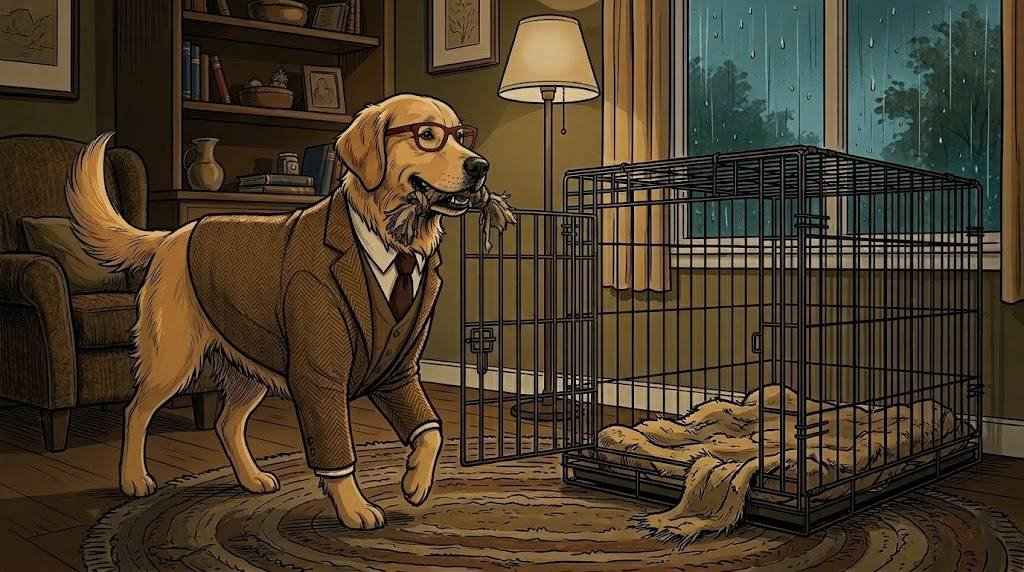
I am now five years old, roughly—and I want to note that I am prohibited from stating my exact age, which strikes me as both reasonable and slightly vain—and I still use my crate voluntarily. When guests visit and I need a break from being petted by strangers, I go to my crate. When The Therapist is working and I want to nap without being accidentally disturbed, I go to my crate. When a thunderstorm rolls through and the sound feels larger than my body can manage, I go to my crate. It is, after all these years, still the place I chose to retreat to when the world becomes too much, which is exactly what The Therapist was trying to create for me during those first chaotic weeks. She didn’t train me to tolerate the crate. She made it a space I wanted, not feared. Different lesson. Same crate.
Professor Alfred
Survivor of The First Night