Can Dogs Eat Bananas? A Practical Guide From a Dog Who Has Tested This
Yo, food lovers.
Answer first
Yes, dogs can eat bananas. Why it matters: bananas are sweet, and the sugar adds up faster than the size of the fruit suggests. The three things that go wrong: too much at once, the wrong form (banana bread, smoothies, dried chips), or the wrong dog (diabetic, overweight, very young).
What to do today: peel a banana, give your dog two or three thin slices if small, four or five if medium, half a banana if large. Watch for twenty-four hours. If everything’s fine, repeat two or three times a week — not daily.
Here’s how I learned this. By stealing one and getting away with it, mostly.
How I Got My First Banana
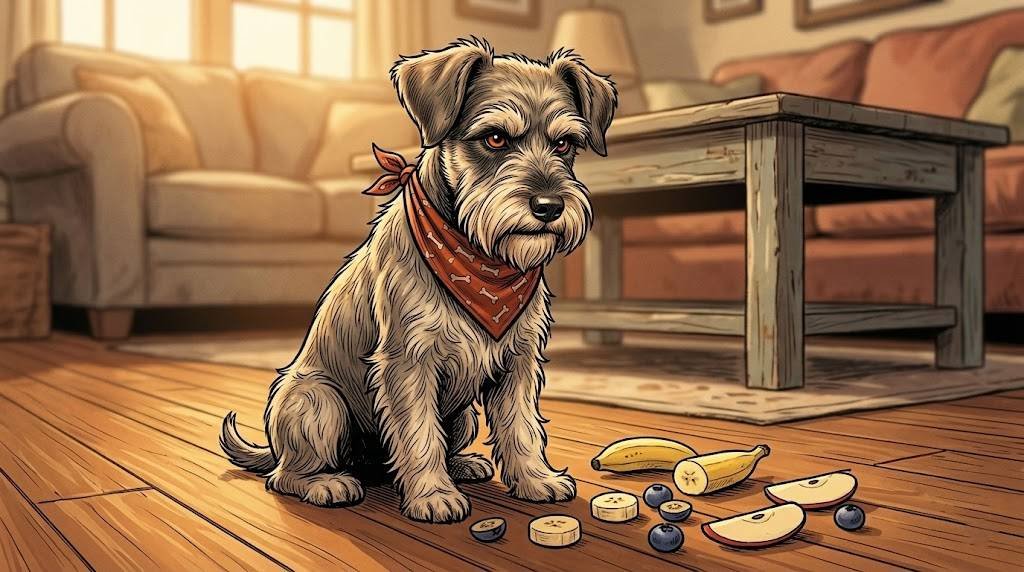
It was a quiet afternoon. Big Guy was on the couch with a book. On the coffee table sat half a banana, peeled, sliced into rounds for whatever he was planning. The other half was still in its skin, off to the side. I was on the floor in my usual spot, registering the situation.
The math was straightforward. Big Guy turned a page. He turned another page. A third page. By the third page, I had calculated his reading speed, his angle of attention, and the probable cost-benefit of one slice. I rose. The slice disappeared. Big Guy turned another page.

This was, as far as I can reconstruct, my first deliberate banana. The taste registered immediately — sweet, soft, gone in less than a second. The texture was strange. Somewhere between food and not-food. I returned to my position. Big Guy never looked up. The afternoon continued.
The next morning was less successful. The details are not interesting and not flattering. Let’s just say my digestive system filed a complaint, and Big Guy figured out the source before I did. You take one bite of dessert and tell yourself it was just one bite. Then there’s no dessert left, and you understand something about yourself you’d rather not. Same logic. The difference: you have free will. I have a different relationship with the coffee table.
So yes, dogs can eat bananas. The question that actually matters is how much, and in what form, and when not to. Let me walk you through it.
Quick Diagnosis: Should I Worry About This Banana?
- If your dog ate a small piece of banana flesh → fine, no action needed
- If your dog ate a whole banana including peel → likely fine, but watch for vomiting or constipation in the next 24 hours
- If your dog has diabetes or is overweight → talk to your vet before making banana a regular thing
- If your dog ate banana bread or anything baked with banana → check the ingredients first; xylitol and chocolate are the actual risks
- If your dog has loose stools after banana → cut the portion, wait a few days, try again with less
Are Bananas Safe for Dogs?
The short answer is yes. Banana flesh is not toxic to dogs in any way. There is no active poison, no compound that builds up in the system, no breed-specific danger. A dog can eat banana, and most dogs enjoy it.
There are real benefits. Bananas contain potassium, vitamin B6, vitamin C, magnesium, and a small amount of fiber. None of these are nutrients a dog desperately needs from human food, because regular dog food is balanced for what a dog actually needs, but they’re nice to have. The flavor is mild and sweet, which most dogs enjoy. The texture is soft, which makes bananas a useful treat for older dogs with dental issues, or for hiding a pill that needs taking.
So why isn’t this just “yes, eat all the bananas”? Because of sugar. A medium banana contains around 14 grams of sugar. That’s a lot. For a small dog whose entire daily calorie budget is around 200-300 calories, half a banana is a meaningful chunk of that budget — and almost all of it is sugar. Safe is not the same as unlimited, but it lands hardest on fruit, where the natural sweetness disguises how dense the calories are.
If it were up to me, bananas would be a daily event. Big Guy doesn’t run the household that way. You eat fruit because it’s healthier than candy. Same logic for me. The catch: “healthier than candy” isn’t the same as “free of consequences.” Three bananas a day is still a lot of sugar. Ask anyone whose stomach has registered a complaint.
The move is simple: treat banana as a sometimes-treat, not a daily food. Sweet doesn’t mean free.
How Much Banana Can a Dog Eat?
This is the part most articles skip over. The honest answer depends on your dog’s size, and within reason, here’s how to think about it.
Small dogs, under 20 pounds. Two or three thin slices is plenty. A whole banana is too much for one sitting and far too much as a regular thing. I am, for the record, in this size category. My banana intake is monitored. I have opinions about this monitoring system that I keep to myself.
Medium dogs, 20 to 50 pounds. Four or five slices, or roughly a quarter of a banana. Manageable, occasional, not a daily occurrence.
Large dogs, 50 pounds and up. Up to half a banana is fine. A whole banana is not toxic but is more sugar than a healthy treat needs to deliver in one go.
Puppies. Wait until at least six months. A puppy’s digestive system is still adjusting to solid food, and a sweet, fiber-heavy fruit is more disruption than benefit early on. After six months, start with half the adult portion and watch how the puppy handles it.
For all sizes, the right frequency is two or three times a week, not daily. Bananas are a treat, not a staple. The pillar’s ten-percent rule applies — treats and table food combined should stay under ten percent of daily calories, and bananas are calorie-dense for a fruit.
The other rule, no matter the size of your dog: start small, watch for twenty-four hours, increase only if everything went smoothly. The first time my banana intake exceeded what my system could handle, the consequences arrived the next morning, and Big Guy noticed before I did. You know what happens when you eat too much of one thing too fast. Same physics. Smaller body, same rule. The difference is I don’t have the option to lie about it.
Start with the smaller end of the size range. Watch for twenty-four hours. Only increase if there was no reaction. Two or three times a week, never daily.
Can Dogs Eat Banana Peels?
The peel is not toxic. This is the most reassuring sentence you’ll read about banana peels and dogs.
The peel is, however, hard to digest. Dog digestive systems are not built for the kind of dense fiber a banana peel contains. Most dogs who eat a peel will be fine. Some will throw up. A few — usually small dogs eating a large peel — can develop a partial blockage, which is rare but serious. The peel is also slightly bitter and, by most accounts, unappetizing.
If your dog accidentally eats a banana peel, here’s what to do. For most dogs, watch and wait for twenty-four hours. Look for vomiting, signs of stomach pain, lack of appetite, or constipation. If any of these appear and don’t resolve, call your vet. For small dogs that ate a whole peel, or for any dog that ate multiple peels at once, a vet call is the right move sooner rather than later.
What you should not do: don’t deliberately feed your dog the peel. There’s no nutritional reason to. The flesh has all the benefits and none of the digestive trouble. Save yourself the experiment.
For the record, I once tried the peel myself, on a slow afternoon when nothing else was available. The taste was a disappointment. The aftermath was educational. You don’t eat orange peel either. Same kind of math. The peel exists for the fruit’s sake, not yours.
Don’t deliberately feed the peel. If it happens by accident, watch for twenty-four hours and call your vet if anything’s off.
When Bananas Are a Bad Idea
Most dogs can have banana without issues. There are situations where the answer is different.
Dogs with diabetes. Bananas are sugar-dense. For a diabetic dog, even small amounts can affect blood sugar in ways that complicate management. Talk to your vet before adding banana to a diabetic dog’s treat list. The vet may approve small amounts on specific days, or may say no entirely.
Overweight dogs. Bananas are a calorie hit. A dog who is already carrying extra weight does not benefit from sweet, dense treats — even healthy-sounding ones. For overweight dogs, swap banana for lower-calorie options like cucumber, plain green beans, or carrot. Same satisfaction of getting a treat, fraction of the calories.
Dogs with sensitive stomachs. If your dog has had digestive issues with new foods before, banana is one to introduce slowly or skip. Loose stools after banana are a clear sign that this particular dog and this particular food don’t agree.
Banana bread, muffins, anything baked. Banana on its own is fine. Banana baked into something else is a different question. Baked goods often contain sugar, butter, sometimes raisins, sometimes chocolate, and increasingly often, xylitol — an artificial sweetener that is catastrophic for dogs in tiny amounts. Once Big Guy made banana bread. The smell filled the apartment for a full hour. I positioned myself accordingly. I received nothing. I did not understand at the time. I do now.
Banana smoothies and shakes. These are almost never a good idea for dogs. The banana is fine, but the milk, yogurt, honey, sugar, or peanut butter mixed in often comes with its own problems — lactose intolerance, sugar overload, or xylitol in the peanut butter. If you want to share something banana-flavored with your dog, share plain banana. The smoothie is for you.
Dried banana chips from the store. These are bad on multiple counts. The drying process concentrates the sugar dramatically, the chips are often coated in extra sugar or oil, and many brands include preservatives. Skip them.
You read ingredient labels for yourself when you’re avoiding something. Same instinct here. The banana isn’t usually the problem. What it’s mixed with is.
Before sharing anything banana-flavored, read the ingredients. If you can’t read the label or don’t recognize an ingredient, skip it.
How to Serve Banana to Your Dog
The simplest delivery is the best delivery. Plain. Peeled. In appropriate-size pieces. No need to overthink it.
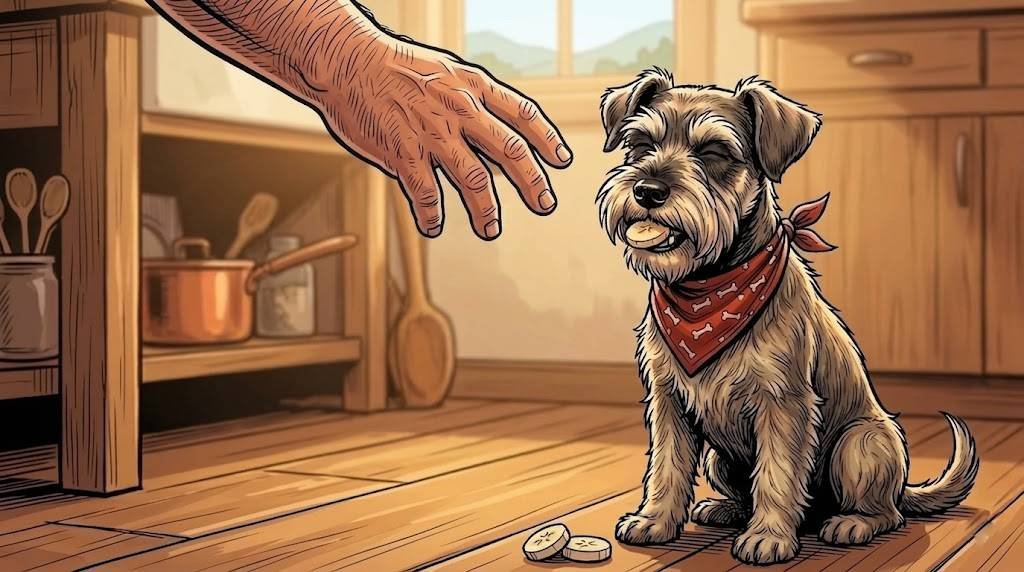
A few specific approaches that work well:
Plain slices. The default. Cut a banana into rounds, give your dog the appropriate amount for their size, save the rest for yourself or for the next session. Easy, fast, no production required.
Frozen banana chunks. On warm days, frozen banana is a popular treat. Slice the banana, freeze the slices on a tray, then store in a container. They last for weeks. The cold extends the eating time and adds a small relief on hot afternoons. Watch for very small dogs — frozen pieces should be small enough to chew, not swallow whole.
Banana inside a Kong toy. Mash a small amount of banana, smear it inside a Kong, give it to your dog. This turns a thirty-second treat into a twenty-minute project. Big Guy does this rarely. When he does, my afternoon clears completely. I respect the engineering.
Banana mixed with plain yogurt. Only if your dog tolerates dairy. Many dogs don’t. I am one of them. The first and last yogurt experiment in this household was an event neither of us discusses.
What to skip:
- Store-bought banana chips (concentrated sugar, often oil and preservatives)
- Banana sweetened with honey or syrup (don’t add sugar to fruit)
- Banana baked into bread, muffins, or pancakes (see above)
- Banana smoothies with mixed ingredients (see above)
You meal-prep on Sundays so the food stays simple all week. Same idea here. Plain banana, plain delivery, no surprises.
Default to plain slices. Save the Kong technique for slow afternoons. Skip the store-bought banana chips entirely.
What I Tell Other Dogs About Bananas
The banana is still on the coffee table sometimes. I am still on the floor sometimes. The geometry has not changed since the original incident.
What has changed is the portion. The morning after the first banana made the situation clear to Big Guy in a way I would have preferred to keep private. Since then he slices the banana, sets it on the table, eats most of it. Two slices come my way before he sits down with the rest. Daily? No. Weekly? Sometimes. The arrangement works.
Bananas, for me, are not a daily event and not a forbidden fruit. They are a regular but limited pleasure, somewhere in my top five foods, behind chicken and ahead of most vegetables. Bananas aren’t a safety question. They’re a discipline question. Most owners who run into banana problems with their dogs do so because the portion got out of hand, not because the banana itself was wrong.
Right now, though, there’s a coffee table. There’s a banana on it. Big Guy is reading. The page-turn rate is steady. I am, as always, in position.
Ham
Resident Banana Tactician